
Business Model Design Process for Revenue Visibility
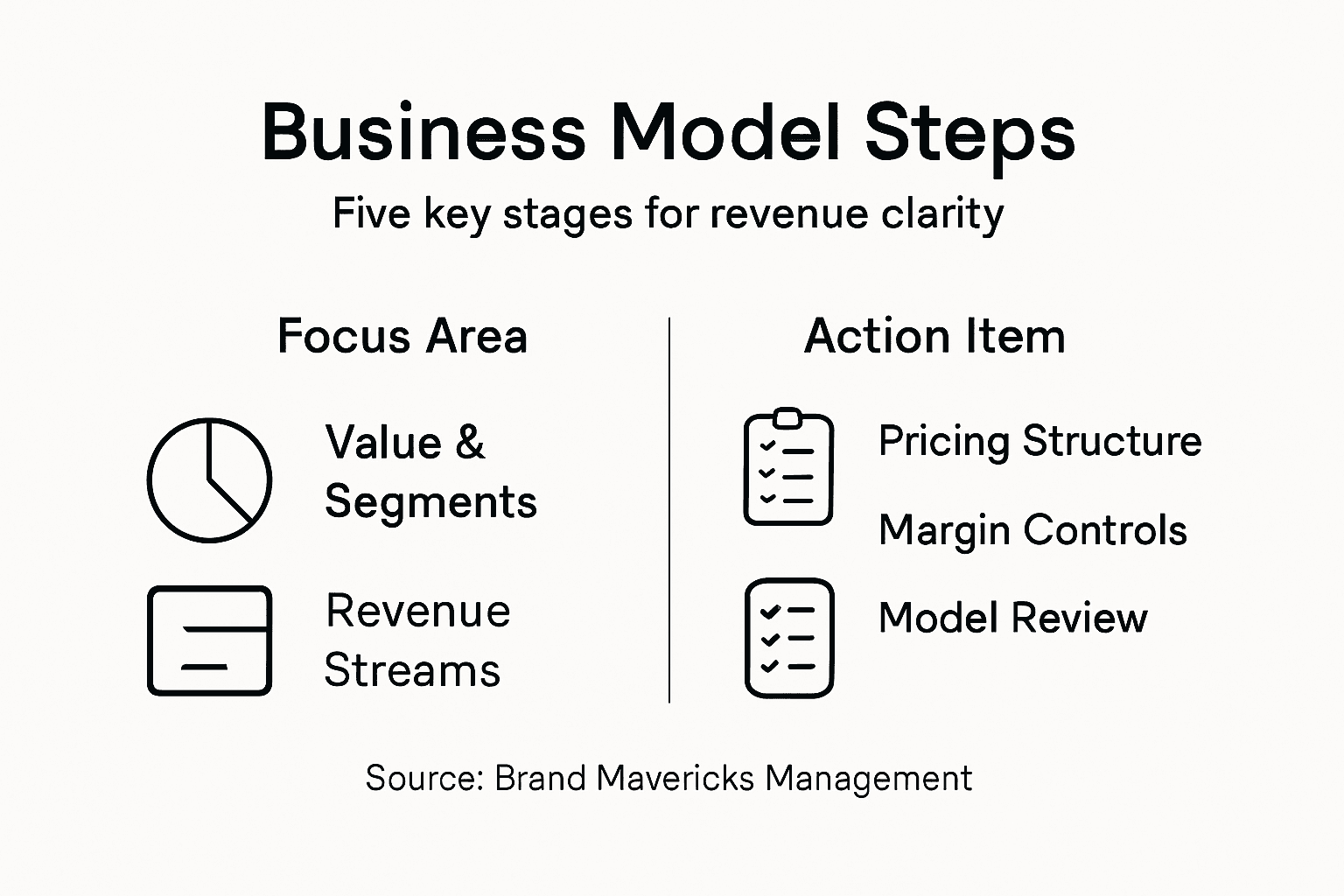
Master the business model design process with this step-by-step guide, ensuring structured revenue clarity, margin control, and commercial predictability.

Rapid expansion often brings complex questions about which markets truly drive growth and how to communicate your unique value effectively. For Commercial Directors steering fintech companies with rising revenue targets, achieving crystal-clear margin visibility starts with defining your core value and target segments. This article guides you through proven frameworks, helping you map your business strengths to the most lucrative customer profiles while laying the groundwork for sharper financial outcomes.
Table of Contents
- Step 1: Define Core Value And Target Segments
- Step 2: Map And Streamline Revenue Streams
- Step 3: Structure Pricing And Profit Frameworks
- Step 4: Integrate Financial And Margin Controls
- Step 5: Validate Model Performance And Outputs
Quick Summary
| Main Insight | Explanation |
|---|---|
| 1. Define Core Value and Audience | Identify what sets your business apart and who will benefit most from your offerings. Focus on understanding customer needs deeply. |
| 2. Map Revenue Streams Strategically | Break down income sources into primary and auxiliary streams to create an integrated financial ecosystem that maximizes profitability. |
| 3. Structure Pricing for Value | Develop a pricing strategy based on cost, customer value perception, and market dynamics to enhance profitability and competitive position. |
| 4. Integrate Financial Controls | Establish systems that track performance metrics and optimize financial health, transforming the approach to managing revenue and costs. |
| 5. Regularly Validate Business Performance | Continuously assess and refine your business model using performance metrics to ensure alignment with strategic goals and customer needs. |
Step 1: Define core value and target segments
Defining your core value and target segments is about creating a razor-sharp understanding of what makes your business unique and who specifically will benefit most from your offerings. In this critical step, you’ll map out the precise intersection between your business’s distinctive capabilities and the customers who need them most.
To begin identifying your core value, start by analyzing your business through the lens of strategic market segmentation. This involves breaking down your potential market into distinct groups based on several key criteria:
- Demographic characteristics: Age, income, education level
- Geographic location: Regional or global market segments
- Behavioral patterns: Purchasing habits, brand interactions
- Psychological profiles: Values, motivations, lifestyle preferences
Next, conduct a deep dive into understanding the psychological drivers that make your offering compelling. Reference empirical research on value-driven attitudes to understand how core values influence customer behaviors. This means moving beyond surface-level descriptions and uncovering the fundamental emotional and rational needs your product or service addresses.
Successful market segmentation isn’t about appealing to everyone, but about becoming indispensable to a specific group.
To refine your target segments, create detailed customer personas that capture not just demographics, but the deeper motivations and challenges your ideal customers face. Ask yourself: Who experiences the most acute pain that your solution alleviates? What unique combination of skills and offerings makes your business different from competitors?
Here’s a comparison of market segmentation approaches and their typical business impact:
| Segmentation Approach | Focus Area | Business Impact |
|---|---|---|
| Demographic | Age, income, education | Targets products more efficiently |
| Geographic | Region or location | Expands reach to new markets |
| Behavioral | Habits and brand usage | Increases relevance and retention |
| Psychological | Values and motivations | Deepens emotional customer connection |
Pro tip: Continuously validate your target segment assumptions through direct customer interviews and ongoing market research to ensure your value proposition remains precisely aligned with evolving customer needs.
Step 2: Map and streamline revenue streams
Mapping and streamlining your revenue streams is about creating a comprehensive, strategic approach to generating and optimizing income sources. In this step, you’ll transform your business’s financial architecture from a scattered collection of opportunities into a focused, integrated revenue ecosystem.
Begin by conducting a thorough revenue mapping exercise that identifies diverse income channels. This involves breaking down your current and potential revenue sources into clear, actionable categories:
- Primary revenue streams: Core product or service sales
- Auxiliary income sources: Complementary services, consulting, training
- Partnership revenues: Collaborative ventures, sponsorships, affiliate programs
- Recurring income: Subscriptions, maintenance contracts, ongoing support
- Innovative monetization: Digital products, intellectual property licensing
Analyze each revenue stream’s performance by tracking key metrics such as gross margin, customer acquisition cost, and long-term growth potential. Look for interconnections between different income channels and identify opportunities to cross-pollinate or consolidate your revenue generation strategies.
Effective revenue streamlining is not about adding more income sources, but about creating a strategic, synergistic financial ecosystem.
Prioritize revenue streams that demonstrate consistent performance, scalability, and alignment with your core business values. This might mean phasing out low-performing initiatives or investing more resources into high-potential channels that offer sustainable growth and strategic advantage.

Below is a summary of common revenue stream types and their strategic value:
| Revenue Stream Type | Description | Strategic Value |
|---|---|---|
| Primary | Main product or service sales | Consistent profit source |
| Auxiliary | Complementary offerings | Diversifies income |
| Partnership | Joint ventures, affiliates | Expands business network |
| Recurring | Subscriptions, contracts | Stabilizes long-term revenue |
| Innovative | IP licensing, digital goods | Encourages business agility |
Pro tip: Implement a quarterly revenue review process that systematically evaluates each income stream’s performance, allowing you to quickly adapt and reallocate resources for maximum financial efficiency.
Step 3: Structure pricing and profit frameworks
Structuring pricing and profit frameworks is about developing a strategic approach that transforms your pricing from a simple cost-plus calculation into a sophisticated value-driven mechanism. In this critical step, you’ll design a pricing strategy that not only covers your costs but maximizes your profitability and market positioning.
Begin by exploring comprehensive pricing strategy frameworks that align with your business’s unique value proposition. Your pricing model should encompass multiple strategic dimensions:
- Cost-based pricing: Calculate direct and indirect expenses
- Value-based pricing: Align price with perceived customer value
- Competitive pricing: Understand market positioning
- Dynamic pricing: Flexible rates based on demand and market conditions
- Tiered pricing: Multiple price points for different customer segments
Analyze your profit margins by developing a granular understanding of your cost structure. This means breaking down every expense category – from direct production costs to overhead, marketing, and support expenses – to create a transparent financial framework that reveals true profitability.
Effective pricing is not about being the cheapest, but about communicating and capturing the unique value you deliver.
Implement a systematic pricing review process that continually evaluates your pricing strategy against market dynamics, customer feedback, and internal performance metrics. This approach allows you to make data-driven adjustments that protect and enhance your profit margins while remaining responsive to changing market conditions.
Pro tip: Create a dynamic pricing model spreadsheet that allows you to instantly simulate how changes in costs, value perception, and market conditions impact your overall profitability.
Step 4: Integrate financial and margin controls
Integrating financial and margin controls transforms your business from a reactive financial model to a proactive, strategically managed financial ecosystem. In this step, you’ll build a comprehensive framework that tracks, analyzes, and optimizes your financial performance with precision and insight.
Begin by implementing integrated financial management strategies that break down traditional silos between financial departments. Your control framework should encompass multiple critical dimensions:
- Operational cost tracking: Monitor direct and indirect expenses
- Margin analysis: Calculate profitability across different revenue streams
- Performance benchmarking: Compare internal metrics against industry standards
- Variance reporting: Identify and investigate financial deviations
- Predictive financial modeling: Forecast potential financial scenarios
Develop a comprehensive margin control system that enables real-time financial visibility. This involves creating detailed profitability analysis frameworks that decompose your financial performance into granular components like profit margin, asset turnover, and funding ratios.
Effective margin control is not about cutting costs, but about understanding and optimizing your financial ecosystem.
Implement automated reporting mechanisms that provide instant insights into your financial health. This means developing dashboards and alert systems that highlight potential margin risks, track key performance indicators, and enable rapid, data-driven decision-making across your organization.
Pro tip: Invest in integrated financial management software that provides real-time margin tracking and allows you to simulate financial scenarios before making critical business decisions.
Step 5: Validate model performance and outputs
Validating your business model performance is about transforming theoretical strategies into measurable, actionable insights that drive real-world success. In this critical step, you’ll develop a robust framework for continuously assessing and refining your business model’s effectiveness.
Begin by establishing comprehensive performance validation frameworks that systematically track your business model’s key performance indicators (KPIs). Your validation approach should encompass multiple critical dimensions:
- Financial performance metrics: Revenue, profitability, margin analysis
- Operational efficiency indicators: Cost structures, productivity rates
- Customer engagement measurements: Retention, satisfaction scores
- Strategic alignment indicators: Market positioning, competitive differentiation
- Innovation and adaptability metrics: Response time to market changes
Develop a rigorous validation process that goes beyond surface-level metrics. This involves empirically testing business model innovations through structured modeling that connects strategic initiatives directly to organizational outcomes.
Performance validation is not about perfection, but about creating a continuous learning and improvement mechanism.
Implement a quarterly review system that critically examines your model’s performance, comparing projected outcomes against actual results. This means creating feedback loops that allow you to quickly identify and address any gaps between your strategic intentions and real-world performance.
Pro tip: Create a dynamic scorecard that weights different performance indicators, allowing you to see at a glance how changes in one area of your business model impact overall performance.
Unlock Revenue Clarity and Control with Structured Business Model Design
If you struggle with fragmented sales efforts and lack clear revenue visibility, the business model design process outlined in the article highlights exactly the challenges you face. From defining core value and target segments to structuring pricing and integrating margin controls, these steps reveal how critical it is to build a connected and measurable revenue ecosystem. Without this clarity your growth can feel unpredictable and your profit margins remain a mystery.
At Brand Mavericks Management we specialize in solving these precise commercial problems. Our Revenue Ready and Growth Engine offerings help you design and control your full revenue architecture with board-level commercial visibility. We transform your revenue streams into structured, predictable engines and deliver ongoing performance intelligence that tracks margin leaks and renewal risks. Discover how to turn revenue fragmentation into strategic advantage by visiting Brand Mavericks Management today.
Ready to gain control over your revenue ecosystem and build sustainable profit frameworks Take the next step by exploring how our proven commercial systems can unlock precise revenue intelligence and scalable growth. Contact Brand Mavericks Management now to start structuring a business model that delivers real-time visibility and measurable commercial outcomes.
Frequently Asked Questions
What are the key steps in the business model design process for revenue visibility?
To achieve effective revenue visibility, start by defining your core value and target segments, mapping your revenue streams, structuring pricing frameworks, integrating financial controls, and validating performance. Follow these steps systematically to enhance your understanding of financial dynamics within your business model.
How can I identify my core value and target segments effectively?
Begin by conducting a strategic market segmentation analysis focused on demographics, geography, behaviors, and psychological profiles. Develop detailed customer personas to understand their motivations and pain points, which will help you tailor your offerings to meet their specific needs.
What metrics should I track to ensure revenue streams are performing well?
Track key metrics like gross margin, customer acquisition cost, and long-term growth potential for each revenue stream. Regularly analyze these metrics to identify areas for improvement, aiming for a reduction in underperforming revenue sources by at least 15% within the next quarter.
How do I structure my pricing strategy to enhance profit margins?
Create a pricing strategy that includes cost-based, value-based, competitive, dynamic, and tiered pricing models. Assess your pricing against customer perceptions and market conditions regularly to align your pricing structure with your business’s unique value proposition and maximize profitability.
What are effective methods for validating my business model’s performance?
Implement a quarterly review system to assess key performance indicators like revenue, profitability, and customer retention. Create feedback loops that allow for quick adjustments, aiming for continuous improvement in your business model’s effectiveness based on real-world performance.
How can integrated financial controls help my business?
Integrated financial controls can provide real-time visibility into your operational costs, margin analysis, and financial performance. Develop automated reporting mechanisms to highlight potential risks, enabling you to make informed decisions and optimize your financial ecosystem.