
Business Model Explained: Driving Predictable Growth
Business model explained for founders and directors. Learn key types, revenue streams, system design, financial risks, and margin clarity for 2026 growth.

Every sports organization faces the challenge of turning diverse revenue streams into sustainable profit. Without a clear and structured business model, revenue can feel unpredictable and fragmented. Founders and commercial directors need a system that connects ticket sales, sponsorship, merchandise, and media rights for true financial visibility. This guide explains the core principles of a business model and reveals how intentional design transforms chaos into predictable growth for sports organizations worldwide.
Table of Contents
- What Is A Business Model Today?
- Core Types And Modern Variations
- How Revenue Streams Connect And Scale
- Financial Risks, Margin Leaks, And Visibility
- Building A Structured Commercial System
Key Takeaways
| Point | Details |
|---|---|
| Understanding Business Models | A business model defines how an organization creates, delivers, and captures value, crucial for profitability and sustainability. |
| Design vs. Default | Business models must be intentionally designed to align revenue streams, customer segments, and value propositions, rather than developed accidentally. |
| Visibility in Revenue Streams | Tracking profitability by revenue stream is essential to identify margin leaks and manage financial risks effectively. |
| Structured Commercial Systems | Implementing a structured system allows organizations to clarify offerings, assign ownership, and integrate revenue streams for predictable growth. |
What Is a Business Model Today?
A business model is not a business plan. It’s the foundational logic of how your organization creates, delivers, and captures value. For sports organizations, this means defining exactly what you sell, to whom, and how you earn revenue from it.
Think of it as the engine beneath the surface. Your business plan describes where you want to go. Your business model describes how the engine runs.
The Core Definition
A business model describes how an organization creates, delivers, and captures value in economic, social, and other contexts. It outlines your operations, spending patterns, and profit structures.
For a sports organization, this could mean:
- Ticket sales and season memberships
- Sponsorship agreements with corporate partners
- Broadcasting rights or media partnerships
- Merchandise and licensed products
- Hospitality and premium seating experiences
Each revenue stream is a thread in your business model. How they connect, reinforce each other, and generate profit determines your model’s strength.
Design, Not Default
Your business model isn’t something that happens by accident. It’s designed. According to the Business Model Canvas framework, a sound business model addresses three critical questions:
- Desirability: Do customers actually want what you’re offering?
- Feasibility: Can you realistically deliver it?
- Viability: Will it make money sustainably?
Many sports organizations operate with fragmented revenue streams that never got intentionally designed. Sponsorship deals happen opportunistically. Ticket pricing follows tradition. Merchandise gets added as an afterthought.
A structured business model changes that.
Why This Matters Now
Your business model directly determines your predictability. Without clarity on how revenue flows, connects, and reinforces itself, you’re flying blind on profitability.
Consider these real scenarios:
- A basketball club adds premium seating but doesn’t understand its margin impact on other ticket tiers
- A sports league structures sponsorship deals without analyzing renewal risk across the portfolio
- A franchise invests in content production without measuring ROI or audience growth
These aren’t operational failures. They’re business model blindspots.
Your business model is the difference between revenue that feels random and revenue that feels predictable.
The Components You Need to Define
- Revenue streams: What are you actually selling and at what price?
- Customer segments: Who pays for each offering and why?
- Value proposition: What specific problem does each offering solve?
- Distribution channels: How do customers access your offerings?
- Cost structure: What does it cost to deliver each revenue stream?
- Unit economics: How much profit does each sale generate after costs?
Without these clearly mapped, you can’t see profit leaks, renewal risk, or scaling constraints.
The Sports Organization Reality
Unlike software companies with one or two revenue streams, sports organizations typically operate across four to seven simultaneous models. A Premier League club generates revenue from ticket sales, hospitality, merchandise, broadcast rights, sponsorship, licensing, and sometimes player sales.
Each operates on different unit economics. Sponsorship might carry 70% margins while merchandise carries 35%. Ticket sales have seasonal concentration while broadcast deals provide predictable annual payments.

Without a clear model showing how these connect and support each other, you’re managing chaos disguised as revenue diversity.
Pro tip: Map your actual revenue streams by source, margin, and renewal risk in a single document. You’ll immediately see which streams are truly profitable and which are masking losses elsewhere.
Core Types and Modern Variations
Business models aren’t one-size-fits-all. Different sports organizations use fundamentally different approaches to create and capture value. Understanding which type matches your context is critical to building sustainable revenue.
The variations matter because they determine your revenue predictability, scaling potential, and competitive positioning.
The Business Model Canvas Framework
Alexander Osterwalder’s business model canvas framework provides nine building blocks that help you visualize and design your model. These blocks apply across all business model types:
- Customer segments: Who you serve
- Value propositions: What problems you solve
- Channels: How you reach customers
- Customer relationships: How you maintain engagement
- Revenue streams: How you earn money
- Key resources: What you need to operate
- Key activities: What you actually do
- Partnerships: Who helps you deliver
- Cost structure: What it costs to run
This framework helps sports organizations see which blocks are strong and which are weak.
Common Model Types in Sports
Subscription/Membership Models: Fans pay recurring fees for season tickets or exclusive access. Think Premier League season pass holders or golf club memberships. This model creates predictable annual revenue but requires consistent content or access value.
Sponsorship-First Models: Revenue comes primarily from corporate partners rather than fans. Many lower-league clubs and youth organizations operate this way. The challenge: sponsorship renewal risk and customer concentration.
Ticket + Hospitality Models: Live events generate revenue through attendance plus premium experiences. Premium seating, private suites, and VIP packages carry higher margins than general admission.
Media Rights Models: Broadcasting and streaming partnerships pay for the right to air content. Professional leagues depend heavily on this. It’s predictable but creates dependency on media companies.
Merchandise + Licensing Models: Player jerseys, club merchandise, and branded products generate margin-heavy revenue. Often underutilized by smaller organizations.
Multi-Stream Hybrid Models: Most mature sports organizations combine four to six models simultaneously. A professional club might earn revenue from tickets, sponsorship, hospitality, broadcast rights, merchandise, and player sales.
Why Model Type Drives Strategy
Different models require different operational focus. A sponsorship-first model demands relationship management and activation. A subscription model requires consistent content value. A ticket model requires fan experience excellence.
The mistake: operating multiple models without understanding their individual unit economics and how they support each other.
Your business model type determines which revenue streams you can actually scale and which are fundamentally limited by capacity.
Modern Variations and Disruption
According to business model research, different types exist across organizations, with over 19 documented variations depending on strategy and market context. Modern sports organizations are experimenting with new approaches:
- Direct-to-fan platforms: Bypassing traditional media to sell content and access directly
- Tokenization and NFT models: Digital asset ownership and engagement
- Dynamic pricing: Real-time pricing adjusted by demand and inventory
- Athlete equity models: Sharing revenue directly with players
- Community ownership: Fans owning stakes in the organization
These variations work only if your underlying business model clearly defines value creation and capture.
Pro tip: Identify which model type you currently operate, map its margins and growth constraints, then audit whether additional models could fill revenue gaps without cannibalizing existing streams.
How Revenue Streams Connect and Scale
Isolated revenue streams don’t create predictable growth. Real scaling happens when streams reinforce each other, share customer bases, and build on the same operational infrastructure.
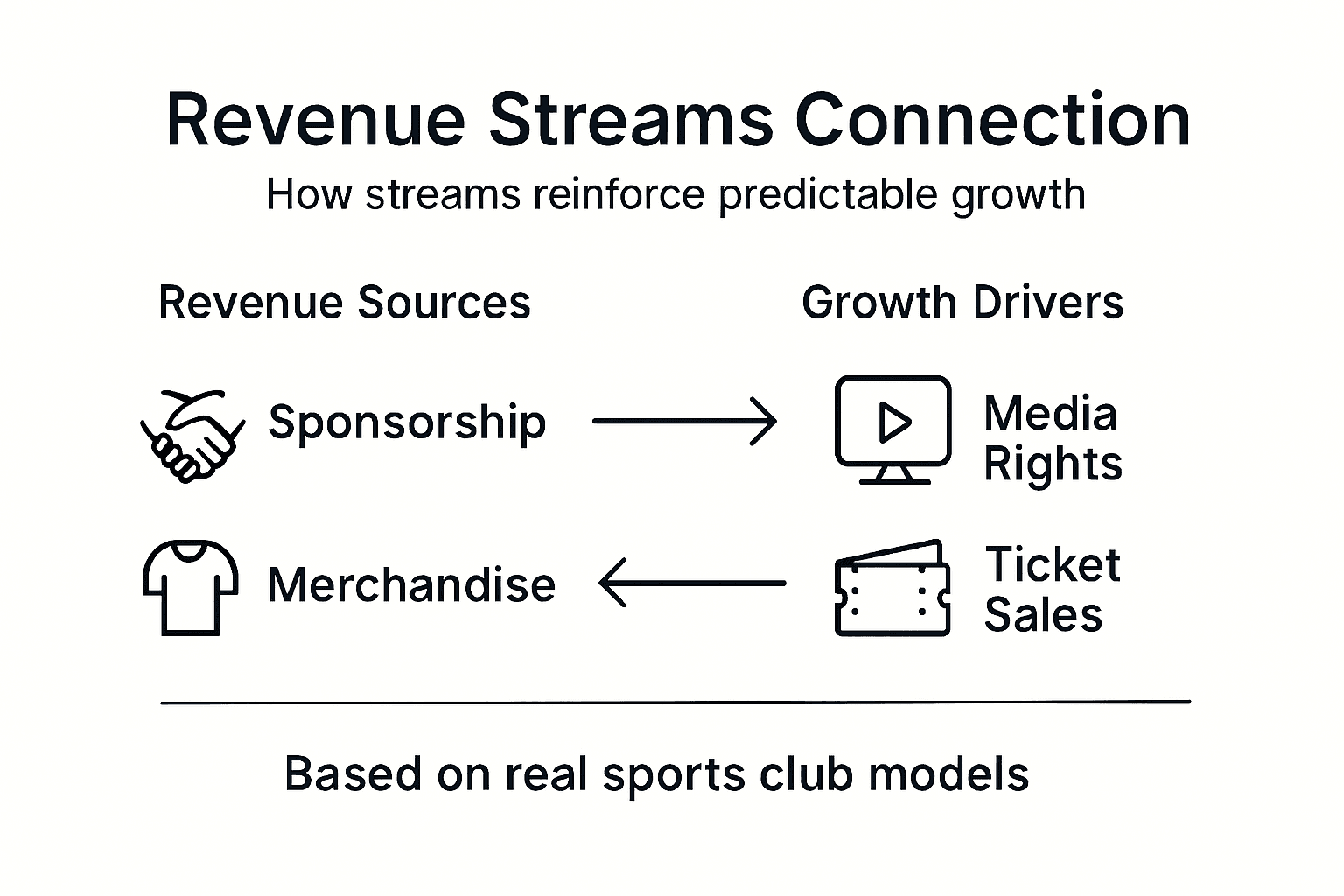
Most sports organizations treat their revenue sources as separate buckets. Sponsorship operates independently from ticket sales. Merchandise exists as an afterthought. Broadcasting rights get negotiated separately from fan engagement strategy.
This fragmentation kills growth.
Understanding Stream Connection
Revenue streams describe the cash generated from each customer segment. But the real power emerges when you see how streams connect through the same customers, channels, and value propositions.
Consider a professional soccer club:
- Season ticket holders (subscription revenue) attend matches and buy merchandise (product revenue)
- Broadcast viewership drives sponsorship interest and merchandise demand
- Premium hospitality customers become season ticket renewals and sponsorship advocates
- Strong fan engagement attracts media partnership premiums
Each stream amplifies the others. This is connection.
The Connection Framework
Think about three connection points:
Customer overlap: Do your streams target the same people? A merchandise buyer might also be a season ticket holder. A broadcast viewer might become a sponsor contact. The more overlap, the higher the leverage.
Channel efficiency: Can you deliver multiple streams through the same channel? Social media sells merchandise and drives ticket sales. Your stadium experience upsells hospitality and creates content. One operational channel, multiple revenue flows.
Value reinforcement: Do streams strengthen each other’s value proposition? Better broadcast reach increases sponsorship value. More engaged fans buy more merchandise. Stronger sponsorship funding improves player quality, which drives ticket demand.
Real Example: Manchester City’s Model
Manchester City generates revenue across seven simultaneous streams:
- Ticket sales (subscription + event revenue)
- Sponsorship deals (primary shirt, training kit, stadium)
- Hospitality packages (premium seating, VIP experiences)
- Merchandise (jerseys, branded products)
- Broadcasting rights (domestic and international)
- Player sales (transfers and loan fees)
- Academy and licensing (global football schools)
These aren’t random. They’re architected. Strong player performance (driven by broadcast revenue and sponsorship funding) drives ticket demand and merchandise sales. Growing fan base increases broadcast value and sponsorship interest. Each stream creates conditions for others to thrive.
Without this architecture, you’re just collecting revenue.
Scaling Through Connection
True scaling happens by expanding one stream while leveraging existing infrastructure. Adding a new sponsorship tier doesn’t cost proportionally more if you use existing relationships and channels. Launching merchandise works better if you have engaged fans already buying tickets.
The constraint isn’t the stream itself. It’s your operational capacity to serve multiple streams simultaneously without cannibalizing margin.
The difference between stalled revenue and exponential growth is understanding which streams can scale together and which create operational conflict.
The Cannibalization Risk
Not all stream connections work. Adding discounted merchandise can hurt premium product sales. Introducing sponsorship tiers might devalue existing partner packages. Offering cheaper ticket access can reduce premium seating demand.
You need to map margin impact, not just revenue growth.
Pro tip: Create a simple matrix showing which revenue streams share customer segments and which channels they use. Then identify which streams could genuinely amplify each other without margin leakage versus which ones compete for the same revenue dollar.
Financial Risks, Margin Leaks, and Visibility
You can’t manage what you can’t see. Most sports organizations operate without clear visibility into which revenue streams actually profit, which ones drain resources, and where margin leakage happens silently.
This invisibility is the real financial risk.
Where Margins Actually Disappear
Financial risks in business models arise from misalignment between design and reality. In sports organizations, margin leaks happen through specific, predictable channels:
- Overservicing partners: Delivering more value than contractually required without charging extra
- Hidden fulfillment costs: Sponsorship activation, merchandise logistics, or event production costs nobody tracks
- Renewal risk concentration: Heavy dependence on one or two sponsors that might not renew
- Pricing inefficiency: Ticket, merchandise, and partnership prices set by tradition, not data
- Channel misalignment: Using expensive channels to reach customers who’d buy through cheaper channels
- Operational overlap: Duplicated efforts across ticket sales, sponsorship, and merchandise teams
Each leak seems small individually. Together, they can erase 30-50% of gross profit.
Here’s how common financial risks affect sports organization business models:
| Financial Risk Type | Impact on Organization | Example Scenario |
|---|---|---|
| Overservicing partners | Shrinks profit margins | Delivering extra sponsorship value |
| Hidden fulfillment costs | Unexpected expense increases | Merchandise shipping cost overruns |
| Renewal risk concentration | Revenue volatility | One sponsor is 25%+ of revenue |
| Pricing inefficiency | Lost revenue opportunities | Tradition-based ticket prices |
| Channel misalignment | Higher acquisition costs | Costly sales channels for cheap offers |
| Operational duplication | Wasted resources, confusion | Multiple teams doing similar sales |
The Visibility Problem
Most sports organizations track revenue by category but not profitability by stream. You know you made $2 million in sponsorship. You don’t know if you spent $1.2 million fulfilling those contracts.
You track ticket sales volume. You don’t track the cost to acquire each ticket buyer or the margin after venue, staffing, and operational overhead.
This creates blind spots:
- A “successful” sponsorship deal might carry 20% margin while a smaller deal carries 60%
- Your highest revenue stream might be your lowest margin business
- Growth in one area might cannibalize higher-margin revenue elsewhere
- Renewal risk concentrates in streams you think are stable
Common Margin Leak Categories
Sponsorship overservicing: You promised activation. Activation cost more than expected. You absorb it rather than renegotiate.
Merchandise inefficiency: High inventory carrying costs, unsold stock, or expensive fulfillment reduce actual margin below theoretical.
Ticket channel costs: Using expensive sales channels to fill seats that could sell through cheaper direct channels.
Partner concentration risk: One sponsor represents 25% of revenue. If they don’t renew, you lose $250,000 with no backup plan.
Operational duplication: Three team members doing overlapping sponsorship, ticketing, and relationship work instead of one structured system.
Building Visibility
Real visibility requires tracking five metrics for every revenue stream:
- Gross revenue: Total dollars collected
- Direct costs: What it costs to fulfill that revenue
- Contribution margin: Revenue minus direct costs
- Margin percentage: Contribution margin divided by revenue
- Renewal risk: What percentage is at risk of not recurring
Without these five numbers, you’re guessing.
A $1 million sponsorship deal with 30% margin is less valuable than a $400,000 deal with 70% margin. Revenue tells one story. Margin tells the true story.
Risk Management Through Architecture
Once you see margins clearly, you can manage risk. Concentration risk becomes obvious when one sponsor represents 40% of profit margin. You then diversify or renegotiate terms.
Overservicing becomes visible when activation costs exceed budget. You either adjust pricing or reduce scope.
Channel inefficiency jumps out when you compare ticket acquisition cost across social, email, and paid advertising.
Pro tip: Build a simple monthly P&L by revenue stream showing gross revenue, direct costs, contribution margin, and margin percentage. Run this for three months before making any strategic decisions about growth or pricing.
Building a Structured Commercial System
Structure beats chaos every time. The difference between organizations that grow predictably and those that struggle is simple: one has a system, the other doesn’t.
A structured commercial system means everyone knows what they’re selling, to whom, at what price, and how it connects to organizational goals. It means your revenue engine runs by design, not luck.
What Structure Actually Means
Building a structured system involves organizing value propositions, customer segments, revenue streams, and distribution channels systematically. This isn’t bureaucracy. It’s clarity.
Structure means:
- Clear definitions of what each revenue stream is and isn’t
- Assigned owners responsible for each stream’s performance
- Documented processes for acquiring, servicing, and retaining customers
- Transparent pricing logic and renewal management
- Regular reporting that shows margin, not just revenue
- Integration points where streams reinforce each other
Without structure, you have talented people doing disconnected work.
See how the four pillars of commercial structure align with practical actions:
| Pillar | Key Focus | Practical Action Example |
|---|---|---|
| Offering clarity | Define revenue streams precisely | Itemized sponsorship packages |
| Customer segmentation | Understand distinct buyers | Separate plans for ticket types |
| Channel architecture | Match sales channel to product | Online for merch, direct for B2B |
| Performance visibility | Track relevant business metrics | Monthly profit margin reports |
The Four Pillars of Commercial Structure
Offering clarity: Define exactly what you sell. Not “sponsorship deals” but “primary kit sponsorship at $150,000 annually with activation allowance of $25,000.” Precision eliminates confusion and enables pricing discipline.
Customer segmentation: Map who buys each offering and why. Season ticket holders aren’t the same customer as broadcast partners. Each needs different acquisition, servicing, and retention approaches.
Channel architecture: Decide how each offering reaches customers. Tickets sell through your website and stadium box office. Sponsorship sells through direct relationship management. Merchandise sells through online, retail, and stadium. One system can’t serve all channels equally.
Performance visibility: Track metrics that matter. Revenue is vanity. Margin is sanity. Renewal rate determines stability. Customer acquisition cost determines scalability.
Real Structure in Action
Consider how a well-structured sports organization handles sponsorship:
- Offering design: Three sponsorship tiers with specific benefits, activation allowances, and pricing
- Customer segmentation: Enterprise partners (high-value, long-term), mid-market partners (growth opportunity), local partners (community)
- Process: Documented proposal template, contract terms, activation checklist, renewal timeline
- Performance tracking: Monthly dashboard showing revenue by tier, renewal status, activation cost vs. budget, margin by partner
- Integration: Sponsorship activation fuels content for broadcast partners and merchandise sales
Each element is clear. Every person involved knows their role and the expected outcome.
Implementation Steps
Building structure doesn’t require months of planning. Start here:
- Map current reality: List every way you make money, how much, and what it costs
- Assign ownership: Who owns sponsorship? Tickets? Merchandise? Direct accountability matters
- Document offerings: Write down exactly what you sell for each revenue stream
- Create reporting: Build a monthly P&L showing revenue, cost, and margin by stream
- Define renewal cycle: When does each stream need to renew? Build a calendar
- Establish pricing logic: Why does one sponsorship cost $100,000 and another $50,000?
Structure transforms commercial chaos into predictable revenue. The complexity doesn’t disappear. It just becomes visible and manageable.
Integration and Scaling
Once you have structure, scaling becomes possible. You can add sponsorship tiers because you understand the economics. You can launch new merchandise because you know fulfillment costs. You can negotiate broadcast deals because you understand how they reinforce other streams.
Without structure, growth is random.
Pro tip: Start with one revenue stream. Document what you sell, who buys it, what it costs to deliver, and what margin it generates. Master one stream before building complexity across multiple streams.
Build a Predictable Revenue Engine That Drives Growth
The article highlights the critical challenge sports organizations face when their revenue streams operate as disconnected buckets without clear visibility into margins or renewal risks. If you feel overwhelmed by fragmented sales efforts, pricing guesswork, or margin leaks, you are not alone. Concepts like business model architecture, margin visibility, and structured commercial systems are more than buzzwords — they are the foundation for turning unpredictable revenue into a reliable growth engine.
At Brand Mavericks Management, we specialize in designing and implementing precisely this type of commercial clarity. Our expertise in Revenue Design and Commercial Strategy ensures you clearly define what you sell, who buys it, and how your revenue streams connect and amplify each other. We complement this with robust financial architecture and real-time revenue intelligence so you can spot margin leaks, renewal risks, and pricing inefficiencies before they impact profitability.
Transform your chaos into control and take the first step toward predictable growth with our practical, structured approach to revenue architecture.
Ready to replace guesswork with measurable systems that unlock scalable revenue? Visit our services page now to explore how our tailored solutions can help you design, control, and scale your commercial operating system. Don’t wait until margin leaks erode your hard-earned revenue. Act now and build the structured revenue engine your organization deserves.
Frequently Asked Questions
What is a business model?
A business model describes how an organization creates, delivers, and captures value. It outlines operations, revenue generation, and customer segments, making it distinct from a business plan.
Why is understanding my business model important for predictable growth?
Clarity on how revenue flows and connects allows organizations to optimize profitability and navigate potential blind spots, leading to more predictable and strategic growth.
How can I identify the revenue streams of my sports organization?
To identify revenue streams, list all current income sources, such as ticket sales, sponsorship, merchandise, and media rights, and analyze their profitability, customer segments, and operational costs.
What are common types of business models in sports organizations?
Common business models in sports include subscription/membership models, sponsorship-first models, ticket and hospitality models, media rights models, merchandise and licensing models, and multi-stream hybrid models.