
Business Model Design for Predictable Growth
Business model definition for growth companies, types, frameworks, value drivers, risks, and actionable steps to build scalable revenue engines.

Business Model Design for Predictable Growth
Growth-stage founders recognize the pressure to deliver both innovation and steady revenue, especially in fast-moving sectors like fintech and healthcare. Every decision depends on a clear plan for value creation, targeted customer segments, and predictable income streams. Understanding business model fundamentals is crucial for transforming ambition into sustainable commercial results. This guide offers practical examples and frameworks to help leaders refine their approach, adapt to market shifts, and support ongoing organizational growth.
Table of Contents
Key Takeaways
| Point | Details |
| Business Model Importance | A well-constructed business model is crucial for transforming ideas into sustainable revenue streams and guiding strategic decisions. |
| Adaptability of Models | Successful business models must continuously adapt to market changes, customer needs, and technological advancements to maintain relevance. |
| Scalable Revenue Models | Effective revenue models require diversified income sources and pricing flexibility to manage growth efficiently. |
| Financial Insights | Growth-stage businesses should prioritize comprehensive financial planning and regular audits to avoid common pitfalls and ensure resilience. |
Business Model Definition and Key Concepts
A business model defines how an organization creates, delivers, and captures economic value through a strategic blueprint of its commercial operations. Business model design represents the foundational architecture that transforms innovative ideas into sustainable revenue streams.
At its core, a business model encompasses several critical components that collectively determine an organization’s potential for success:
-
Value Proposition: The unique solution or benefit offered to customers
-
Customer Segments: Specific target markets and consumer groups
-
Revenue Streams: Primary mechanisms for generating financial returns
-
Cost Structure: Operational expenses and investment requirements
-
Distribution Channels: Methods of delivering products or services
The strategic importance of a well-constructed business model cannot be overstated. Business model innovation represents a powerful mechanism for gaining competitive advantage, allowing companies to reimagine how they create and capture economic value.
Successful business models go beyond simple transactional frameworks. They represent dynamic systems that continuously adapt to market changes, customer needs, and emerging technological opportunities. These models serve as comprehensive roadmaps that guide strategic decision-making, resource allocation, and long-term growth initiatives.
A robust business model transforms abstract entrepreneurial vision into a concrete, executable strategy for sustainable commercial success.
Pro tip: Regularly audit and refresh your business model to ensure ongoing relevance and alignment with evolving market dynamics.
Types of Business Models for Growth Companies
Growth companies have multiple strategic approaches to designing their commercial frameworks, each offering unique advantages in capturing market opportunities. Business model taxonomy reveals a diverse landscape of revenue generation strategies tailored to different industry contexts and organizational capabilities.
Key business model types for growth-stage ventures include:
-
Subscription Model: Recurring revenue through predictable monthly/annual customer payments
-
Freemium Model: Basic services offered free, with premium features requiring payment
-
Marketplace/Aggregator Model: Platform connecting buyers and sellers while taking transaction fees
-
Direct Sales Model: Products sold directly to consumers without intermediary channels
-
Affiliate Marketing Model: Generating revenue by promoting third-party products
-
Franchise Model: Scaling through licensed business operation rights
Internet business model categories demonstrate how modern organizations can strategically combine multiple approaches to optimize revenue potential. The most successful growth companies often hybridize these models, creating flexible frameworks that adapt to changing market dynamics.
Each business model presents distinct advantages and challenges. Franchise models, for instance, enable rapid geographic expansion with minimal direct capital investment. Subscription models provide predictable recurring revenue streams. Marketplace models leverage network effects to create exponential growth potential.

Here’s a quick comparison of popular business models for growth companies:
| Model Type | Revenue Predictability | Scalability Potential | Typical Challenge |
| Subscription | High | Strong with digital products | Customer retention |
| Freemium | Moderate | High if user base expands | Monetization conversion |
| Marketplace/Aggregator | Variable | Significant via network effects | Balancing supply/demand |
| Direct Sales | Lower | Limited by resources | Salesforce costs |
| Affiliate Marketing | Variable | Dependent on partner reach | Control over branding |
| Franchise | Moderate | Rapid geographic growth | Franchisee management |
Effective business model selection requires deep understanding of your specific market, customer needs, and organizational capabilities.
Pro tip: Continuously experiment and iterate on your business model, treating it as a dynamic strategy rather than a static document.
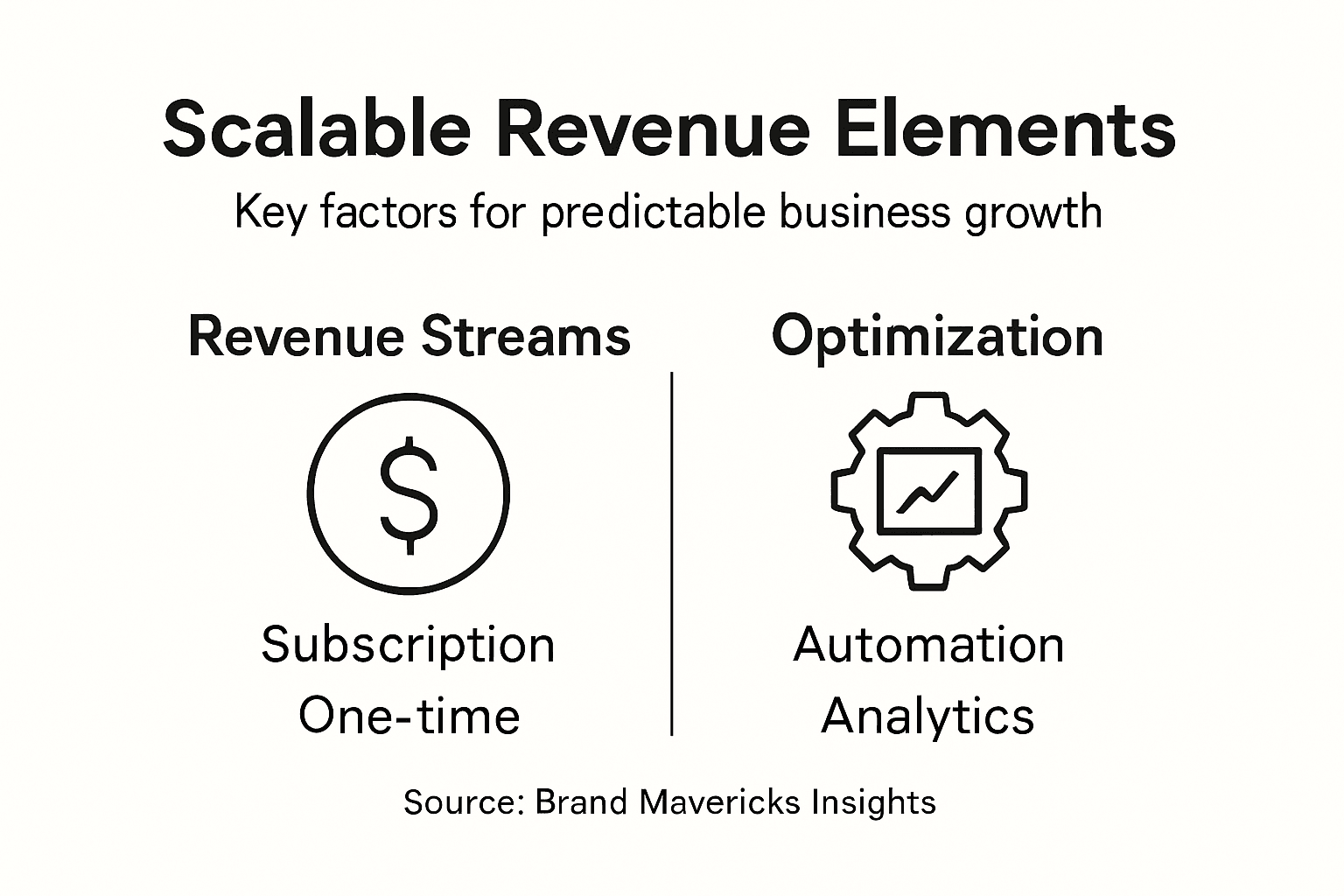
Essential Elements of a Scalable Revenue Model
A scalable revenue model represents the strategic blueprint that enables businesses to generate sustainable income while maintaining efficient growth trajectories. Revenue model components provide critical insights into creating financially robust and adaptable business frameworks.
Key elements of a highly effective scalable revenue model include:
-
Diversified Revenue Streams: Multiple income sources to reduce financial vulnerability
-
Customer Lifetime Value (CLV): Understanding long-term customer economic potential
-
Pricing Flexibility: Dynamic pricing strategies that adapt to market conditions
-
Scalable Infrastructure: Technological and operational systems that support growth
-
Cost Management: Ensuring revenue growth outpaces operational expenses
-
Performance Metrics: Clear tracking mechanisms for revenue generation
Revenue stream strategies demonstrate that successful models balance recurring and transactional revenues. Recurring revenue models, such as subscriptions, provide predictable income streams, while transactional models offer flexibility in monetization approaches.
Effective revenue models require continuous refinement and strategic alignment. Companies must develop adaptive frameworks that can quickly respond to market changes, technological disruptions, and evolving customer expectations. This means regularly reassessing pricing structures, exploring new revenue channels, and maintaining a dynamic approach to financial strategy.
Scalability is not just about growing revenue, but about growing revenue more efficiently than costs.
Pro tip: Conduct quarterly revenue model audits to identify optimization opportunities and potential scaling constraints.
Frameworks and Tools for Growth-Stage Businesses
Growth-stage businesses require sophisticated strategic frameworks that provide structured approaches to decision-making, resource allocation, and competitive positioning. Strategy frameworks offer critical tools for navigating complex commercial landscapes and driving sustainable organizational development.
Key strategic frameworks for growth-stage businesses include:
-
Porter’s Five Forces: Analyzing competitive landscape and industry dynamics
-
BCG Growth-Share Matrix: Prioritizing business portfolio investments
-
Balanced Scorecard: Comprehensive performance management approach
-
Core Competencies Framework: Identifying and leveraging organizational strengths
-
Stakeholder Analysis: Mapping critical external and internal relationships
-
Scenario Planning: Developing adaptive strategic responses
Strategic tools and techniques enable businesses to create robust strategies that align organizational resources with growth objectives. These frameworks provide systematic methods for understanding market complexities, identifying opportunities, and making informed strategic decisions.
Successful implementation requires more than simply adopting frameworks. Growth-stage businesses must customize these tools to their unique context, integrating them into a comprehensive strategic management approach that supports continuous learning and adaptive strategy development. This means regularly reviewing and refining strategic frameworks to ensure they remain relevant and effective.
Strategic frameworks are not rigid templates, but dynamic tools for understanding and navigating business complexity.
Pro tip: Conduct annual strategic framework reviews to ensure your tools remain aligned with evolving business objectives and market conditions.
Financial Implications and Avoiding Common Pitfalls
Growth-stage businesses face complex financial challenges that require strategic foresight and meticulous planning. Business Impact Analysis provides critical insights into predicting potential financial risks and developing robust mitigation strategies.
Common financial pitfalls for growth-stage companies include:
-
Underestimating Operating Costs: Failing to account for hidden expenses
-
Poor Cash Flow Management: Inadequate tracking of income and expenditure
-
Insufficient Financial Forecasting: Lacking detailed predictive financial models
-
Overextension: Scaling faster than financial capabilities can support
-
Neglecting Contingency Planning: Failing to prepare for unexpected financial disruptions
-
Inconsistent Revenue Tracking: Poor monitoring of revenue streams
Financial management techniques emphasize the importance of comprehensive financial planning and proactive risk management. Successful companies develop sophisticated financial models that provide real-time visibility into their economic performance, enabling quick strategic adjustments.
Navigating financial complexity requires more than spreadsheets and projections. Growth-stage businesses must cultivate a holistic approach to financial management that integrates strategic planning, rigorous analysis, and adaptive decision-making. This means developing dynamic financial systems that can quickly respond to market changes and internal organizational shifts.
Below is a summary of common financial pitfalls and proactive strategies to address them:
| Financial Pitfall | Impact on Growth | Proactive Solution |
| Underestimating operating costs | Limits profitability | Conduct frequent expense reviews |
| Poor cash flow management | Risk of insolvency | Use automated cash tracking systems |
| Insufficient financial forecasting | Missed opportunities | Implement scenario-based forecasts |
| Overextension | Financial strain | Align expansion with capital levels |
| Neglecting contingency planning | Vulnerability to shocks | Create reserve funds and backup plans |
| Inconsistent revenue tracking | Missed revenue trends | Set up real-time revenue dashboards |
Financial resilience is built through systematic risk management, not just numbers on a balance sheet.
Pro tip: Implement quarterly financial stress tests to identify potential vulnerabilities and develop proactive mitigation strategies.
Unlock Predictable Growth with Structured Business Model Design
The article highlights critical challenges such as lacking a clear value proposition, unpredictable revenue streams, and the complexity of scaling without a solid financial and operational framework. If you find yourself overwhelmed by fluctuating cash flow, unclear pricing strategies, or inconsistent performance visibility, you are not alone. Many growth-stage companies struggle to transform innovative ideas into repeatable revenue models that balance scalability with cost management.
At Brand Mavericks Management, we specialize in turning these exact pain points into strengths. Our expertise in Revenue Design & Commercial Strategy ensures that your business model is no longer a static plan but a dynamic, adaptable system. Through comprehensive Business Model & Financial Architecture, we create investor-ready financial plans and scalable revenue ecosystems that enable sustainable growth. By embedding our Revenue Intelligence & Performance Management solutions, your organization gains clear commercial visibility that replaces guesswork with actionable insights.
Transform your fragmented sales efforts into a structured commercial operating system today.
Explore how our tailored frameworks and hands-on execution can propel your growth from unpredictable to predictable.
Ready to design a business model that drives reliable revenue and scales with confidence Explore our services at Brand Mavericks Management and take the first step towards commercial clarity and controlled growth.
Frequently Asked Questions
What is a business model, and why is it important?
A business model defines how an organization creates, delivers, and captures value. It is crucial for strategic planning and outlines how a business intends to generate revenue and sustain growth.
What are the key components of a successful business model?
The essential components include the value proposition, customer segments, revenue streams, cost structure, and distribution channels. Each component plays a critical role in determining the overall effectiveness of the business model.
How can a company innovate its business model for growth?
Companies can innovate their business model by re-evaluating their value proposition, exploring new customer segments, diversifying revenue streams, and adapting to market changes and technological advancements.
What strategies can be employed to create a scalable revenue model?
To create a scalable revenue model, businesses should focus on diversifying revenue streams, understanding customer lifetime value, employing pricing flexibility, managing costs effectively, and continually tracking performance metrics.