
Commercial Strategy Explained: Driving Predictable Growth
Commercial strategy explained for founders, sports leaders, and directors—learn structured revenue models, key execution pillars, risks, and performance clarity.

Making sense of revenue across sponsorships, ticketing, and partnerships is a daily challenge for leaders of growth-stage sports organizations. Without a unified approach, sales decisions feel reactive and profitability remains uncertain. Establishing a commercial strategy as a comprehensive plan brings structure to your revenue streams and shifts you from uncertainty to control, helping you identify what drives real value and which customers truly power your growth.
Table of Contents
- What Is Commercial Strategy And Revenue Architecture
- Core Pillars Of A Successful Revenue Model
- Types Of Commercial Strategy And Real-World Use Cases
- Key Risks, Margin Leaks, And How To Avoid Them
- Performance Management, Measurement, And Optimization
Key Takeaways
| Point | Details |
|---|---|
| Importance of Commercial Strategy | A well-defined commercial strategy is crucial for turning revenue potential into scalable growth, preventing disorganized decision-making. |
| Core Components | Effective commercial strategy relies on Revenue Architecture, Market Positioning, and an Execution Framework to connect revenue streams. |
| Pillar System | A successful revenue model is built on five essential pillars that ensure alignment across all revenue operations and prevent margin leaks. |
| Performance Measurement | Tracking key metrics like gross margin, renewal rates, and customer lifetime value helps organizations identify inefficiencies and optimize revenue. |
What Is Commercial Strategy and Revenue Architecture
Commercial strategy is the operational backbone that turns revenue potential into predictable, scalable growth. It’s not a marketing plan or a sales tactic—it’s the complete system that defines what you sell, who buys it, how you price it, and how all revenue streams connect to drive profitability.
For sports organizations and growth-stage companies, having a clear commercial strategy is the difference between chaos and control. Without one, you’re making pricing decisions in the dark, renewing contracts by accident, and leaving money on the table every quarter.
At its core, commercial strategy is a comprehensive plan that encompasses market analysis, goal setting, identifying competitive opportunities, and the tactical execution to increase revenue, improve margins, and capture market share.
The Three Core Components
Effective commercial strategy rests on three pillars:
- Revenue Architecture — What you’re actually selling and how revenue streams connect and generate profit
- Market Positioning — Who your customers are, what problems you solve, and why they choose you over alternatives
- Execution Framework — How deals move through your pipeline, how you measure success, and how you adapt when markets shift
Revenue architecture is the foundation. Most sports organizations have fragmented offerings: sponsorship packages, ticketing, merchandise, licensing, partnerships. But they rarely connect these streams into a coherent system that shows which combinations drive the highest margin and which customers have the greatest lifetime value.
Commercial strategy brings those streams together. It shows you the full picture.
Why This Matters for Your Organization
Without structured commercial strategy, you’re vulnerable:
- Pricing decisions are reactive, not strategic—you undervalue offerings because you don’t know your true cost structure
- Revenue is unpredictable—you can’t forecast accurately because you don’t understand renewal risk or pipeline health
- Margin leaks go undetected—you overservice clients, give away add-ons, or negotiate away profitability without realizing it
- Growth plateaus—you hit a ceiling because you’re operating at capacity with no scalable model
A clearly defined commercial strategy transforms revenue from a chaotic, transactional activity into a measurable, predictable system.
Revenue architecture specifically addresses the structural question: How do all your monetization levers work together? For a football club, this might mean understanding how sponsorship tier pricing affects ticket demand, or how premium hospitality packages drive both revenue and fan retention.
Most organizations optimize each stream independently. That’s leaving money on the table. Strategic architecture shows you the interdependencies and the compound effect of integrated offerings.
What This Looks Like in Practice
A well-structured commercial strategy includes:
- Clear definition of commercial offerings with distinct value propositions
- Pricing architecture aligned to market positioning and cost structure
- Customer segmentation and targeting framework
- Pipeline and opportunity identification process
- Renewal and retention strategy
- Financial projections tied to commercial execution
- Performance reporting that shows margin, ROI, and pipeline health
The strategy answers these fundamental questions: What are we really selling? Who benefits most from it? How do we price for profitability, not just revenue? How do we know if it’s working?
Without these answers, you’re operating on assumptions. Commercial strategy replaces assumptions with data and structure.
Pro tip: Start by mapping all current revenue streams on one page, showing annual value, margin, and renewal risk. This single visual often reveals where your organization is misaligned or leaving money on the table.
Core Pillars of a Successful Revenue Model
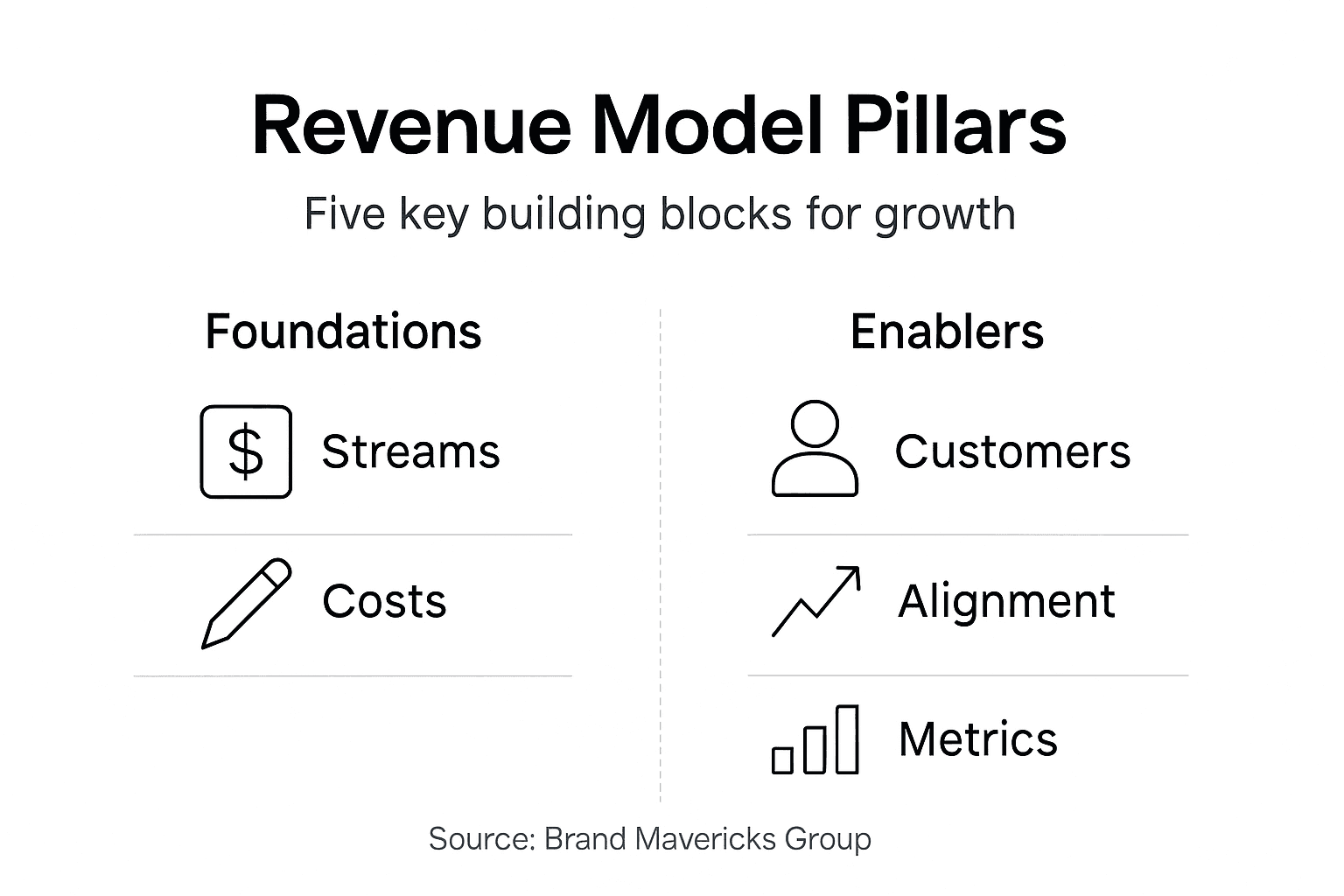
A revenue model is only as strong as its foundation. For sports organizations and growth-stage companies, this foundation rests on five interconnected pillars that determine whether your revenue system generates predictable growth or constant firefighting.
Think of your revenue model as a bridge. Each pillar must be equally strong. If one is weak, the entire structure becomes unstable.

The Five Essential Pillars
Successful revenue operations depend on five pillars including assessing reality, linking teams and data, integrating processes, governing with transparency, and nurturing continuous improvement. For sports organizations, these translate directly into actionable practice:
- Revenue Stream Definition — You know exactly what you’re monetizing and which streams drive the highest margin
- Cost Structure Clarity — You understand the true cost of delivering each offering, not just top-line revenue
- Customer Segmentation — You’ve identified which customer types generate the most lifetime value and profitability
- Operational Alignment — Your sales, partnerships, and customer success teams work from the same revenue playbook
- Performance Visibility — You track margin, renewal risk, and pipeline health weekly, not annually
Most sports organizations have fragmented systems. Sales tracks pipeline in one tool. Finance tracks margin in another. Customer success operates independently. No one has a complete picture of revenue health.
The pillar approach forces integration. It makes invisible problems visible.
Why Each Pillar Matters
Revenue stream definition prevents the trap of treating all revenue the same. A $500,000 sponsorship with 30 percent margin is not equal to a $500,000 ticketing contract with 60 percent margin. Yet most organizations report them identically.
Cost structure clarity is where most sports organizations fail catastrophically. You don’t know if hospitality packages are profitable because you haven’t calculated the true cost of delivery. You give away event activation because you can’t measure its margin impact.
Customer segmentation lets you stop chasing every deal and start pursuing the ones that matter. A corporate sponsor buying three tiers of hospitality has different value than a single-seat ticket buyer. Your pricing and approach should reflect that difference.
Operational alignment is the glue. Understanding how revenue streams contribute to financial stability and sustainable growth requires that all teams speak the same language about what success looks like.
Performance visibility transforms reactive decision-making into strategic planning. You can’t manage what you don’t measure.
Putting the Pillars Into Practice
Start here:
- Define and document every revenue stream your organization currently sells
- Calculate the true cost of delivering each stream (not just direct labor)
- Segment your customer base by revenue contribution and profitability
- Map how your sales, partnerships, and operations teams currently interact
- Establish weekly reporting that shows margin, renewal risk, and pipeline health
This isn’t complex. It’s foundational.
Strong revenue models are built on clarity about what you sell, what it costs, who buys it, and whether it’s profitable.
Without these five pillars in place, you’re operating on hope. With them aligned, you’re operating with control.
Pro tip: Start with pillar three: segment your customers by annual revenue and gross margin. This single exercise often reveals that 20 percent of your customer base generates 80 percent of your profit—and you’re likely over-servicing the low-margin 80 percent.
Types of Commercial Strategy and Real-World Use Cases
Commercial strategies don’t fit a one-size-fits-all template. Different sports organizations face different market conditions, revenue maturities, and competitive pressures. Your strategy must be tailored to your specific situation.
Commercial strategy requires deep market understanding and customer insight, covering aspects like product differentiation, pricing models, customer targeting, and operational alignment. The key is recognizing which approach matches your current reality.
Growth-Stage Organizations
If you’re generating $500K to $5M in revenue but feel chaotic, you need a Structured Revenue Design strategy. This focuses on clarifying what you’re actually selling and how streams interconnect.
The approach:
- Document every current revenue stream and its contribution
- Calculate true cost of delivery for each offering
- Identify which customer segments drive profitability
- Build a unified pricing architecture across offerings
- Create a simple weekly reporting framework
A minor league sports organization typically starts here. They have multiple revenue sources—sponsorship, ticketing, merchandise, concessions—but no integrated view of which combinations drive margin.
Scaling Organizations
If you’re hitting $5M to $25M and wondering why growth has plateaued, you need a Revenue Optimization strategy. This reveals hidden profitability and removes margin leaks.
This requires deeper analysis:
- Profitability analysis by customer, product, and channel
- Renewal risk modeling to prevent churn
- Overservicing identification (where you’re giving away value)
- Customer lifetime value segmentation
- Margin protection through operational efficiency
A professional sports club at this stage often discovers they’re underpricing premium hospitality while over-servicing low-margin sponsors. The strategy quantifies the cost of this misalignment.
Mature Organizations
If you’re over $25M but facing new market competition or need new revenue streams, you need an Innovation and Market Expansion strategy. This creates new monetization pathways while protecting existing revenue.
This might include:
Here’s a quick overview comparing commercial strategies at different business maturity stages:
| Stage | Strategic Focus | Key Benefit | Typical Risk |
|---|---|---|---|
| Growth-Stage | Structured Revenue Design | Establishes clear offerings | Pricing inconsistency |
| Scaling | Revenue Optimization | Protects and grows margin | Margin leakage |
| Mature | Innovation & Market Expansion | Opens new revenue sources | Stagnation or complacency |
- New geographic market entry
- Digital and media monetization
- Licensing and IP commercialization
- Ecosystem partnerships
- Adjacent revenue opportunities
Case Study: Championship Football Club
A professional football club was generating $8M annually across sponsorship, ticketing, hospitality, and media rights. Management felt the organization was underperforming but couldn’t identify where.
A structured revenue architecture exercise revealed that their top 12 sponsors (15 percent of sponsor base) generated 68 percent of sponsorship margin. Yet the sales team spent equal energy pursuing the low-margin 85 percent. They were also overcomplicating hospitality packages, raising delivery costs while reducing perceived value.
The strategy reallocated resources to high-margin segments and simplified the product line. Within 18 months, sponsorship margin improved by 34 percent without increasing headcount.
Case Study: Growth-Stage Rugby Union
A regional rugby union was launching new commercial initiatives but lacked structure. Revenue was growing but so was chaos—different staff were quoting different prices, and no one understood true profitability.
A commercial strategy clarified their offering architecture, established tiered sponsorship with clear value propositions, and created a weekly revenue dashboard. This removed decision-making friction and improved forecast accuracy. Their sales team could now speak with confidence about pricing because they understood the underlying economics.
Effective commercial strategy adapts continuously to market changes while maintaining clarity about what drives profitability.
Neither organization solved their problems with more sales activity. Both solved them by building structured, transparent systems that revealed hidden opportunities.
Pro tip: Before choosing a strategy type, assess your current revenue maturity honestly. Are you still figuring out what to sell (growth-stage)? Are you scaling but losing margin (scaling-stage)? Are you mature and seeking new growth vectors (mature)? Your strategy type depends on this diagnosis.
Key Risks, Margin Leaks, and How to Avoid Them
Every sports organization loses money without realizing it. Margin leaks are silent. They don’t announce themselves. You discover them only when you look—and most organizations never do.
These leaks come from structural risks embedded in your commercial model. Understanding them is the first step to protecting profitability.
The Most Common Margin Leaks
Most sports organizations experience these problems simultaneously:
- Overservicing — You deliver premium hospitality packages but haven’t calculated true delivery cost, so what feels like profit is actually break-even or loss
- Untracked giveaways — Sales staff negotiate away add-ons without approval, and finance never sees the margin impact
- Pricing misalignment — You price based on last year’s rate or competitor guessing, not actual cost structure
- Renewal underperformance — You win contracts at discounted rates to hit targets, then struggle to renew at higher margins
- Channel confusion — You sell the same sponsorship package through different channels at different prices, training customers to wait for discounts
Effective risk management requires system-wide responses beyond individual teams, emphasizing proactive identification, assessment, and mitigation strategies. One person’s discount is an entire system’s margin leak.
Structural Risks That Enable Leaks
These leaks don’t happen by accident. They’re enabled by structural gaps:
Lack of cost visibility. You don’t know the true cost of hospitality, event activation, or partnership management. Without this data, pricing is guesswork.
Disconnected systems. Sales quotes in one tool. Finance tracks in another. Operations manages delivery elsewhere. No one sees the complete picture until after the contract closes.
Weak approval gates. Discounts and add-ons get negotiated without documented criteria or margin thresholds. Every deal is a unique negotiation.
No renewal tracking. You win customers at low rates to hit targets. When renewal arrives, you have no data on what you actually delivered, what it cost, or what sustainable margins look like.
Performance blindness. You track deals closed and revenue won. You don’t track margin by customer, product, or sales rep. You can’t identify which revenue is actually profitable.
How to Identify Margin Leaks in Your Organization
Start with a simple exercise:
- Select your top 10 customers by annual revenue
- Calculate what you actually spent delivering their contracts (not just labor—all costs)
- Compare against what you charged them
- Calculate actual margin percentage
- Segment by offering type (sponsorship tier, hospitality, media, etc.)
Most organizations discover that 20 percent of customers generate 80 percent of margin, while the remaining 80 percent are marginally profitable or loss-making. You’re likely over-investing in servicing the unprofitable 80 percent.
Protection Mechanisms
Build these into your system:
Explore common sources of margin leaks and effective protection mechanisms:
| Margin Leak Type | Root Cause | Impact on Profitability | Prevention Strategy |
|---|---|---|---|
| Overservicing | Underestimated delivery costs | Hidden losses or break-even | Track true costs; align packaging |
| Pricing Misalignment | Outdated or guesswork pricing | Undervalued revenue streams | Base pricing on actual costs |
| Untracked Giveaways | Undocumented sales concessions | Erodes deal margins | Implement discount approval gates |
| Renewal Underpricing | Discounted contracts to win deals | Low renewal profitability | Set renewal margin benchmarks |
- Cost tracking — Know the true cost of every offering before pricing
- Approval gates — Require documented approval for discounts above defined thresholds
- Deal terms templates — Standardize what’s included in each tier; negotiate price, not scope
- Weekly margin reporting — Track margin by customer and offering every week
- Renewal protocols — Establish margin targets before negotiating renewals
Margin leaks are invisible until you measure them. Once you measure them, they become your highest-ROI fix.
A championship-level football club discovered they were losing $180,000 annually on overserviced hospitality. The package included deliverables worth $400,000 in cost but priced at $220,000. Once they quantified it, the fix took two months: tighten scope, adjust pricing, train sales team. The result was immediate margin protection.
Pro tip: This week, calculate the true gross margin on your top three revenue-generating contracts. Include all costs: labor, events, gifts, staffing, production. Compare against what you charged. This single exercise often reveals 5-15 percent margin leaks that you can recover immediately.
Performance Management, Measurement, and Optimization
You cannot improve what you don’t measure. Most sports organizations track revenue won and deals closed. They don’t track whether those deals are actually profitable, whether customers will renew, or whether the sales team is pursuing the right opportunities.
Performance management in commercial strategy means building a system that reveals what’s working and what isn’t—then optimizing based on evidence, not intuition.
What to Measure
Effective commercial performance tracking requires evaluation of effectiveness through both individual and organizational factors, clarifying conceptual approaches and methodological measurement. For sports organizations, this means tracking:
- Revenue by stream — Annual value, growth rate, and trend by sponsorship tier, ticketing, hospitality, media, licensing
- Gross margin by customer — What you actually earned after delivery costs, not just what you invoiced
- Renewal rate and risk — Which customers are likely to renew and at what margin
- Sales cycle length — Days from first conversation to contract signature
- Deal velocity — How many opportunities move through each stage of your pipeline weekly
- Customer acquisition cost — Total investment to win a new customer relationship
- Customer lifetime value — Total margin you expect from a customer over their relationship
Without these metrics, you’re flying blind. You think you’re profitable when you’re actually losing money on half your customer base.
Building Your Measurement Framework
Start simple. Don’t try to measure everything at once.
Week one priorities:
- Define your revenue streams clearly (sponsorship tier names, ticketing categories, hospitality packages)
- Calculate cost of delivery for each stream (include all labor, events, gifts, production)
- Pull last year’s contracts and calculate true margin by customer
- Identify your top 20 customers and their renewal dates
- Create a simple spreadsheet showing these four metrics
Week two and beyond, add pipeline tracking: opportunities in each stage, days in stage, and conversion rate from stage to stage.
This foundation takes two weeks of focused work. It transforms your commercial visibility.
Optimization in Practice
Once you’re measuring, optimization becomes straightforward. You pursue three types of improvements:
Margin optimization — Identify low-margin customers and either increase price at renewal or reduce service delivery. A regional sports team discovered their third-largest customer was barely profitable. At renewal, they simplified the package and increased price by 12 percent. The customer stayed; margin improved by $140,000 annually.
Efficiency optimization — Reduce cost of delivery without reducing customer value. A football club was spending $45,000 annually on hospitality staff for premium packages. They restructured to partner with a catering vendor and reduced costs to $18,000 while improving customer perception of value.
Pipeline optimization — Identify which opportunity types convert best and which sales reps close highest-margin deals. Then allocate resources accordingly. Most organizations spray effort evenly across all opportunities. Strategic allocation concentrates effort on highest-probability, highest-margin prospects.
The Weekly Review Discipline
Measurement without review is pointless. Establish a weekly 30-minute commercial review:
- Pipeline health: how many qualified opportunities in each stage?
- Margin trend: is average deal margin improving or declining?
- Renewal risk: which customers are at risk of non-renewal?
- Sales velocity: how many deals closed this week, and what was average margin?
- Obstacles: what’s blocking progress on key opportunities?
This weekly rhythm transforms data into action. You spot problems early and capitalize on opportunities quickly.
Performance management isn’t about accountability—it’s about clarity. Clarity enables better decisions.
A professional rugby club implemented weekly performance reviews and discovered their sales team was pursuing low-margin sponsorship deals because those were easier to close. Within one quarter of shifting focus to high-margin prospects, average deal value increased 34 percent with zero increase in effort.
Pro tip: Create a single-page dashboard showing five metrics: total pipeline value, average deal margin, renewal rate, sales cycle length, and margin by customer segment. Review it every Monday morning. This single discipline often reveals optimization opportunities worth $100K+ annually.
Unlock Predictable Growth with Structured Commercial Strategy
If you are facing unpredictable revenue, margin leaks, or fragmented sales efforts as outlined in the article, it is time to regain control through a clear and actionable commercial strategy. Many sports organizations and growth-stage businesses struggle without a unified revenue architecture that connects pricing, customer segmentation, and performance management. At Brand Mavericks Management, we specialize in transforming chaotic revenue systems into predictable, scalable growth engines.
Take action now by exploring our comprehensive Revenue Design & Commercial Strategy service. We help you define exactly what you sell, optimize pricing architecture, and build transparent performance frameworks that reveal margin leaks and renewal risks. Whether you need to design your commercial model from scratch or optimize your existing revenue streams, our Full Commercial Operating System embeds the control and clarity your business needs.
Don’t let margin leaks and unmanaged complexity hold your organization back. Visit Brand Mavericks Management Services to start building your structured, measurable commercial system today.
Frequently Asked Questions
What is a commercial strategy?
A commercial strategy is a comprehensive plan that outlines how an organization defines what it sells, who its customers are, and how it connects different revenue streams to achieve predictable and scalable growth.
Why is revenue architecture important in commercial strategy?
Revenue architecture is crucial because it clarifies what products or services are being offered and how these offerings interconnect to generate profit. This ensures that an organization can identify which combinations drive the highest margins and optimize customer lifetime value.
How can a sports organization identify margin leaks?
Margin leaks can be identified by calculating the true costs of delivering services, comparing these costs against the revenue generated for top customers, and analyzing pricing structures for inconsistencies that may lead to undervalued offerings.
What are the key components of an effective commercial strategy?
An effective commercial strategy typically includes revenue architecture, market positioning, and an execution framework. These components work together to provide clear guidance on pricing, customer targeting, and measuring success in a dynamic market.