
Commercial strategy guide for apps: drive growth & maximize revenue
Discover a step-by-step commercial strategy framework for app founders to drive sustainable growth, optimize monetization, and maximize revenue through systematic experimentation and data-driven decisions.

This guide delivers a step-by-step commercial strategy framework for app founders and directors who generate revenue but struggle with sustainable growth. You’ll discover how to build measurement foundations, execute full-funnel marketing, optimize monetization models through systematic experimentation, and verify success using retention and LTV metrics. By following this structured approach from preparation through verification, you can transform fragmented efforts into a predictable revenue engine that scales profitably without wasting spend on poorly engaged users or guessing at pricing decisions.
Table of Contents
- Building The Foundation: Product Clarity And Measurement
- Executing A Full-Funnel Commercialization Strategy
- Monetization Models And Paywall Experimentation For Sustainable Revenue
- Verifying Success And Scaling Your Commercial Strategy
- Boost Your App’s Commercialization With Expert Support
- Frequently Asked Questions
Key takeaways
| Point | Details |
|---|---|
| Retention drives profitability | Focus on user retention and LTV rather than installs alone to maximize marketing ROI. |
| Product foundation first | Strong product foundations including clear value propositions must precede scaling marketing spend. |
| Experimentation multiplies revenue | Apps running systematic experiments earn 40x more revenue than those relying on static strategies. |
| Hybrid models balance growth | Hard paywalls generate 8x more revenue by Day 60 than freemium models while maintaining conversion rates. |
Building the foundation: product clarity and measurement
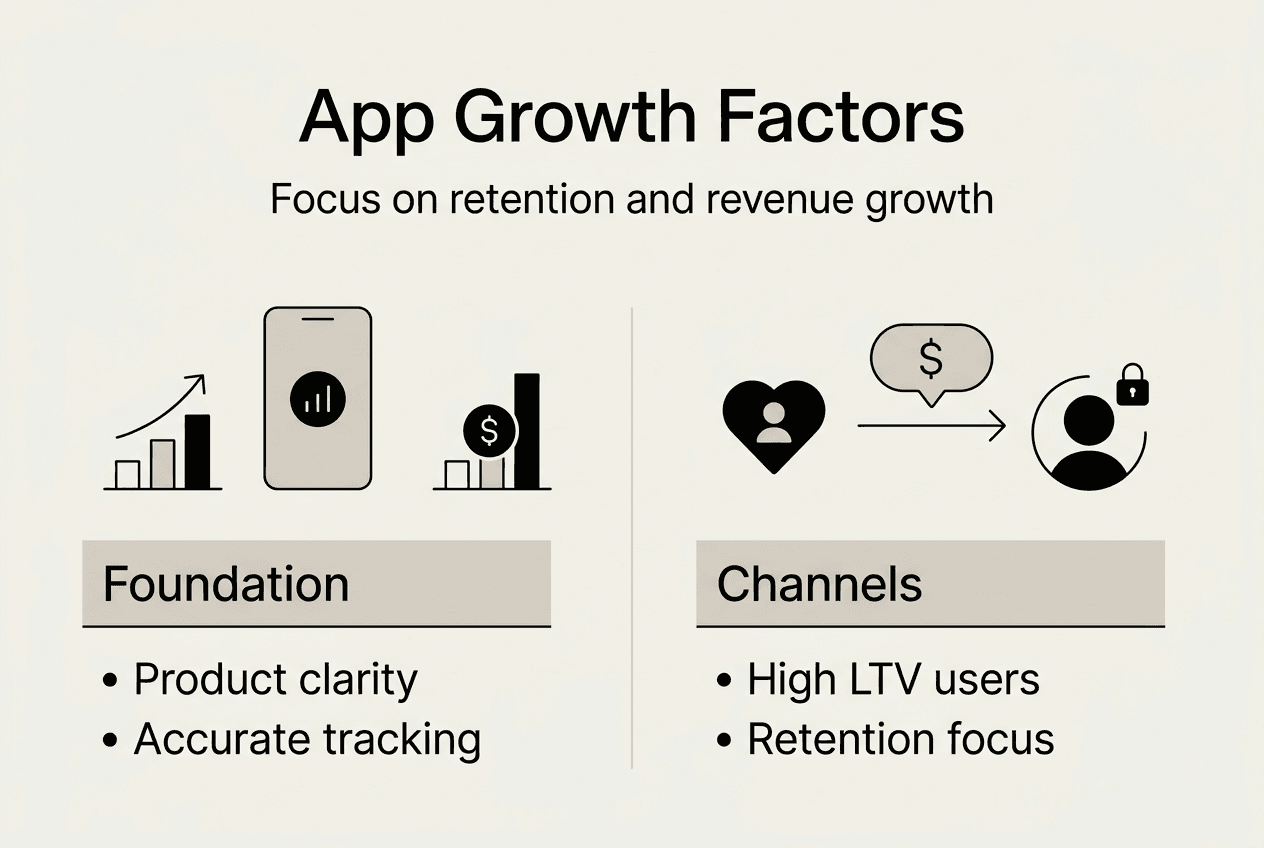
Before launching any commercial strategy, you need crystal-clear product foundations and measurement systems. A strong product foundation, including a clear value proposition and user-friendly onboarding, is essential for maximizing marketing ROI. Without this clarity, you’ll burn cash acquiring users who never convert or stick around.
Define your app’s core value proposition so users understand it immediately upon opening the app. Your onboarding flow should communicate this value within the first 30 seconds, removing friction and confusion. Every screen should guide users toward their first meaningful action, whether that’s completing a profile, accessing core features, or experiencing the primary benefit.
Next, implement comprehensive event tracking across your entire user journey. Effective measurement, including tracking installs, key events, retention, and revenue, is critical for identifying high-ROI marketing channels. Track these essential metrics:
- Install sources and attribution data
- Signup completions and onboarding drop-off points
- Retention cohorts at Day 1, Day 7, Day 30, and Day 90
- Revenue attribution by channel and user segment
- Feature engagement and session frequency
Use data-driven measurement to focus resources on channels delivering high retention and LTV rather than just cheap installs. Comprehensive measurement is essential for understanding channel performance and avoiding the trap of vanity metrics. A channel delivering 10,000 installs at $0.50 CPI means nothing if those users churn within 48 hours.
Pro Tip: Invest in product analytics tools early to identify and fix drop-off points in your onboarding flow within days, not months. The faster you spot friction, the less money you waste acquiring users who bounce.
This measurement foundation prevents the costly mistake of scaling marketing spend before securing product-market fit and retention. You’ll know exactly which channels deliver engaged users worth the acquisition cost, and which ones drain your budget without meaningful returns. Once these systems are in place, you’re ready to execute systematic commercial strategies that compound growth rather than just buying temporary spikes in downloads.
Executing a full-funnel commercialization strategy
With your foundation set, execute a tactical commercialization strategy that spans acquisition, conversion, and retention. Mobile app marketing ROI depends on user retention and lifetime value rather than cost per install. Here’s your step-by-step execution framework:
-
Launch user-generated content campaigns to slash acquisition costs. UGC can cut CPI in half and improve conversion dramatically by showcasing real users experiencing genuine value. Partner with micro-influencers in your niche who already use similar apps, offering them early access or revenue share in exchange for authentic content creation.
-
Integrate app store optimization with paid advertising for compounding returns. Most apps see a 15 to 40 percent increase in conversion when ASO and ads reinforce each other. Your paid ad creative should mirror your app store screenshots and messaging, creating a seamless narrative from ad impression through install.
-
Evaluate marketing channels by retention metrics, not just installs. A channel delivering 1,000 installs at $2 CPI with 40% Day 7 retention outperforms one delivering 5,000 installs at $0.50 CPI with 5% retention. Calculate channel-specific LTV at 30, 60, and 90 days to identify your true growth engines.
-
Tailor onboarding flows to convert users within their first session. Segment users by acquisition source and customize the first-run experience accordingly. Users from productivity-focused ads need different messaging than those from entertainment-focused campaigns. Test variations that reduce time-to-value and increase activation rates.
-
Maintain a multi-channel approach across the entire funnel. Don’t rely on a single acquisition source or retention tactic. Diversify across paid social, ASO, content marketing, partnerships, and referral programs. Balance top-of-funnel acquisition with mid-funnel engagement and bottom-funnel monetization tactics.
| Marketing Approach | Typical CPI | Conversion Impact | Retention Impact |
|---|---|---|---|
| UGC + Influencer | $0.50 to $1.50 | High (authentic social proof) | High (engaged audience) |
| ASO + Paid Ads | $1.00 to $3.00 | Very High (reinforced messaging) | Medium (intent-driven) |
| Paid Social Only | $2.00 to $5.00 | Medium (creative dependent) | Low to Medium (broad targeting) |
| Organic ASO Only | $0.00 | Medium (search intent) | High (problem-aware users) |
Pro Tip: Prioritize speed over perfection when launching experiments. In competitive app markets, the team that tests fastest learns fastest and captures market share while competitors debate strategy. Launch a minimum viable test, gather data for two weeks, and iterate based on results.
This full-funnel approach ensures you’re not just acquiring users but converting them into engaged customers who stick around. Every dollar spent on acquisition should be evaluated against its ability to deliver retained, monetizable users. Once you’ve built this engine, the next step is optimizing how you extract value through strategic monetization models and continuous paywall experimentation.
Monetization models and paywall experimentation for sustainable revenue
Choosing the right monetization strategy and systematically testing variations can multiply your revenue by 10x or more. Hard paywalls convert downloads to paid at a median of 10.7% versus freemium’s 2.1%, generating 8x more revenue by Day 60. Understanding these tradeoffs helps you select the model aligned with your growth stage and user acquisition strategy.

Hard paywalls require payment before users access core features. They convert fewer downloads into trials but generate significantly higher revenue per install because every user who passes the paywall has genuine purchase intent. This model works best when you have strong brand recognition, a unique value proposition, or users with urgent pain points they’ll pay immediately to solve.
Soft paywalls allow limited free access before requiring payment. They convert more downloads into active users and let people experience value before committing. However, many users never convert, leading to lower revenue per install. This model suits apps where network effects matter, where free users add value to paid users, or where you need scale to compete.
The highest-performing monetization structure combines strategic elements. The best paywall setup by one-year LTV uses a weekly plan with a 3-day free trial, boosting LTV by 636%. Weekly subscriptions create lower psychological barriers to entry while maximizing annual revenue. The short trial period converts users quickly before they lose interest or find alternatives.
Systematic experimentation separates winning apps from the rest. Apps that run experiments consistently earn up to 40x more revenue than those using static paywalls. Test these variables:
- Paywall timing (immediate, after onboarding, after value demonstration)
- Pricing tiers (single plan versus multiple options)
- Trial lengths (no trial, 3-day, 7-day, 14-day)
- Billing periods (weekly, monthly, annual)
- Discount structures (introductory pricing, seasonal promotions)
- Copy and design elements (urgency messaging, social proof, benefit lists)
Avoid common pitfalls that kill monetization performance. Offering free trials without data backing the decision often reduces revenue because users exploit the trial without intending to pay. Test trials against no-trial paywalls to verify they actually improve LTV in your specific context. Don’t copy competitor strategies blindly; what works for a meditation app may fail for a productivity tool.
| Paywall Type | Median Conversion | Day 14 Revenue per Install | Day 60 Revenue per Install |
|---|---|---|---|
| Hard Paywall | 10.7% | $1.85 | $4.20 |
| Soft Paywall | 6.2% | $0.95 | $2.10 |
| Freemium | 2.1% | $0.35 | $0.50 |
| Hybrid (Limited Free + Premium) | 4.8% | $1.20 | $2.80 |
Pro Tip: Use no-code paywall builders like RevenueCat or Adapty for rapid iteration without engineering bottlenecks. You can test new pricing structures, trial lengths, and copy variations in hours rather than waiting weeks for development cycles.
Monetization isn’t a one-time decision but an ongoing optimization process. The winning strategy today may underperform in six months as user expectations shift, competitors adjust pricing, or seasonal factors change behavior. Build experimentation into your commercial operating system, running at least one paywall test per month to continuously improve revenue performance and stay ahead of market dynamics.
Verifying success and scaling your commercial strategy
Once you’ve implemented acquisition, conversion, and monetization strategies, verification through rigorous measurement determines what scales and what gets cut. Track retention cohorts alongside conversion and revenue metrics to verify channel health. A channel delivering strong Day 1 retention but terrible Day 30 retention signals onboarding issues or poor product-market fit for that audience segment.
Analyze paywall experiments with statistical rigor to identify true winners versus noise. Run tests for at least two weeks or until you reach statistical significance, whichever comes first. Compare variants across multiple metrics including conversion rate, trial-to-paid conversion, Day 30 retention, and 90-day LTV. A variant that boosts immediate conversions but increases cancellations may reduce long-term revenue.
Avoid the fatal mistake of overspending on acquisition before securing retention and product-market fit. If you do not design retention early, you will overspend on user acquisition and lose profitability. Many founders scale paid advertising too quickly, acquiring thousands of users who churn within days. This burns cash without building a sustainable revenue base.
Remember that 35% of startups fail because they create something nobody wants. Your measurement systems should validate product-market fit before you pour money into growth. If retention metrics remain weak despite onboarding optimizations, you may need to pivot your value proposition or target audience rather than simply spending more on marketing.
Monitor cancellation patterns, especially early trial drop-offs, to optimize onboarding and offer structures. Users canceling within 24 hours of starting a trial likely experienced friction or mismatched expectations. Those canceling after experiencing the product for a week may have found it didn’t solve their problem or wasn’t worth the price. Knowing what to price, how to convert, and when to change is key to sustainable growth.
Set up your measurement dashboard following these steps:
-
Define your north star metric that represents genuine user value and correlates with revenue. This might be weekly active users, sessions per week, or key actions completed.
-
Establish baseline performance across all channels and user segments before making changes. You need historical data to measure improvement accurately.
-
Create cohort reports that track user behavior over 7, 30, 60, and 90 days by acquisition source, onboarding variant, and paywall experience.
-
Build automated alerts for significant metric changes, especially drops in conversion rates or spikes in cancellations that signal problems requiring immediate attention.
-
Schedule weekly reviews of your commercial dashboard with your team, focusing on actionable insights rather than vanity metrics.
Common pitfalls and troubleshooting tips:
- High CPI but low LTV: Your targeting is too broad or your creative attracts the wrong audience. Narrow your targeting to users with demonstrated intent or pain points your app solves.
- Strong installs but weak retention: Your value proposition isn’t clear in onboarding, or your core features don’t deliver on marketing promises. Audit your first-run experience for friction and confusion.
- Good retention but poor monetization: Your pricing may be too high, your paywall timing is wrong, or users don’t perceive enough value to justify payment. Test lower price points or delay the paywall until after users experience core value.
- Inconsistent experiment results: Your sample sizes are too small or test durations too short. Run tests longer and ensure each variant reaches at least 1,000 users before drawing conclusions.
Once you’ve verified which strategies work, scale them systematically. Double down on high-performing channels, replicate winning experiments across user segments, and continuously test new variations to prevent performance plateaus. Sustainable growth comes from compounding small improvements across acquisition, conversion, and retention rather than searching for a single magic bullet that transforms your business overnight.
Boost your app’s commercialization with expert support
Implementing a complete commercial strategy requires coordinating product optimization, marketing execution, monetization testing, and performance measurement simultaneously. Brand Mavericks Management specializes in building structured revenue architecture for growth-stage apps, turning fragmented efforts into predictable commercial systems. We design monetization frameworks, optimize pricing strategies, and implement experimentation processes that systematically increase LTV and revenue. Our approach combines commercial strategy with financial modeling and performance intelligence, giving you board-level visibility without building an entire in-house commercial team.  If you’re generating revenue but lack the structured systems to scale profitably, explore our app commercialization services to accelerate growth with expert guidance tailored to your specific market position and growth stage.
Frequently asked questions
What metrics should I focus on for app commercialization?
Focus on user retention, lifetime value, and revenue per user rather than installs alone. Track conversion rates at each funnel stage and monitor cancellation metrics to optimize monetization continuously. Use cohort analysis to understand how user behavior evolves over 30, 60, and 90 days, revealing which acquisition sources and onboarding experiences deliver the highest long-term value.
How do I choose between hard and soft paywalls for my app?
Hard paywalls convert fewer downloads but generate significantly higher revenue per install, working best when you have strong brand recognition or solve urgent pain points. Soft paywalls convert more downloads into active users but produce lower revenue per install, suiting apps where network effects matter or free users add value to paid users. Choose based on your user acquisition strategy, competitive positioning, and whether you need scale or immediate revenue.
When should I start monetizing my app?
Monetizing too early can kill growth by preventing users from experiencing value, while monetizing too late loses revenue momentum and trains users to expect free access. Focus on building strong product foundations and achieving solid retention metrics before implementing aggressive monetization. Use systematic experiments to find the optimal monetization window for your specific app, testing different paywall timings against retention and LTV metrics.
What role does experimentation play in app commercial success?
Apps that experiment systematically can earn up to 40x more revenue than those using static strategies. Continuous testing optimizes pricing structures, paywall timing, trial lengths, and conversion copy, compounding improvements over time. Experimentation is essential for sustaining and growing app revenues because user expectations, competitive dynamics, and seasonal factors constantly shift, requiring ongoing optimization rather than one-time decisions.