
Commercial strategy guide healthcare: drive 2026 growth
Discover a step-by-step commercial strategy guide for healthcare founders to achieve predictable revenue growth, enhanced profitability, and clear performance visibility in 2026.

Healthcare founders and commercial directors often face erratic revenue despite strong clinical validation. Fragmented sales efforts and absence of structured commercial systems block predictable growth. This guide delivers a step-by-step commercial strategy framework designed for healthcare companies seeking scalable revenue, enhanced profitability, and clear performance visibility in 2026.
Table of Contents
- Prerequisites: What You Need Before Starting
- Step 1: Revenue Design And Commercial Strategy
- Step 2: Business Model And Financial Architecture
- Step 3: Revenue Intelligence And Performance Management
- Step 4: Commercial Execution And Operating Systems
- Common Mistakes And Troubleshooting
- Expected Results And Outcomes
- Explore Expert Commercial Strategy Support For Healthcare Growth
- Frequently Asked Questions
Key takeaways
| Point | Details |
|---|---|
| Prerequisites | Validate your product, understand current revenue streams, and secure leadership commitment before implementing commercial strategy. |
| Revenue design | Define offerings, build value-based pricing, and segment healthcare markets to optimize value capture and align revenue streams. |
| Financial architecture | Develop 5-year projections, cashflow forecasts, and unit economics to support sustainable growth and investor readiness. |
| Performance management | Deploy revenue intelligence systems to track margin leaks, renewal risk, and ROI for continuous optimization. |
| Execution systems | Embed commercial operating systems to manage pipeline, automate prospect scoring, and accelerate deal closures. |
Prerequisites: what you need before starting
Before launching a commercial strategy, healthcare leaders must establish foundational elements that determine readiness and maximize success potential. These prerequisites ensure your organization can effectively implement and sustain structured revenue systems.
First, understand your current revenue streams and identify where sales fragmentation occurs. Map existing income sources, customer acquisition channels, and sales processes to reveal gaps and inefficiencies. This baseline visibility is essential for designing improvements.
Second, develop basic financial literacy including cashflow forecasting and break-even analysis. You need to interpret financial statements, understand margin dynamics, and recognize when revenue growth masks underlying profitability issues. Without this literacy, strategic decisions lack grounding.
Third, validate your business or product within your healthcare market. Clinical validation alone is insufficient. You need evidence that customers will pay, understand your value proposition, and engage repeatedly. Validation reduces strategy risk and focuses execution.
Key prerequisites include:
- Clear understanding of current revenue streams and sales fragmentation points
- Basic financial literacy covering cashflow, margins, and break-even analysis
- Product or service validation within your specific healthcare market segment
- Commitment to implementing measurable performance management and reporting systems
- Leadership buy-in and organizational readiness to adopt structured commercial processes
Fourth, commit to measurable performance management. Strategy without measurement creates blind spots. Establish readiness to deploy dashboards, track key metrics, and act on intelligence. This discipline transforms guesswork into data-driven growth.
Finally, secure leadership buy-in and organizational readiness. Commercial strategy requires cross-functional alignment, resource allocation, and sustained focus. Leaders must champion change and empower teams to execute new processes consistently.
Step 1: revenue design and commercial strategy
Revenue design establishes what you sell, how you price it, and who you target. For healthcare founders and commercial directors, this step aligns product value with market dynamics to optimize value capture and customer segmentation.
Start by defining your commercial offerings clearly based on validated healthcare value propositions. Articulate each offering’s scope, deliverables, and outcomes in terms healthcare buyers understand. Vague offerings confuse prospects and dilute pricing power. Specificity builds trust and accelerates sales cycles.
Next, create value-based pricing tailored to healthcare payer and provider expectations. Value-based models tie pricing to outcomes, risk sharing, or cost savings rather than arbitrary markups. This approach aligns with healthcare’s shift toward value and positions your offering as a strategic investment rather than a cost.
Segment your target market precisely to focus on high-value healthcare customers. Not all healthcare organizations are equal prospects. Prioritize segments where your solution delivers maximum impact, customers have budget authority, and sales cycles are manageable. Narrow focus accelerates growth more effectively than broad targeting.
Revenue design essentials:
- Define commercial offerings with clarity based on validated value propositions
- Build value-based pricing models aligned with healthcare outcome expectations
- Segment target markets to prioritize high-value customers and efficient sales cycles
- Design interconnected revenue streams including partnership and sponsorship monetization
- Adapt pricing and value architecture to healthcare regulatory and reimbursement realities
Design interconnected revenue streams including partnership monetization models. Healthcare offers diverse revenue opportunities beyond direct sales: licensing, data partnerships, co-marketing agreements, and sponsorships. Integrating these streams diversifies income and reduces dependence on single channels.
Finally, adapt pricing and value architecture to healthcare regulatory and market realities. Compliance, reimbursement policies, and procurement processes shape pricing feasibility. Ignoring these constraints creates friction and delays. Build flexibility into your revenue design to navigate regulatory shifts.
Step 2: business model and financial architecture
Financial architecture underpins commercial strategy by ensuring fiscal sustainability and alignment with growth objectives. Healthcare companies need robust financial models to support decision making, attract investors, and manage operational risk.
Develop detailed 5-year profit and loss projections reflecting healthcare market conditions. These projections should model revenue growth, cost structures, and profitability trajectories based on realistic assumptions. Include sensitivity analyses to understand how key variables impact outcomes. Credible projections demonstrate strategic thinking to boards and investors.
Implement cashflow forecasting tools to avoid operational shortfalls. Revenue recognition and cash collection often diverge in healthcare due to payer cycles and contract terms. Cashflow forecasts reveal timing gaps and inform working capital needs. This visibility prevents cash crises that derail growth.

Conduct break-even and unit economics analyses to understand costs versus revenue drivers. Know your customer acquisition cost, lifetime value, and contribution margin per offering. These metrics guide pricing, marketing spend, and scalability decisions. Without unit economics clarity, growth can become unprofitable.
Financial planning steps:
- Build 5-year P&L projections with healthcare-specific revenue and cost assumptions
- Deploy cashflow forecasting to manage timing gaps between revenue recognition and cash collection
- Analyze break-even points and unit economics for each commercial offering
- Conduct scenario planning to prepare for financial risks and market shifts
- Align all financial architecture directly with commercial strategy goals for scalability
| Financial Metric | Purpose | Typical Healthcare Benchmark |
|---|---|---|
| Customer Acquisition Cost | Measures sales and marketing efficiency | $5,000 to $50,000 depending on segment |
| Lifetime Value | Projects total revenue per customer | 3x to 5x CAC for healthy economics |
| Gross Margin | Indicates profitability after direct costs | 60% to 80% for software/services |
| Burn Rate | Tracks monthly cash consumption | Maintain 12+ months runway |
Use scenario planning to prepare for financial risks and market shifts. Model best-case, base-case, and worst-case scenarios to stress-test your strategy. Healthcare markets face regulatory changes, reimbursement pressures, and competitive dynamics. Scenario planning builds resilience and informs contingency actions.
Align all financial architecture components directly with commercial goals for scalability. Financial models should reflect strategic priorities: expanding into new segments, launching offerings, or improving margins. This alignment ensures financial planning supports rather than constrains growth.
Step 3: revenue intelligence and performance management
Revenue intelligence systems provide actionable visibility into performance and revenue health. Healthcare companies need these systems to track margin leaks, identify renewal risks, and drive retention strategies that sustain revenue streams.
Deploy weekly executive briefings and dashboards to monitor margin leaks and renewal risks. Real-time visibility enables rapid course correction. Dashboards should surface key metrics: pipeline health, deal velocity, margin by offering, and renewal probabilities. Weekly cadence maintains focus and accountability.
Regularly track ROI and conduct profitability audits to inform decision making. Not all revenue is equally profitable. Audits reveal which offerings, customers, or channels deliver strong margins and which erode profitability. This intelligence guides resource allocation and strategic pivots.
Develop and implement data-driven renewal and retention programs. Renewal and retention strategies lead to a 15% increase in recurring revenue within the first year when backed by commercial intelligence systems. Proactive retention is far more cost-effective than new customer acquisition. Track renewal timelines, engagement signals, and satisfaction metrics to intervene before churn.
Performance management essentials:
- Deploy weekly executive dashboards tracking margin leaks, renewal risk, and pipeline health
- Conduct regular ROI tracking and profitability audits across offerings and customer segments
- Implement data-driven renewal and retention programs to protect recurring revenue
- Use revenue intelligence to uncover growth opportunities and operational inefficiencies
- Integrate performance management tools for real-time commercial insights and rapid response
Use revenue intelligence to uncover growth opportunities and cost inefficiencies. Intelligence systems reveal patterns: which sales tactics work, where deals stall, and how pricing impacts win rates. This insight informs strategy refinement and operational improvements. You can also improve workflow visibility for better performance by integrating these tools across teams.
Pro Tip: Establish a single source of truth for commercial data by centralizing metrics in one platform. Fragmented data across spreadsheets and tools creates inconsistencies and slows decision making. Unified dashboards accelerate insight and alignment.
Integrate performance management tools for real-time commercial insights. Modern platforms enable automated reporting, predictive analytics, and alert systems. These capabilities transform reactive management into proactive optimization. Real-time insights empower teams to act on opportunities and address issues immediately.
Step 4: commercial execution and operating systems
Operationalizing commercial strategy requires structured systems supporting sales pipeline, client management, and ongoing performance optimization. Healthcare companies must embed these disciplines to execute consistently and sustain results.
Embed commercial operating systems to maintain pipeline health and accelerate deal closures. Operating systems standardize processes: lead qualification, proposal development, contract negotiation, and onboarding. Standardization reduces variability, improves forecasting accuracy, and scales expertise across teams.
Automate prospect identification and lead scoring to improve sales efficiency. Manual prospecting is time-intensive and inconsistent. Automation leverages data to identify ideal prospects, prioritize leads by fit and intent, and route opportunities to the right salespeople. This efficiency shortens sales cycles and increases conversion rates.
Implement content review and approval protocols to ensure messaging consistency. Healthcare sales require precise, compliant messaging. Review protocols prevent off-brand or inaccurate communications that damage credibility. Consistency builds trust and reinforces positioning across touchpoints.
Execution system components:
- Embed standardized commercial operating systems for pipeline management and deal acceleration
- Automate prospect identification and lead scoring to boost sales team efficiency
- Establish content review and approval workflows to maintain messaging consistency and compliance
- Consider fractional commercial leadership for continuous strategy adjustment and execution support
- Compare embedded commercial OS benefits versus isolated revenue tools to inform investment decisions
Consider fractional commercial leadership for continuous strategy adjustment and execution support. Fractional leaders bring expertise without full-time cost. They embed within your team to drive strategy, optimize processes, and coach personnel. This model suits growth-stage healthcare companies needing senior commercial talent without expanding headcount.
Pro Tip: Start with core operating system components (pipeline tracking, reporting cadence, lead scoring) before layering advanced automation. Over-engineering early creates complexity without value. Build incrementally as your team matures.
| Approach | Benefits | Limitations |
|---|---|---|
| Embedded Commercial OS | Unified strategy, execution, and intelligence; continuous optimization; scalable processes | Higher initial investment; requires cultural adoption |
| Isolated Revenue Tools | Lower upfront cost; modular implementation; familiar to teams | Fragmented data; limited integration; reactive rather than strategic |
Compare embedded commercial OS benefits with isolated revenue tools to highlight value. Isolated tools (CRM, marketing automation, analytics platforms) address point problems but lack integration. Embedded operating systems unify these functions into a cohesive revenue engine. The integration delivers compound benefits: better forecasting, faster insights, and aligned execution.
Common mistakes and troubleshooting
Healthcare companies frequently make execution errors that undermine commercial strategy success. Recognizing these mistakes and applying fixes improves outcomes and accelerates progress.
-
Neglecting partnership monetization leads to margin erosion. Healthcare offers rich partnership opportunities: data licensing, co-development, and sponsorships. Ignoring these streams leaves revenue on the table. Fix this by integrating partnership monetization into your revenue design and actively pursuing strategic alliances.
-
Failing to align sales and marketing causes fragmented efforts. Misalignment creates duplicated work, inconsistent messaging, and missed opportunities. Sales blames marketing for poor leads; marketing blames sales for not closing. Fix this by establishing joint revenue targets, shared definitions of qualified leads, and regular strategy sessions.
-
Ignoring renewal risk tracking results in revenue loss. Many healthcare companies focus on new customer acquisition while existing customers churn silently. Tracking renewal risk, engagement, and satisfaction enables proactive retention. Fix this by deploying comprehensive reporting systems that surface churn signals early. You can explore tips to increase profitability by optimizing retention and operational efficiency.
-
Underestimating time and resources for system building delays progress. Commercial operating systems require investment: technology, training, and change management. Rushing implementation creates half-built systems that frustrate teams. Fix this with realistic planning, phased rollouts, and sustained leadership commitment.
-
Fragmented reporting prevents clear commercial visibility. Scattered metrics across tools obscure performance. Leaders lack confidence in data and delay decisions. Fix this by deploying centralized dashboards that consolidate key metrics into a single view. Unified reporting accelerates insight and alignment. Healthcare leaders should also stay aware of common cybersecurity threats in healthcare to protect the integrity of commercial data systems.
Avoiding these mistakes requires discipline, realistic expectations, and continuous improvement. Troubleshooting early prevents small issues from becoming strategic failures.
Expected results and outcomes
Healthcare companies implementing structured commercial strategies achieve measurable improvements in growth, profitability, and operational visibility. Setting realistic expectations for timelines and benchmarks helps leaders evaluate progress and sustain commitment.
Structured commercial strategies yield 25% to 30% faster revenue growth versus unstructured peers. This acceleration results from focused execution, optimized pricing, and efficient resource allocation. Growth becomes predictable rather than episodic.
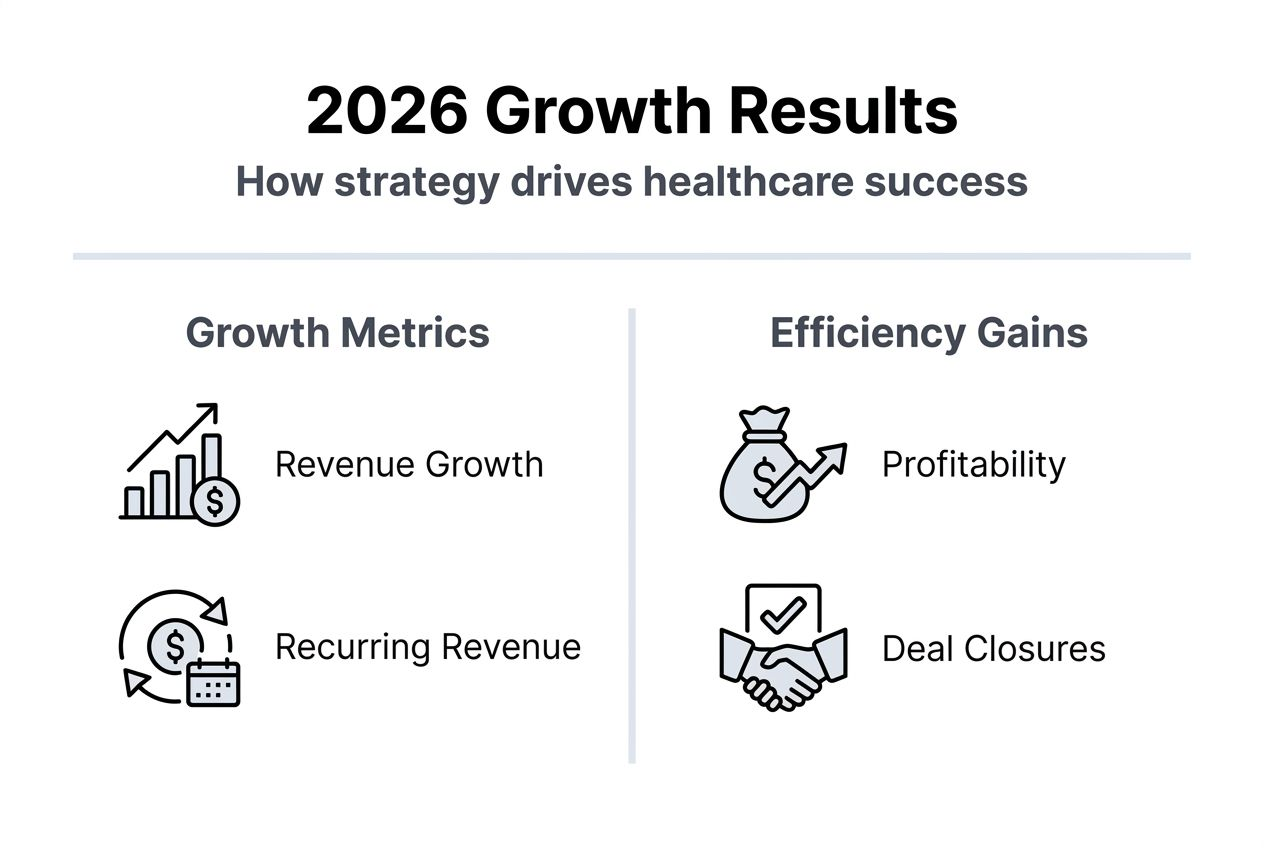
Profitability typically improves within 12 to 18 months after implementation. Early phases require investment in systems and talent, which temporarily pressures margins. As processes mature and efficiency gains compound, profitability rises. Patience and sustained focus are essential.
Margin leak detection improves by approximately 40% through revenue intelligence. Visibility into overservicing, discounting, and low-margin deals enables corrective action. Protecting margins is as critical as growing revenue for sustainable success.
| Outcome Metric | Typical Improvement | Timeline |
|---|---|---|
| Revenue Growth Rate | 25% to 30% faster | 6 to 12 months |
| Profitability Improvement | 15% to 20% margin gain | 12 to 18 months |
| Margin Leak Detection | 40% better visibility | 3 to 6 months |
| Recurring Revenue Growth | 15% increase | 12 months |
| Deal Closure Speed | 20% to 30% faster | 6 to 9 months |
Recurring revenue grows approximately 15% in the first year with effective retention. Retention programs reduce churn, extend customer lifetime value, and stabilize cashflow. Recurring revenue provides financial predictability that supports strategic investment.
Operational efficiencies and deal closures accelerate post full commercial OS embedding. Standardized processes reduce sales cycle length, improve forecast accuracy, and scale best practices. Teams spend less time on administrative tasks and more time on revenue-generating activities. Results compound over time as the operating system matures.
Explore expert commercial strategy support for healthcare growth
Healthcare founders and commercial directors face complex challenges turning clinical innovation into predictable revenue. Professional consulting accelerates commercial strategy adoption and success by providing tailored frameworks, execution support, and performance intelligence.
Brand Mavericks Management offers expert commercial strategy support designed for healthcare ventures seeking structured revenue growth and enhanced profitability. Our services address the specific needs of healthcare companies: revenue design, financial architecture, performance management, and commercial execution. Engage expert teams to ensure your commercial strategy delivers measurable results. Explore services online to find the right solution for your healthcare venture’s growth needs.
Frequently asked questions
What prerequisites are essential before starting a commercial strategy?
You need validated product-market fit, basic financial literacy, understanding of current revenue streams, and leadership commitment to structured processes. Without these foundations, strategy implementation faces unnecessary obstacles and delays.
How long does it take to see measurable revenue improvements?
Most healthcare companies observe initial improvements within 6 to 12 months, with profitability gains materializing in 12 to 18 months. Timeline depends on organizational readiness, market conditions, and execution consistency.
How do I handle data collection and reporting system challenges?
Start with centralized dashboards consolidating key metrics from existing tools. Invest in training teams on data hygiene and reporting protocols. Phased implementation prevents overwhelm and builds capability incrementally.
What are the benefits of integrating commercial operating systems versus standalone tools?
Integrated operating systems unify strategy, execution, and intelligence into a cohesive revenue engine. Standalone tools address point problems but lack integration, resulting in fragmented data and limited strategic impact.
How can I maintain alignment between sales and marketing teams?
Establish joint revenue targets, shared definitions of qualified leads, and regular strategy sessions. Alignment requires ongoing communication, mutual accountability, and leadership reinforcement of collaborative culture.
What financial metrics should healthcare founders prioritize?
Focus on customer acquisition cost, lifetime value, gross margin, cashflow, and unit economics. These metrics reveal profitability drivers, scalability potential, and financial sustainability essential for informed decision making.