
Commercialisation blueprint guide for predictable growth
Learn how to build a scalable commercial function with proven frameworks for customer success, unit economics, and repeatable revenue growth in 2026.

Most founders believe hiring a few salespeople will unlock predictable revenue growth. This assumption leads to fragmented commercial efforts, inconsistent customer experiences, and unpredictable cash flow. Building a scalable and repeatable commercial function is the key for success of any company at early stage. This guide provides a structured blueprint addressing strategy, operations, and metrics to help growth-stage companies transform fragmented sales activity into a repeatable commercial engine that scales beyond founder dependency.
Table of Contents
- Understanding Why A Scalable Commercial Function Matters
- Core Components Of The Commercialisation Blueprint
- Leveraging Customer Success As A Growth Lever
- Measuring Unit Economics And Optimizing Growth Channels
- How Brand Mavericks Management Supports Your Commercial Growth
Key takeaways
| Point | Details |
|---|---|
| Build commercial functions across the company | Embed commercial thinking beyond sales into product, operations, and leadership for faster learning. |
| Clarify your ideal customer profile and sales model | Define buyer segments, value proposition, and operating roles to create repeatable sales architecture. |
| Integrate customer success early | Formalize customer success when founder time on customer issues exceeds half your schedule. |
| Measure unit economics closely | Track LTV:CAC ratios of 4:1 or higher, churn under 5%, and NRR above 110% for sustainable scale. |
| Target high-intent channels | Focus on psychological intent and competitor conquesting for predictable revenue with repeatable models. |
Understanding why a scalable commercial function matters
Many founders chase sales activity instead of building systems that deliver measurable progress. They hire salespeople, set quotas, and expect revenue to follow. This approach fails because it lacks the foundational architecture required for predictable growth.
Sales-Market Fit occurs when your sales motion becomes embedded, predictable, and independent of founder involvement. It means your commercial function operates as a repeatable system rather than a collection of individual efforts. Achieving this requires clear buyer definition, a documented value path, and consistent behaviors that drive results.
Your commercial function should include precise answers to critical questions. Who exactly are you selling to? What specific value do you deliver at each customer interaction? Which repeatable behaviors generate the highest conversion rates? Without these answers, you are building on assumptions rather than evidence.
The most common mistake is measuring activity instead of outcomes. Sales calls made, emails sent, and meetings booked create the illusion of progress without guaranteeing revenue.
Embedding commercial thinking across your organization accelerates learning and improves execution. When product teams understand customer objections, they build features that reduce friction. When operations teams grasp pricing psychology, they design processes that support value delivery. This cross-functional approach creates alignment that individual sales efforts cannot achieve.
Consider how industrial marketing strategy built to scale integrates commercial logic throughout the business model. Every department contributes to revenue generation when commercial architecture guides decision-making. This systematic approach replaces guesswork with frameworks that produce consistent results.
The transition from founder-led sales to scalable commercial operations requires intentional design. You must document what works, identify why it works, and create systems that replicate success. This foundation enables growth without proportional increases in founder time or operational complexity.
Core components of the commercialisation blueprint
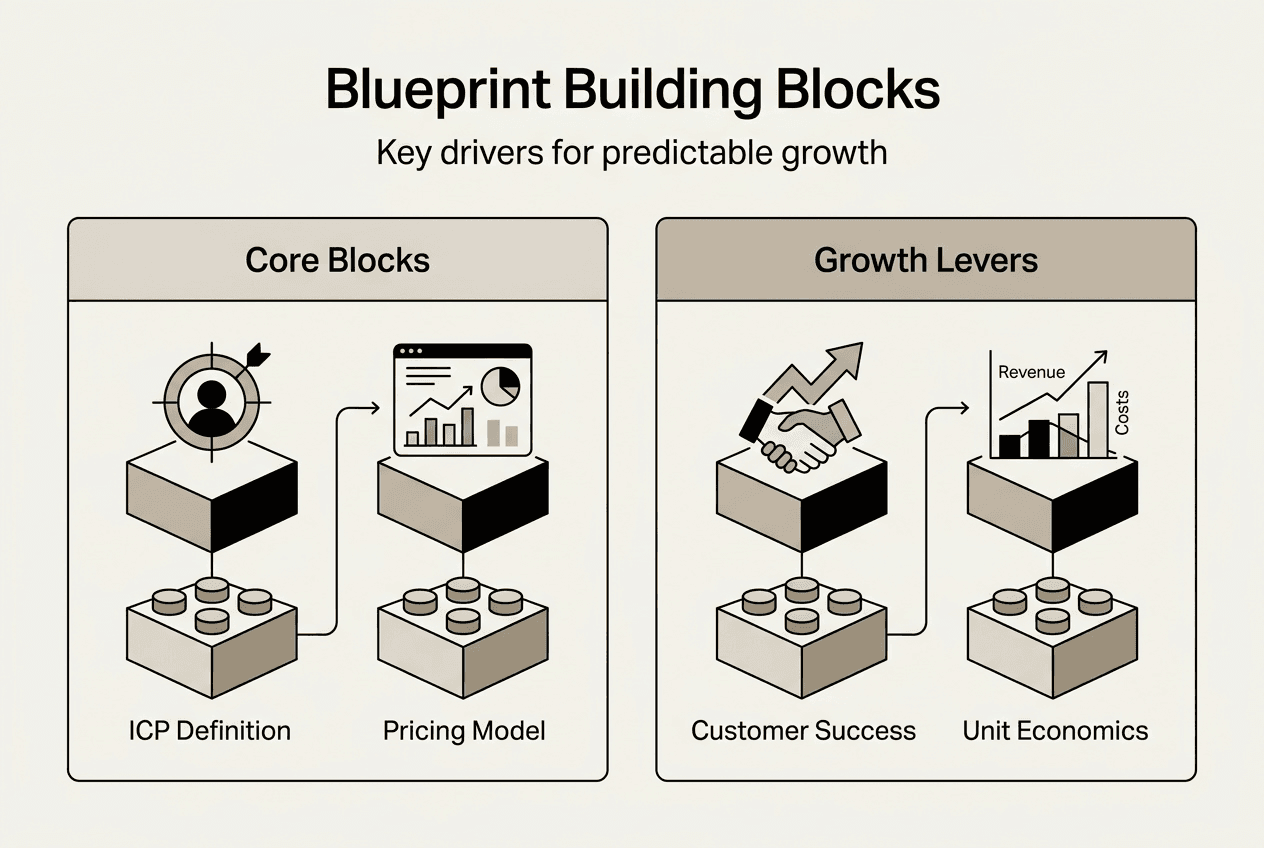
The 8 Commercial Building Blocks provide a framework for designing repeatable commercial architecture. Each component addresses a specific aspect of your revenue engine, from customer identification to cultural mindset.
-
Ideal Customer Profile (ICP): Segment customers by deal size, complexity, and buying behavior. Your ICP should identify which prospects convert fastest, generate highest lifetime value, and require least support resources. This precision prevents wasted effort on low-fit opportunities.
-
Sales Operating Model: Define how commercial responsibilities distribute across your organization. Clarify who owns prospecting, qualification, closing, and expansion. Link these roles to compensation structures that reward desired behaviors.
-
Pricing Strategy: Align pricing to value-based tiers that support sustainable growth. Your pricing should reflect customer outcomes rather than cost-plus calculations. This approach enables premium positioning and protects margins during scaling.
-
Battlecards: Create competitive positioning documents that address common objections and highlight differentiation. Battlecards ensure consistent messaging across all customer touchpoints, reducing variability in sales conversations.
-
Elevator Pitch: Develop a clear value statement that communicates what you do, who you serve, and why it matters. This foundation supports all marketing and sales communications.
-
Values and Language: Establish the cultural principles and terminology that guide commercial decisions. Shared language accelerates onboarding and ensures alignment as you scale.
-
Sales Profiles: Document the characteristics of successful salespeople in your organization. These profiles inform hiring decisions and training programs.
-
Mindset: Build a cultural foundation that embraces commercial discipline, experimentation, and continuous improvement. Mindset shapes how teams respond to challenges and opportunities.
Pro Tip: Prioritize precise ICP definition and value-based pricing before investing heavily in sales hiring. These two components prevent the most common scaling failures.
Compare the impact of each building block on your commercial engine:
| Building Block | Primary Impact | Secondary Benefit |
|---|---|---|
| Ideal Customer Profile | Reduces wasted prospecting effort | Improves conversion rates |
| Sales Operating Model | Clarifies accountability | Enables performance measurement |
| Pricing Strategy | Protects margins during growth | Positions against competitors |
| Battlecards | Ensures message consistency | Shortens sales cycles |
| Elevator Pitch | Simplifies positioning | Supports marketing efficiency |
Implementing these building blocks creates a commercial operating system that functions independently of any individual contributor. This systematic approach transforms sales from an art into a science, enabling predictable forecasting and resource allocation.
Leveraging customer success as a growth lever
Customer success establishes the critical link between product, sales, and go-to-market functions. When implemented strategically, customer success can be a growth lever that drives retention, expansion, and advocacy.

Many founders delay formalizing customer success until churn becomes painful. This reactive approach misses the opportunity to build expansion loops early. Customer success should reduce founder time spent solving customer issues while simultaneously identifying upsell opportunities and preventing churn.
Establish metrics that connect customer success activities to revenue outcomes. Track churn rate, net revenue retention (NRR), and the LTV:CAC ratio to measure success impact. These metrics reveal whether customer success investments generate positive returns or simply add operational costs.
Your first customer success hire requires careful alignment on compensation and team goals. Should they focus on retention, expansion, or both? How do their incentives align with sales team objectives? Misaligned goals create internal competition that damages customer experience.
Customer success teams generate valuable intelligence that improves your entire commercial engine. They identify common onboarding friction points, usage patterns that predict churn, and feature requests that signal expansion readiness. This feedback loop informs product development, sales messaging, and pricing strategy.
Pro Tip: Monitor the percentage of founder time spent solving customer experience issues. When this exceeds 50%, formalize customer success operations immediately to prevent founder burnout and enable strategic focus.
Consider these indicators that signal readiness for dedicated customer success resources:
- Customer support requests consume more than 20 hours per week of founder or senior team time
- Churn analysis reveals preventable losses due to onboarding gaps or feature confusion
- Expansion opportunities exist but lack systematic identification and pursuit
- Customer feedback remains fragmented across email, calls, and informal conversations
- Renewal processes depend entirely on founder relationships rather than documented value delivery
Building customer success early creates competitive advantages that compound over time. Retained customers cost less to serve, generate predictable revenue, and provide referrals that reduce acquisition costs. This virtuous cycle accelerates growth while improving unit economics.
Measuring unit economics and optimizing growth channels
Sustainable scaling requires precise measurement of the economics underlying each customer acquisition. Reach LTV:CAC ratios of 4:1 or higher, churn under 5%, and NRR of 110-120% for sustainable growth in 2026. These benchmarks separate viable business models from those that consume cash without generating returns.
Lifetime value to customer acquisition cost (LTV:CAC) ratio measures the return on each dollar spent acquiring customers. A 4:1 ratio means every dollar invested in acquisition generates four dollars in customer lifetime value. Ratios below 3:1 suggest either acquisition costs are too high or customer value is too low.
Churn rate directly impacts your ability to grow efficiently. Monthly churn above 5% creates a leaky bucket that requires constant new customer acquisition just to maintain revenue. Reducing churn by even 1% can dramatically improve growth trajectory and valuation multiples.
Net revenue retention (NRR) measures revenue growth from existing customers through expansion, upsells, and cross-sells, minus revenue lost to churn and downgrades. NRR above 110% means your existing customer base grows revenue faster than you lose it, enabling growth even without new customer acquisition.
Compare your performance against these targets:
| Metric | Target | Good | Needs Improvement |
|---|---|---|---|
| LTV:CAC Ratio | 4:1 or higher | 3:1 to 4:1 | Below 3:1 |
| Monthly Churn | Under 2% | 2% to 5% | Above 5% |
| Net Revenue Retention | 110-120% | 100-110% | Below 100% |
| CAC Payback Period | Under 12 months | 12-18 months | Above 18 months |
CAC payback period measures how long it takes to recover the cost of acquiring a customer. Shorter payback periods improve cash flow and reduce the capital required to scale. Companies with payback periods exceeding 18 months often struggle to self-fund growth.
Channel strategy should prioritize high-intent prospects who demonstrate buying signals before engaging with your sales team. Psychological intent conquesting targets prospects actively researching solutions to problems you solve. Competitor conquesting focuses on prospects already using competitive products who may be open to switching.
Optimize your growth channels using these practices:
- Focus acquisition spending on channels with proven conversion rates rather than experimenting broadly
- Implement attribution tracking that connects revenue to specific campaigns and touchpoints
- Test messaging variations that address different buyer motivations and objections
- Build remarketing audiences from high-intent behaviors like pricing page views and demo requests
- Develop content that answers specific questions prospects ask during buying research
- Create comparison content that positions your solution against alternatives prospects are evaluating
Understanding how to reduce customer acquisition cost enables more efficient scaling. Small improvements in conversion rates, average deal size, or sales cycle length compound into significant economic advantages over time.
How Brand Mavericks Management supports your commercial growth
Transforming the frameworks in this guide into operational reality requires expertise in commercial architecture and revenue systems. Brand Mavericks Management specializes in helping growth-stage companies build the structured commercial functions described throughout this blueprint.
We design complete revenue ecosystems that connect strategy, execution, and intelligence into one coherent system. Our approach addresses the exact challenges outlined here, from defining your ideal customer profile to optimizing unit economics and building customer success operations that drive expansion.
Our commercial growth consulting services provide the commercial clarity and performance visibility that growth-stage companies need to scale predictably. We embed as your fractional commercial engine, running strategy, pipeline management, reporting, renewals, and optimization under one structured system. This enables you to access senior commercial expertise without building an entire in-house team.
FAQ
What is a commercialisation blueprint and why does my company need one?
A commercialisation blueprint provides a structured approach to sales, marketing, and customer success that enables predictable revenue growth. It transforms fragmented commercial efforts into a repeatable system that scales beyond founder dependency. Without this blueprint, companies waste resources on inconsistent activities that fail to produce measurable results. The blueprint ensures every commercial investment connects to clear outcomes and builds toward sustainable scaling.
When should I start building a customer success team?
Start building customer success when more than half of founder time is spent solving customer issues or when churn analysis reveals preventable losses. This timing prevents founder burnout while capturing expansion opportunities that informal support misses. Early customer success investment creates competitive advantages through better retention, higher NRR, and valuable product feedback that improves your entire commercial engine.
What are the key metrics to track for commercial success?
Focus on LTV:CAC ratio of 4:1 or higher, churn below 5%, and NRR above 110-120% to ensure solid unit economics and retention. These metrics reveal whether your commercial model generates sustainable returns or consumes cash without building enterprise value. Track CAC payback period to understand cash flow implications and monitor sales cycle length to identify friction in your conversion process.
How do I know if my ideal customer profile is accurate?
Your ICP is accurate when it predicts conversion rates, lifetime value, and support requirements with consistent precision. Test your ICP by analyzing win rates, sales cycle length, and customer success costs across different segments. Accurate ICPs show clear patterns where certain customer types convert faster, generate higher revenue, and require less support than others. Refine your ICP quarterly based on actual performance data rather than assumptions.
What is the difference between sales activity and sales architecture?
Sales activity measures behaviors like calls made, emails sent, and meetings booked without connecting them to outcomes. Sales architecture defines the repeatable systems, processes, and frameworks that consistently generate revenue. Architecture includes documented buyer journeys, qualification criteria, pricing strategies, and competitive positioning that guide individual activities toward predictable results. Companies focused on architecture scale efficiently while those focused only on activity struggle with inconsistent performance.