
Ecosystem design for revenue growth: predictability and margin clarity
Learn how structured revenue ecosystem design drives 30% faster growth with predictable margins. Transform fragmented efforts into scalable commercial systems.

Companies with structured revenue ecosystems grow 30% faster than their peers. If you’re generating revenue but still facing unpredictable growth and murky margins, your commercial efforts are likely fragmented. This guide shows you how to transform scattered sales activities into a unified revenue ecosystem that delivers predictable growth with clear margin visibility.
Table of Contents
- Understanding Revenue Ecosystems And Their Impact
- Core Components Of A Revenue Ecosystem
- Common Misconceptions In Revenue Ecosystem Design
- Frameworks And Decision Criteria For Ecosystem Design
- Practical Implementation And Scaling Strategies
- Summary: From Chaos To Structured Growth
- Discover How Brand Mavericks Can Help You Build Your Revenue Ecosystem
- Frequently Asked Questions
Key takeaways
| Point | Details |
|---|---|
| Revenue ecosystems integrate strategy, pricing, partnerships, and finance for predictability | A structured ecosystem connects all revenue drivers into one coherent system that eliminates guesswork. |
| Ignoring revenue intelligence and financial structure causes margin leakage | Without real-time performance tracking and robust financial modeling, you lose visibility into where profits disappear. |
| Balancing complexity with operational simplicity is crucial for scalability | Overly complex systems create bottlenecks, while simple frameworks enable faster execution and growth. |
| Embedding commercial operating systems drives sustained revenue growth | Integrated operating systems align strategy with execution, ensuring every team moves toward predictable outcomes. |
| Performance metrics enable continuous optimization and margin visibility | Tracking the right KPIs helps you identify problems early and adjust before they impact profitability. |
Understanding revenue ecosystems and their impact
A revenue ecosystem is the complete network of strategies, processes, and relationships that generate and sustain your income. It includes your commercial strategy, pricing models, partnership structures, financial architecture, and performance intelligence systems working together as one unit.
Growth-stage companies often suffer from fragmentation. Your sales team operates independently from finance. Pricing decisions happen in isolation from partnership strategies. Performance data sits in disconnected spreadsheets. This fragmented approach hinders growth and makes margin visibility nearly impossible.
When you design a coherent ecosystem, everything changes. Your pricing strategy aligns with partnership opportunities. Financial forecasts reflect actual pipeline health. Performance metrics flow directly to decision-makers. Companies that implement structured revenue ecosystems see measurable improvements in forecast accuracy, renewal rates, and margin predictability. They stop reacting to revenue surprises and start controlling their growth trajectory.
“The difference between chaos and control is a structured revenue ecosystem that connects every commercial decision to measurable outcomes.”
You can’t scale what you can’t measure. You can’t predict what you don’t structure. Revenue ecosystem design gives you both measurement and structure, transforming how your business generates and protects profit.
Core components of a revenue ecosystem
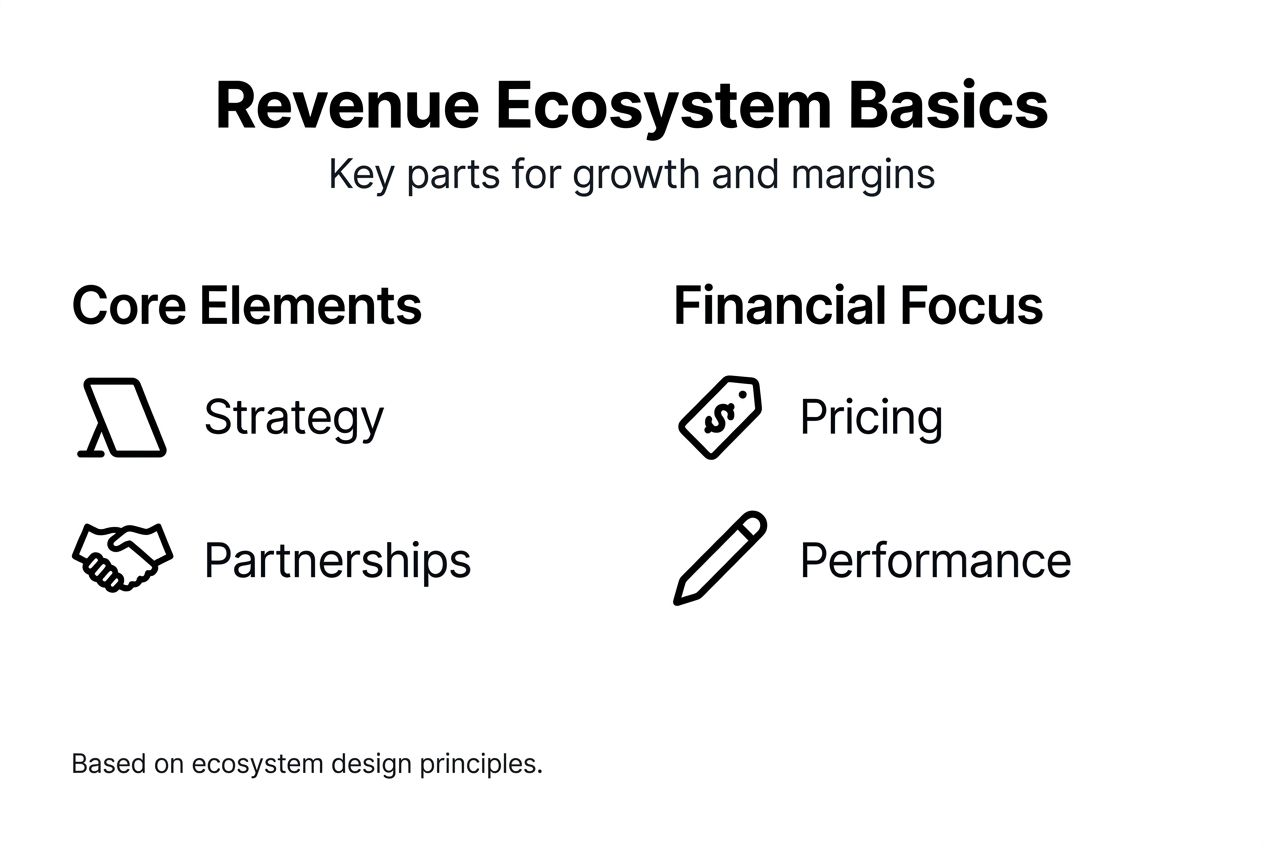
Five critical elements form the foundation of every effective revenue ecosystem.
Commercial strategy integration connects what you sell with who buys it and why. This means clearly defining your offerings, target segments, value propositions, and go-to-market approach. When strategy integrates across all revenue activities, you eliminate conflicting messages and wasted effort.
Pricing and value architecture determines how you capture value from customers. Pricing architecture directly affects margin and revenue predictability. Structured pricing models based on value delivered, not arbitrary discounts, protect your margins while improving close rates.

Partnership and sponsorship strategy diversifies your revenue sources and reduces risk. Strategic partnerships create new channels, expand market reach, and generate recurring revenue streams that complement your core offerings. Well-designed partnership ecosystems can contribute 20 to 40% of total revenue for growth-stage companies.
Financial modeling and architecture provides the numbers that drive decisions. This includes P&L projections, cashflow forecasting, break-even analysis, and unit economics. Without robust financial modeling, you’re flying blind on profitability and can’t identify margin leakage until it’s too late.
Revenue performance management tracks what matters in real time. This component monitors pipeline health, renewal risk, margin by customer segment, ROI on activations, and forecast accuracy. Performance intelligence turns data into actionable insights that prevent problems before they escalate.
| Component | Primary Function | Impact on Growth |
|---|---|---|
| Commercial Strategy | Aligns offerings with market demand | Focuses resources on highest-value opportunities |
| Pricing Architecture | Captures customer value systematically | Protects margins and improves predictability |
| Partnership Strategy | Diversifies revenue streams | Reduces risk and expands market access |
| Financial Modeling | Provides margin visibility and forecasts | Enables data-driven resource allocation |
| Performance Management | Tracks metrics and identifies issues early | Prevents revenue leakage and improves execution |
Pro Tip: Start by auditing your existing revenue activities against these five components. Most growth-stage companies discover they have pieces in place but lack integration, which is where the real value lies.
Common misconceptions in revenue ecosystem design
Several false beliefs prevent companies from building effective revenue ecosystems.
Many founders assume that sales volume alone drives growth. They chase more deals without examining margin quality or customer lifetime value. High-volume, low-margin revenue creates the illusion of success while actually draining resources. Sustainable growth comes from the right revenue, not just more revenue.
Another common mistake is delaying revenue intelligence implementation. Companies tell themselves they’ll add performance tracking once they reach a certain size. This backwards thinking costs them dearly. Without early visibility into margin leakage, renewal risk, and pipeline health, you build scaling problems into your foundation. Revenue intelligence should be embedded from day one, not retrofitted later.
Some leaders believe more complexity equals better systems. They build elaborate processes with multiple approval layers, extensive documentation requirements, and complicated reporting structures. Complexity slows execution and creates bottlenecks. The best revenue ecosystems balance sophistication with operational simplicity, giving teams the structure they need without bureaucratic overhead.
“Adding complexity without improving clarity is just expensive confusion. Effective ecosystems simplify decision-making while increasing control.”
Neglecting financial structure causes margin leakage you can’t see until quarterly reviews reveal the damage. Companies that skip detailed unit economics, profitability analysis by customer segment, and cashflow forecasting discover too late that their fastest-growing products are also their least profitable.
Pro Tip: Review your last quarter’s revenue. Can you identify margin by customer segment, channel, and product line? If not, you’re missing critical financial architecture components.
Frameworks and decision criteria for ecosystem design
Building a revenue ecosystem requires an iterative framework that combines strategy, finance, and operations into one coherent system.
Start with ecosystem mapping. Document every current revenue stream, pricing model, partnership arrangement, and customer segment. Identify where these elements connect and where gaps exist. This map becomes your baseline for improvement.
Next, evaluate integration opportunities. Where can you connect disconnected activities? How can pricing decisions inform partnership strategies? Can performance data flow directly into forecasting models? Integration creates the multiplier effects that drive predictable growth.
You’ll face tradeoffs between data complexity and operational usability. More granular data provides better insights but requires more time to collect and analyze. Find the balance where additional data precision delivers meaningful decision improvements without slowing execution. For most growth-stage companies, this means tracking 8 to 12 core metrics deeply rather than 50 metrics superficially.
Decision criteria for embedding operating systems:
- Do you lack internal commercial leadership with ecosystem design experience?
- Are revenue activities fragmented across departments with no central coordination?
- Is margin visibility poor or nonexistent across customer segments?
- Do you need faster time to market without hiring full-time executives?
If you answer yes to two or more, embedding a fractional commercial operating system accelerates ecosystem development while building internal capabilities.
Scalability criteria:
- Can new team members execute the system with minimal training?
- Does the framework accommodate revenue growth without major redesign?
- Are decision-making processes documented and repeatable?
- Can you add new revenue streams without disrupting existing operations?
| Design Approach | Best For | Key Advantage | Potential Drawback |
|---|---|---|---|
| Build Internal Team | Companies over 100 employees | Full control and customization | Long ramp time and high fixed costs |
| Fractional Leadership | Growth-stage companies | Immediate expertise without overhead | Requires clear scope definition |
| Hybrid Model | Companies scaling rapidly | Combines internal ownership with expert guidance | Coordination complexity |
Your ecosystem design should evolve with your business, not lock you into rigid structures that can’t adapt.
Practical implementation and scaling strategies
Transforming ecosystem design into operational reality requires structured implementation.
Step 1: Map and integrate revenue streams. List every way you generate revenue, including core products, services, partnerships, and recurring arrangements. Identify where these streams share customers, channels, or delivery resources. Integration opportunities exist at every intersection.
Step 2: Establish baseline metrics. Before you can improve, you need to measure current performance. Track revenue growth rate, gross margin percentage, customer acquisition cost, lifetime value, renewal rate, and forecast accuracy. These six metrics provide a comprehensive view of ecosystem health.
Step 3: Build financial architecture. Create detailed P&L projections for the next 12 to 24 months. Model cashflow based on payment terms, seasonal patterns, and growth assumptions. Calculate unit economics for each major product or service line. This financial foundation enables confident resource allocation.
Step 4: Embed performance intelligence. Set up weekly or biweekly reporting that tracks your baseline metrics plus any initiative-specific KPIs. Intelligence briefings should highlight variances from forecast, emerging risks, and optimization opportunities. Real-time visibility prevents small issues from becoming major problems.
Step 5: Leverage partnerships strategically. Partnerships improve renewal rates and margin clarity by diversifying revenue sources and providing complementary capabilities. Identify partners whose strengths offset your weaknesses and whose customer bases complement yours.
“The companies that scale fastest treat partnerships as core revenue architecture, not optional add-ons.”
Case study insights: A software company generating $2M annually with 30% margins implemented structured ecosystem design. They integrated pricing with partnership strategy, embedded weekly performance reporting, and built detailed financial models. Within 18 months, revenue grew to $3.8M while margins expanded to 42%. The key was connecting previously siloed activities into one system where every decision supported predictable growth.
Monitor ecosystem health through leading and lagging indicators. Leading indicators include pipeline velocity, proposal win rates, and engagement scores. Lagging indicators include actual revenue, margin percentage, and customer churn. Together, they give you early warning of problems and confirmation of what’s working.
Summary: from chaos to structured growth
Structured revenue ecosystems transform commercial chaos into predictable growth with clear margin visibility. They replace guesswork with measurable systems that connect strategy directly to execution.
Key transformation points:
- Fragmented activities become integrated systems that multiply effectiveness
- Reactive firefighting shifts to proactive optimization based on real-time intelligence
- Hidden margin leakage becomes visible and controllable through robust financial architecture
- Unpredictable revenue patterns evolve into forecast-able growth trajectories
Adopting ecosystem design isn’t optional for companies serious about sustainable growth. It’s the difference between hoping for good quarters and engineering them. The frameworks, components, and implementation strategies covered here provide your roadmap from where you are to where you need to be.
Your next move determines whether you continue struggling with unpredictability or start building the commercial operating system that scales with you.
Discover how Brand Mavericks can help you build your revenue ecosystem
Transforming fragmented commercial activities into a structured revenue ecosystem requires expertise in strategy, finance, and operational execution.

Brand Mavericks specializes in designing and managing complete revenue ecosystem consulting services for growth-stage companies. We build tailored commercial operating systems that integrate your pricing architecture, partnership strategies, and financial modeling into one predictable growth engine. Our approach gives you real-time revenue intelligence and margin visibility without the overhead of building an entire internal team. Whether you need strategic clarity, execution support, or embedded fractional leadership, we provide the commercial brain behind sustainable growth. Stop reacting to revenue surprises and start controlling your trajectory.
Frequently asked questions
What are the first steps a growth-stage company should take to design a revenue ecosystem?
Start by mapping your existing revenue streams and identifying where fragmentation prevents predictability. Audit your current pricing models, partnership arrangements, and financial reporting to pinpoint integration opportunities. Establish baseline metrics for revenue growth, margin percentage, and forecast accuracy before implementing changes.
Which KPIs are most important to monitor for revenue ecosystem health?
Track revenue growth rate, gross margin percentage, customer renewal rate, forecast accuracy, customer acquisition cost, and lifetime value. These six metrics provide comprehensive visibility into ecosystem performance and early warning of margin leakage or execution problems. Monitor them weekly or biweekly for maximum effectiveness.
How do partnerships enhance revenue ecosystem scalability?
Partnerships diversify your revenue sources, reduce dependency on single channels, and provide complementary capabilities that accelerate growth. Strategic partnerships can contribute 20 to 40% of total revenue while improving renewal rates through integrated customer value. They make your ecosystem more robust and less vulnerable to market shifts.
What are common pitfalls to avoid when scaling a revenue ecosystem?
Avoid excessive complexity that slows execution and creates bottlenecks. Integrate revenue intelligence early rather than waiting until problems are visible in quarterly reviews. Prioritize robust financial modeling that tracks margin by segment, not just top-line revenue. Balance sophistication with operational simplicity to maintain speed as you scale.