
Why ROI Tracking Cuts Fintech Margin Leaks by 18%
Discover how structured ROI tracking cuts fintech margin leaks by 18%. Learn essential KPIs, frameworks, and strategies to enhance revenue visibility and optimize financial performance for growth-stage fintechs.

Many fintech leaders believe ROI tracking is just another accounting task. This misconception costs growth-stage companies millions in hidden margin leaks and missed revenue opportunities. Research shows over 70% of fintech leaders initially misinterpret ROI tracking scope before adoption. Structured ROI tracking transforms commercial chaos into measurable financial outcomes, reducing margin leaks by an average of 18% while enhancing revenue visibility and strategic decision making.
Table of Contents
- Understanding ROI Tracking in Fintech
- Measurement Frameworks and Key Metrics for Fintech ROI
- Common Misconceptions in Fintech ROI Tracking
- Benefits and Business Impacts of Structured ROI Tracking
- Frameworks and Models to Operationalize ROI Tracking
- Legacy vs. Structured ROI Tracking in Fintech
- Bridging ROI Tracking to Commercial Strategy and Execution
- Conclusion: Elevating Fintech Growth Through ROI Tracking
- Unlock Your Fintech’s Growth Potential with Expert ROI Tracking Support
Key Takeaways
| Point | Details |
|---|---|
| ROI tracking transcends accounting | Provides strategic growth insights by connecting commercial activities directly to financial outcomes |
| Essential fintech KPIs include CAC, LTV, and Payback Period | These metrics measure customer acquisition efficiency and long-term profitability |
| Structured systems reduce margin leaks by 18% | Comprehensive ROI frameworks identify revenue inefficiencies and enable rapid resource optimization |
| Implementation requires data integration | Multi-channel revenue tracking consolidates sales, marketing, and partnership performance |
| ROI insights drive commercial strategy | Continuous measurement informs renewal strategies, partnership decisions, and resource allocation |
Understanding ROI Tracking in Fintech
ROI tracking in fintech means measuring how every commercial activity translates into financial outcomes. Unlike traditional accounting that records past transactions, ROI tracking provides forward-looking visibility into which revenue streams perform best and where margins erode.
Growth-stage fintechs face unique revenue complexity. You manage subscription sales, partnership deals, platform fees, and transactional income streams simultaneously. Each revenue source requires different tracking approaches to understand true profitability.
Effective ROI tracking connects these dots:
- Customer acquisition campaigns to lifetime revenue generation
- Partnership investments to recurring revenue outcomes
- Platform feature development to user retention rates
- Sales team activities to qualified pipeline conversion
- Marketing spend across channels to customer acquisition cost
Without structured ROI systems, your commercial team operates blind. You know revenue totals but lack insight into which activities drive profitable growth versus which drain resources. This gap between activity and outcome creates margin leaks that compound over time.
Fintech businesses generating $500K+ revenue often reach an inflection point. Your initial product-market fit delivered early growth, but scaling requires precision. ROI tracking shifts your commercial operations from reactive to predictive, replacing guesswork with measurable systems that protect margins while accelerating growth.
Measurement Frameworks and Key Metrics for Fintech ROI
Building a robust ROI tracking system starts with integrating data from multiple channels. Your sales CRM, marketing automation platform, and partnership agreements each hold pieces of the revenue puzzle. Connecting these sources creates a unified view of commercial performance.
Top-performing fintechs use standardized KPIs to measure ROI accurately. These metrics balance immediate results with long-term value creation, helping you optimize resource allocation.
Critical fintech ROI metrics include:
- Customer Acquisition Cost (CAC): Total sales and marketing spend divided by new customers acquired
- Lifetime Value (LTV): Predicted revenue from a customer over their entire relationship
- Payback Period: Time required for customer revenue to exceed acquisition costs
- Renewal Rates: Percentage of customers who continue subscriptions or contracts
- Revenue per Channel: Attribution of income to specific marketing or sales channels
A practical framework links commercial offers to tracking mechanisms. Define each revenue stream, map customer journeys, assign attribution rules, and establish reporting cadence. This structure transforms raw data into actionable intelligence.
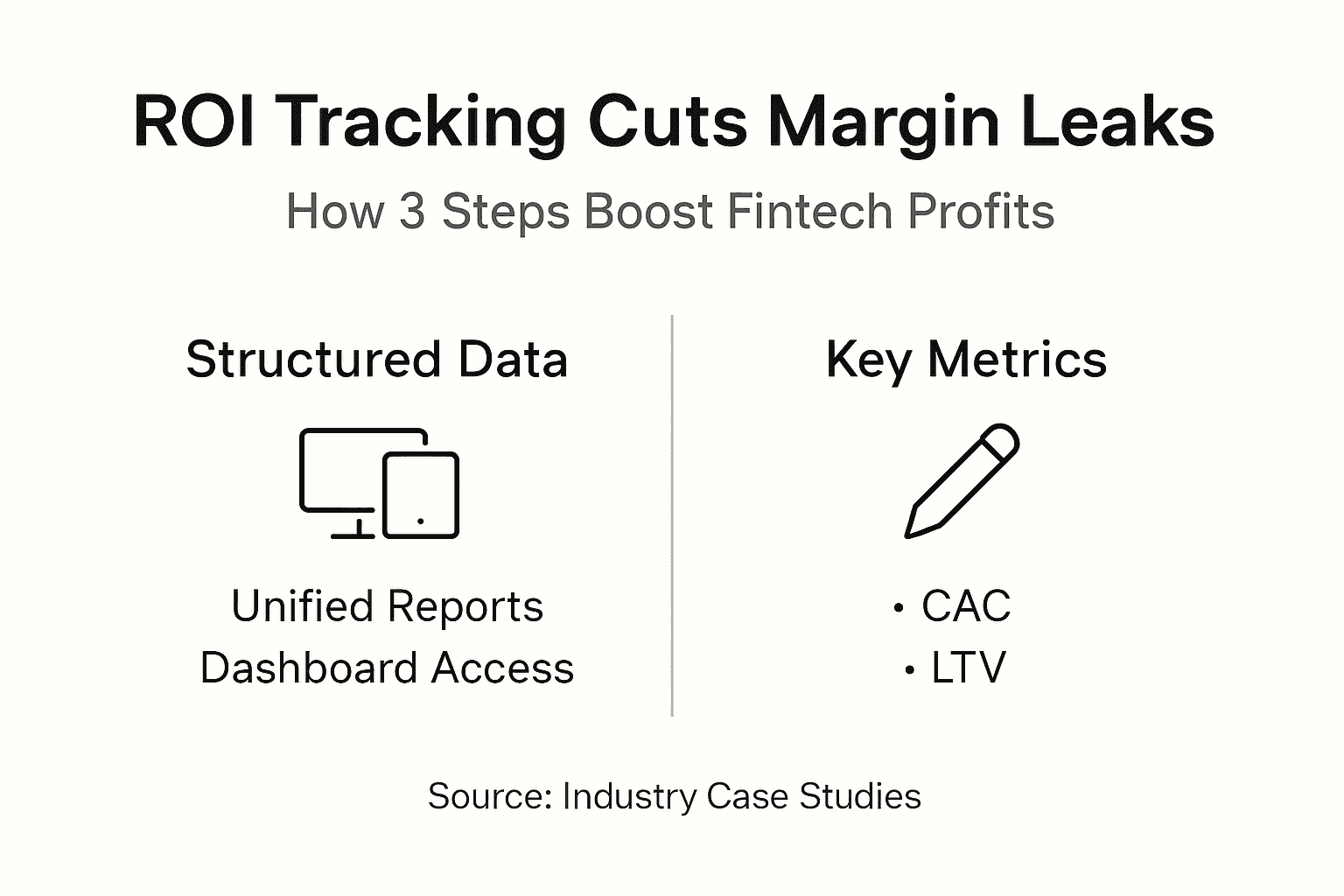
Pro tip: Balance short-term metrics like conversion rates with long-term indicators like LTV ratio. Optimizing only for immediate results often sacrifices sustainable growth and margin protection.
| Metric | Definition | Fintech Relevance |
|---|---|---|
| CAC | Cost to acquire one customer | Measures sales and marketing efficiency across channels |
| LTV | Total customer lifetime revenue | Indicates product stickiness and pricing effectiveness |
| Payback Period | Months to recover CAC | Assesses cash flow health and growth sustainability |
| Churn Rate | Percentage of customers lost | Early warning for product-market fit issues |
| Revenue per Employee | Total revenue divided by headcount | Operational efficiency benchmark for scaling |
Your ROI framework should capture both leading indicators that predict future performance and lagging indicators that confirm results. This dual perspective enables proactive adjustments before problems compound.
Common Misconceptions in Fintech ROI Tracking
The belief that ROI tracking belongs solely in finance departments limits its strategic value. Commercial directors who view ROI as accounting miss opportunities to optimize resource allocation and accelerate growth.
ROI tracking drives commercial strategy, not just financial reporting. When you understand which partnerships generate highest margins or which customer segments renew consistently, you make smarter strategic bets. This commercial intelligence shapes product development, pricing decisions, and market expansion plans.
Another misconception treats ROI as purely short-term marketing measurement. Many fintech leaders focus exclusively on immediate campaign returns, ignoring longer customer journeys. SaaS and platform businesses particularly need multi-year LTV perspectives to evaluate acquisition investments accurately.
Common ROI tracking myths that block success:
- ROI only matters for paid advertising spend
- Financial statements provide sufficient performance visibility
- ROI tracking requires expensive enterprise software
- Only CFOs need access to ROI data
- Tracking adds administrative burden without strategic value
Relying on legacy financial reporting creates blind spots. Monthly P&L statements show aggregate results but hide granular insights about channel performance, customer cohort profitability, or partnership ROI. You see symptoms but miss root causes of margin erosion.
Pro tip: Schedule quarterly ROI training sessions for your entire commercial team. When everyone understands how their activities connect to financial outcomes, they make better daily decisions that compound into significant margin improvements.
Education unlocks ROI tracking’s full potential. Your sales team optimizes deal structures, marketing refines targeting, and partnerships focus on high-value collaborations when they see direct financial impact.
Benefits and Business Impacts of Structured ROI Tracking
Structured ROI tracking delivers measurable financial improvements. Growth-stage fintechs reduce an average 18% margin leak after adopting comprehensive tracking systems. This improvement stems from identifying and eliminating revenue inefficiencies invisible to traditional accounting.

Revenue visibility transforms decision speed. When you track ROI continuously, you spot underperforming initiatives within weeks instead of quarters. This rapid feedback enables resource reallocation before small problems become expensive failures.
Key business impacts include:
- Enhanced Resource Allocation: Data-driven budgeting shifts spending from low-ROI activities to high-performing channels
- Improved Renewal Strategy: Cohort analysis identifies at-risk customers early, enabling proactive retention efforts
- Investor Confidence: Transparent financial metrics and predictable growth models attract capital at better valuations
- Margin Protection: Continuous monitoring catches overservicing, pricing errors, and partnership inefficiencies
- Commercial Clarity: Executive teams align around shared performance metrics and growth priorities
Structured tracking also reveals hidden opportunities. You discover which customer segments have highest LTV, which partnerships drive recurring revenue, and which features improve retention. These insights guide strategic priorities more effectively than intuition alone.
Growth-stage fintechs reduce an average 18% margin leak after adopting structured ROI tracking systems.
Board-level reporting improves significantly with structured ROI data. Instead of presenting revenue totals and vague pipeline projections, you show cohort economics, channel attribution, and renewal forecasts. This transparency builds stakeholder confidence and supports fundraising efforts.
Similar ROI impact studies across growth companies demonstrate consistent patterns. Organizations that implement comprehensive tracking systems consistently outperform peers in margin management and capital efficiency.
Frameworks and Models to Operationalize ROI Tracking
Implementing ROI tracking requires a systematic approach. The most effective framework operates in three phases: definition, revenue mapping, and continuous tracking.
Start by clearly defining what you sell and how you price it. Document every revenue stream, from subscription tiers to partnership agreements to transactional fees. This commercial offerings inventory becomes your tracking foundation.
Next, map customer journeys and revenue attribution. Identify every touchpoint where prospects interact with your business. Assign value to each interaction based on its influence on conversion and retention outcomes.
Structured implementation follows these steps:
- Audit Current Data Sources: Inventory existing CRM, marketing, and financial systems
- Define Integration Points: Establish how data flows between platforms
- Set Baseline Metrics: Record current CAC, LTV, and other key performance indicators
- Build Reporting Dashboard: Create executive view consolidating critical ROI metrics
- Train Commercial Team: Ensure everyone understands how to interpret and act on ROI data
- Establish Review Cadence: Schedule weekly or monthly ROI analysis sessions
- Iterate and Optimize: Refine tracking based on insights gained and changing business needs
Successful implementation requires organizational buy-in. Your commercial team must understand that ROI tracking improves their effectiveness rather than adding bureaucracy.
Pro tip: Secure executive sponsorship before launching ROI initiatives. When leadership prioritizes commercial intelligence, data integration proceeds smoothly and adoption accelerates across teams.
| Framework Component | Purpose | Fintech Benefit |
|---|---|---|
| Commercial Offerings Definition | Clarify what you sell and to whom | Eliminates revenue stream confusion and pricing inconsistency |
| Revenue Attribution Model | Connect activities to financial outcomes | Identifies highest-performing channels and partnerships |
| KPI Dashboard | Centralize performance metrics | Enables rapid decision-making based on real-time data |
| Reporting Cadence | Regular performance review cycles | Catches margin leaks early and maintains accountability |
| Continuous Optimization | Iterative improvement process | Compounds small gains into significant competitive advantages |
Fintech ROI tracking frameworks vary in sophistication but share common elements. The key is starting with core metrics and expanding tracking as your organization matures.
Legacy vs. Structured ROI Tracking in Fintech
Legacy revenue reporting fragments data across disconnected systems. Your finance team sees P&L statements, sales reviews pipeline reports, and marketing analyzes campaign metrics. No single view connects these pieces into coherent commercial intelligence.
This fragmentation creates dangerous blind spots. You might celebrate strong quarterly revenue while missing declining renewal rates or rising acquisition costs. By the time problems surface in financial statements, you’ve already lost significant margin.
Structured ROI tracking consolidates commercial data into unified dashboards. Every stakeholder accesses the same performance metrics, creating alignment around priorities and enabling faster corrective action.
| Characteristic | Legacy System | Structured ROI Tracking |
|---|---|---|
| Data Integration | Siloed across departments | Unified cross-functional view |
| Reporting Speed | Monthly or quarterly | Real-time or weekly |
| Predictive Capability | Limited to historical trends | Forward-looking forecasts |
| Margin Visibility | Aggregate totals only | Granular by channel and cohort |
| Decision Impact | Reactive adjustments | Proactive optimization |
| Resource Allocation | Intuition-based budgeting | Data-driven investment |
Legacy approaches often underestimate revenue opportunities. Without cohort analysis, you miss patterns showing which customer segments have highest LTV or which partnerships drive best margins. This knowledge gap leads to misallocated resources and slower growth.
Structured systems reduce operational risk. When you track renewal rates by cohort, identify margin leaks by revenue stream, and monitor CAC trends across channels, you catch problems early. This early warning system protects against sudden revenue shortfalls that damage investor confidence.
The transition from legacy to structured tracking requires upfront investment but pays back quickly. Most growth-stage fintechs recoup implementation costs within two quarters through improved resource allocation and reduced margin leaks.
Bridging ROI Tracking to Commercial Strategy and Execution
Effective ROI tracking integrates into daily commercial operations. Your insights must flow into decision-making processes, not sit in reports that executives review monthly and forget.
Embed ROI metrics directly into your commercial operating system. Sales teams should see customer acquisition costs and LTV targets in their CRM. Marketing dashboards must display channel-specific ROI alongside campaign performance. Partnership managers need visibility into revenue per collaboration and renewal likelihood.
Continuous margin leak detection becomes standard practice. Weekly intelligence briefings highlight areas where costs exceed targets or revenue falls short of projections. This cadence enables rapid response before small inefficiencies compound.
Strategic applications of ROI insights include:
- Renewal Strategy Optimization: Target retention efforts toward high-LTV customers showing early churn signals
- Partnership Portfolio Management: Double down on collaborations driving recurring revenue while exiting low-margin relationships
- Pricing Architecture Refinement: Adjust tier structures based on actual customer usage patterns and willingness to pay
- Market Expansion Decisions: Validate new segment opportunities with predictive LTV modeling before major investment
- Resource Allocation: Shift budget from saturated channels to emerging opportunities with better unit economics
Proactive adjustments improve growth scalability. Instead of waiting for quarterly reviews to redirect resources, you make continuous micro-optimizations based on real-time data. These incremental improvements compound into significant competitive advantages.
Investor reporting gains credibility with structured ROI evidence. You present cohort economics showing predictable growth patterns rather than optimistic projections. This transparency often unlocks better funding terms and higher valuations.
Commercial teams perform better when they understand financial impact. Sales reps who see how deal structure affects margins negotiate smarter. Marketers who track true customer acquisition costs optimize campaigns more effectively. This organizational alignment around ROI metrics accelerates overall performance.
Conclusion: Elevating Fintech Growth Through ROI Tracking
Structured ROI tracking transforms fintech commercial operations from reactive to predictive. You gain visibility into which activities drive profitable growth, where margins erode, and how resources should shift for optimal outcomes.
The 18% margin leak reduction achieved by growth-stage fintechs demonstrates tangible financial impact. Beyond immediate savings, comprehensive tracking builds investor confidence, accelerates decision-making, and creates sustainable competitive advantages.
Start implementing ROI frameworks today. Define your revenue streams, integrate data sources, establish key metrics, and embed insights into daily commercial execution. Your fintech’s growth trajectory depends on replacing guesswork with measurable systems.
Unlock Your Fintech’s Growth Potential with Expert ROI Tracking Support
Implementing structured ROI tracking systems requires specialized expertise in fintech commercial architecture. Brand Mavericks Management helps growth-stage fintechs design complete revenue intelligence frameworks that eliminate margin leaks and enhance financial visibility.
We build commercial operating systems that connect strategy, execution, and performance measurement into unified dashboards. Our expert ROI tracking services provide the clarity and control you need to scale confidently.
Explore how our growth strategy consulting transforms fragmented commercial efforts into structured revenue engines. Discover performance software solutions that deliver board-level intelligence without building full in-house teams.
FAQ
What are the essential KPIs for fintech ROI tracking?
Customer Acquisition Cost (CAC), Lifetime Value (LTV), Payback Period, and Renewal Rates form the core KPI set. CAC measures acquisition efficiency while LTV indicates long-term customer profitability. Payback Period assesses cash flow sustainability, and Renewal Rates provide early warning signals for product-market fit issues.
How does structured ROI tracking reduce margin leaks in fintech?
Structured systems consolidate revenue data across channels to identify inefficiencies invisible to traditional accounting. This visibility enables rapid detection of overservicing, pricing errors, and underperforming partnerships. Catching these issues early allows timely adjustments that protect margins before small leaks become major financial drains.
What challenges do fintechs face when implementing ROI tracking?
Data fragmentation across disconnected CRM, marketing, and financial systems creates the primary technical hurdle. Organizational resistance represents the human challenge as teams worry tracking adds bureaucracy. Prioritizing data integration investments and securing executive sponsorship helps overcome both obstacles while demonstrating clear value quickly.
Can ROI tracking influence fintech commercial strategy beyond marketing?
ROI insights drive renewal strategies, partnership portfolio decisions, pricing architecture, and resource allocation across all commercial functions. The data informs which customer segments to prioritize, which features to develop, and which markets to enter. This makes ROI tracking a foundational strategic tool rather than just a marketing measurement exercise.