
Partnership Strategy Process for Revenue Growth Success
Master the partnership strategy process to boost revenue and streamline sponsorship deals with clear, actionable steps and measurable outcomes for your business.

Feeling buried under vague sponsorship requests and unpredictable revenue streams is not uncommon for growing sports organizations. Clear partnership strategies matter because they turn scattered efforts into measurable growth, giving you and your stakeholders the confidence to forecast results. By focusing on defining specific business goals, evaluating ideal partners, and structuring scalable packages, your team gains a repeatable playbook for building genuine commercial value that stands out in the North American market.
Table of Contents
- Step 1: Define Commercial Partnership Objectives
- Step 2: Identify And Evaluate Ideal Partners
- Step 3: Structure Scalable Partnership Packages
- Step 4: Execute Agreements And Measure Performance
Quick Summary
| Key Insight | Explanation |
|---|---|
| 1. Define clear partnership goals | Specific goals create accountability and clarity in partnerships, avoiding misaligned expectations that waste time. |
| 2. Systematically identify partners | Conduct thorough market research to find potential partners whose missions and capabilities align with your own. |
| 3. Structure scalable partnership packages | Create tiered packages that offer varying levels of benefits, helping partners find packages that best fit their needs. |
| 4. Execute agreements with clarity | Formalize partnership agreements to set clear expectations and roles, ensuring both parties understand their commitments. |
| 5. Regularly measure and review performance | Establish performance metrics and conduct quarterly reviews to ensure partnerships are delivering value and to address any issues promptly. |
Step 1: Define commercial partnership objectives
Before you approach potential partners, you need absolute clarity on what you want from a partnership. Vague goals lead to misaligned expectations and wasted time. This step forces you to articulate exactly what success looks like.
Start by identifying the specific business problem your organization needs to solve. Are you looking to grow revenue through sponsorship activation? Do you need distribution into new markets? Are you seeking technology or operational expertise you don’t have in-house?
Write down what winning looks like. Not “increase revenue”—that’s too broad. Write “secure $500,000 in new sponsorship commitments within 12 months” or “establish distribution partnerships in three new North American markets.” Specific targets create accountability.
Next, understand who your potential partners might be. Identifying clear research problems and objectives that the company needs to address helps you find partners with complementary skills. For sports organizations, this means thinking about your stakeholders:
- Rights holders and broadcasters who amplify your reach
- Technology or service providers who enhance fan experience
- Brand sponsors who bring capital and marketing support
- Distribution partners who access new audience segments
- Content or talent partners who add value to what you offer
Now assess your organization’s assets and gaps. What do you bring to the table? What are you missing? Assessing compatibility of skill sets and expertise helps form collaborative partnerships that actually work.
Document your partnership objectives in three parts. First, state your primary goal—what you want the partnership to achieve. Second, list mutual benefits—what your potential partner gets from working with you. Third, define success metrics—how you’ll measure whether the partnership delivered.
Partnership success starts with clarity. If both parties can’t articulate why they’re working together, the partnership will drift or fail.
The clearer your objectives, the easier it becomes to identify the right partners. You’ll also negotiate better terms because you know exactly what you need.
Pro tip: Write your partnership objectives as a one-page brief you could hand to a potential partner—if they “get it” after reading one page, your objectives are clear enough to move forward.
Step 2: Identify and evaluate ideal partners
Now that you know what you need, it’s time to find the right organizations to partner with. The wrong partner can derail your strategy; the right one accelerates growth. This step is about being systematic in your search and evaluation.
Start with market research and your existing network. Who already plays in your space? Which organizations have complementary assets to yours? Look at sponsorship databases, industry directories, and trade shows where potential partners gather. Ask your board members, advisors, and peers for recommendations.

Create a shortlist of 15 to 25 potential partners who match your criteria. Don’t overthink it yet—cast a wide net. Identifying partners with complementary capabilities requires thorough market research and leveraging professional networks to assess fit.
Now evaluate each prospect against these factors:
- Mission and values alignment – Do they care about what you care about?
- Complementary capabilities – Do they have what you lack?
- Financial stability – Can they actually deliver on commitments?
- Track record – How do they perform with existing partners?
- Cultural fit – Will your teams work well together?
Next, conduct discovery calls with your top 5 to 8 prospects. Ask about their goals, constraints, and how they measure success in partnerships. Listen more than you talk. These conversations reveal whether the partnership makes sense for both sides.
Evaluating potential partners requires cost-benefit analysis and examination of reputation and performance metrics. Check references. Talk to their existing partners about the experience. Request financial information if capital is involved.
Score your finalists on a simple rubric. Rate each on strategic fit, capability match, financial health, and track record. Your top candidates should score high across all dimensions.
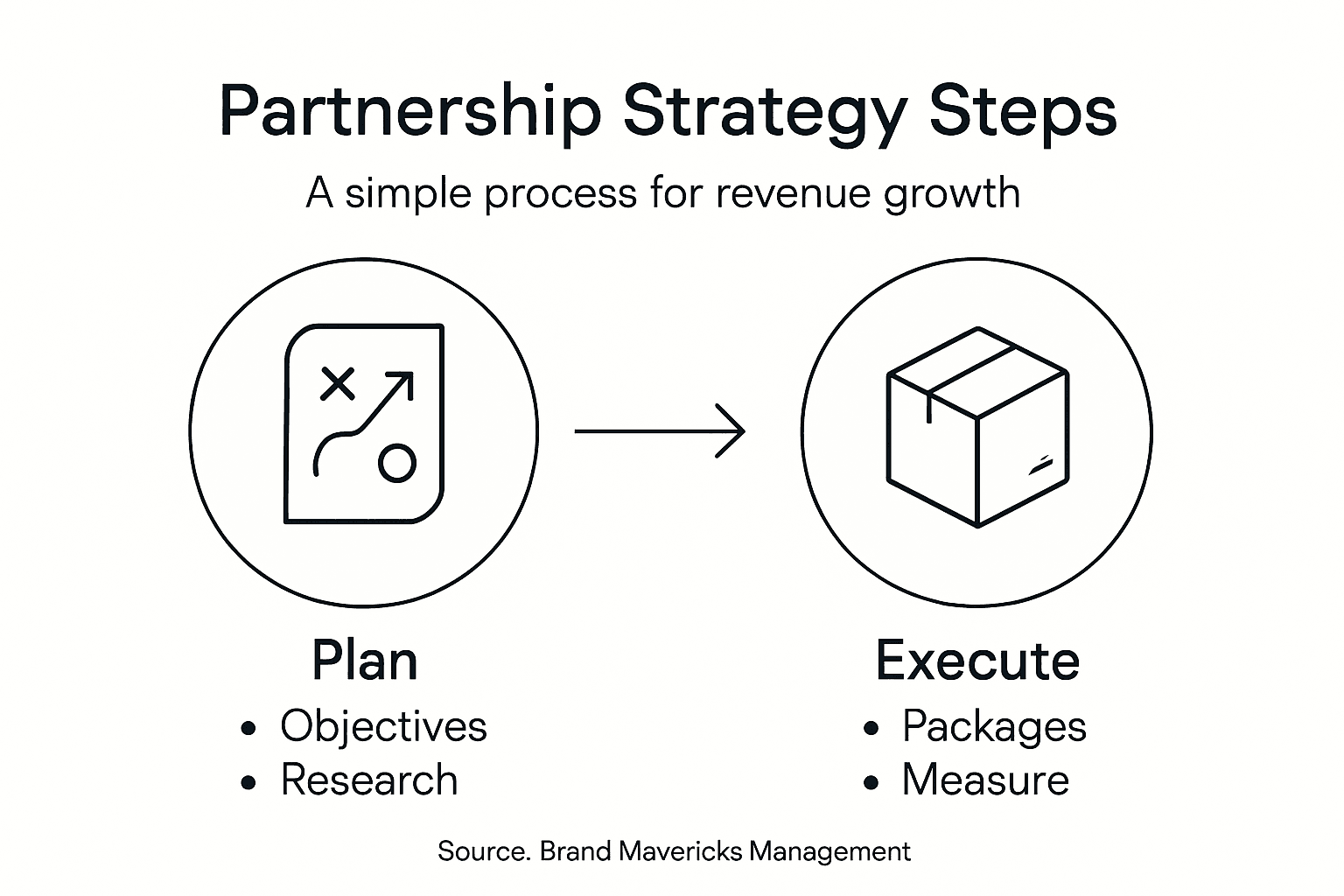
Below is a summary of essential factors for evaluating ideal commercial partners:
| Evaluation Factor | Why It Matters | Impact on Partnership |
|---|---|---|
| Mission Alignment | Ensures shared objectives | Reduces conflicts over goals |
| Financial Stability | Confirms partner reliability | Minimizes risk of default |
| Cultural Compatibility | Fosters teamwork | Improves daily collaboration |
| Proven Track Record | Shows partnership experience | Increases chance of success |
The best partnerships aren’t always with the biggest or most obvious names—they’re with organizations whose goals genuinely align with yours.
Rank your final three to five partners. These are the ones you’ll approach for serious conversations.
Pro tip: Before reaching out formally, have someone on your team use social media or industry connections to learn what these companies value in partnerships—it helps you position your approach to match their priorities.
Step 3: Structure scalable partnership packages
Once you’ve identified your partners, you need to design packages that work for both sides and can grow with your organization. Generic, one-off agreements don’t scale. Structured packages create consistency, reduce negotiation time, and make revenue predictable.
Start by defining what you actually offer. For sports organizations, this typically includes sponsorship rights, activation opportunities, hospitality access, content rights, and branded integrations. Be specific about what’s included at each tier.
Create tiered partnership levels that give partners choices. Think bronze, silver, gold, or platinum packages. Each tier should represent clear value increases and corresponding price differences. A lower tier might include logo placement and social media mentions. A higher tier adds hospitality, exclusive events, and content collaboration.
Here’s a comparison of partnership package tiers and their typical benefits:
| Tier Level | Common Benefits | Example Partner Type |
|---|---|---|
| Bronze | Basic brand exposure, online mentions | Local sponsors |
| Silver | Event access, social promotions | Regional brands |
| Gold | Co-created content, VIP hospitality | Major national companies |
| Platinum | Full integration, custom activations | Global enterprises |
Establishing clear quality benchmarks enables organizations to implement proven methodologies effectively as they grow. Your packages should define exactly what partners receive and when.
Structure each package to include:
- Deliverables – Specific assets, rights, and access provided
- Duration – Term length and renewal conditions
- Performance metrics – How you’ll measure success for both parties
- Support and activation – What your team provides to help the partner succeed
- Pricing – Clear investment levels with no hidden costs
Design your packages so they work for different partner types. A technology company has different needs than a retail brand. A regional sponsor wants different benefits than a global enterprise. Your tiered approach should accommodate these variations.
Document each package in a partnership prospectus that’s easy to understand. Include pricing, what’s included, examples of past activations, and testimonials from current partners. This becomes your sales tool.
Build flexibility into your packages without creating chaos. Partners will ask for customizations. You can offer add-ons or modified terms for strategic partners, but your core packages stay consistent.
Scalable packages aren’t rigid—they’re designed structures that allow for personalization while maintaining operational efficiency.
Test your packages with your first partners. Gather feedback. Refine based on what works and what doesn’t. Your packages will evolve as your organization grows.
Pro tip: Include a “success checklist” in each package that clarifies activation expectations—this prevents confusion after the deal is signed and ensures both parties execute as planned.
Step 4: Execute agreements and measure performance
You’ve found your partners and designed your packages. Now comes the critical part—executing the agreement and tracking whether the partnership actually delivers value. Poor execution kills even great partnerships.
Start by creating a formal partnership agreement that documents everything. This isn’t about being legalistic; it’s about clarity. Well-designed agreements establish clear expectations and define roles that help foster trust and clarify accountability. Your agreement should include what each party delivers, timelines, payment terms, renewal conditions, and what happens if someone underperforms.
Include sections on intellectual property, confidentiality, and dispute resolution. These protect both parties and prevent misunderstandings down the road. Have a lawyer review it, but keep the language accessible—partners should understand what they’re signing.
Create a partnership kickoff process before the agreement goes live. Assign a dedicated point person from your organization. Schedule a call with the partner to review deliverables, confirm timelines, and align on success criteria. Share a project plan that shows exactly what happens and when.
Define clear performance metrics from day one. Performance agreements define goals and standards that organizations aim to achieve within a timeframe and function as accountability mechanisms. Your metrics should measure:
- Revenue delivered or committed
- Activation participation rates
- Content engagement or reach
- Customer satisfaction or feedback
- Partnership objectives achieved
Build a simple tracking system to monitor progress monthly. Create a one-page dashboard showing what was promised versus what’s actually happening. Are you hitting your targets? Is the partner delivering? What needs adjustment?
Schedule quarterly partnership reviews with your partner. Share the data. Discuss what’s working, what’s not, and what needs to change. These conversations build accountability and prevent small issues from becoming big problems.
If a partner isn’t performing, address it immediately. Document the gap. Offer support or solutions. Give them a chance to improve. Only terminate if the situation doesn’t change.
Measurement isn’t about blame—it’s about ensuring both parties get the value they expected and adjusting course when reality differs from the plan.
Renew partnerships 90 days before they expire. Use performance data to decide whether to extend, renegotiate, or part ways.
Pro tip: Create a shared partner portal or dashboard where both parties can track deliverables, progress, and payments in real time—this eliminates surprises and builds confidence in the partnership.
Unlock Your Partnership Potential with Structured Commercial Strategy
The “Partnership Strategy Process for Revenue Growth Success” highlights a common challenge — organizations often struggle with vague goals, misaligned partner expectations, and inconsistent execution that stall revenue growth. The article identifies key pain points such as unclear partnership objectives, lack of scalable partnership packages, and weak performance measurement. These issues can leave teams feeling frustrated by unpredictability and missed opportunities.
Brand Mavericks Management specializes in transforming these challenges into structured commercial systems that deliver clarity and control. Our Partnership & Sponsorship Strategy service helps you define specific goals, identify ideal partners, and build scalable partnership packages aligned with your business objectives. We also embed performance intelligence to track and optimize collaboration results. If you want to move beyond uncertainty and build a professional, repeatable revenue engine, explore our services designed for growth-stage businesses and sports organizations.
Take charge of your partnership success now.
Discover how to design, control, and scale your revenue engine with Brand Mavericks Management. Visit our services to get measurable commercial clarity, implement outcome-based commercial frameworks, and ensure your partnerships accelerate growth rather than drain resources. The time to replace guesswork with reliable systems is now.
Frequently Asked Questions
What are the key steps in the partnership strategy process for revenue growth?
The key steps include defining your partnership objectives, identifying and evaluating ideal partners, structuring scalable partnership packages, and executing agreements while measuring performance. Begin by clarifying your specific goals and what success looks like for your organization.
How can I effectively identify potential partners for my organization?
Conduct thorough market research and utilize your existing network to find organizations that align with your objectives. Create a shortlist of 15 to 25 potential partners based on their mission, capabilities, and cultural fit with your organization.
What should I include in my partnership agreements to ensure clarity?
Your partnership agreements should clearly document expectations, deliverables, timelines, and payment terms. Be specific about roles and responsibilities to foster trust and accountability between both parties from the start.
How can I measure the success of a partnership?
Establish clear performance metrics at the beginning of the partnership, focusing on revenue generated, engagement levels, and overall satisfaction. Build a tracking system to monitor these metrics monthly and conduct quarterly reviews to discuss progress and make adjustments if necessary.
What are scalable partnership packages and why are they important?
Scalable partnership packages are structured agreements that allow for different levels of engagement based on partner needs. They are important because they create consistency in offerings, reduce negotiation time, and help predict revenue by clearly defining what each tier provides.
How should I handle underperformance in a partnership?
Address underperformance immediately by documenting the specific gaps and discussing potential solutions with your partner. Provide support and give them a chance to improve, but be prepared to terminate the partnership if necessary after all options have been explored.