
Pricing architecture definition: build scalable revenue in 2026
Learn the pricing architecture definition and discover how to build a scalable, profitable revenue system for growth-stage companies in 2026.

Pricing architecture often gets confused with simply setting a price. It’s actually a structured framework organizing tiers, packages, and price points into a cohesive revenue system. Many growth-stage companies treat pricing as a one-time decision, yet sustainable growth demands a dynamic, scalable pricing architecture. Fragmented strategies cause margin unpredictability and revenue leaks. This guide clarifies what pricing architecture truly means and how it creates predictable, sustainable growth for commercial leaders and founders.
Table of Contents
- Understanding Pricing Architecture: A Clear Definition
- Why Pricing Architecture Matters For Growth-Stage Companies
- Core Components And Models Of Pricing Architecture
- Common Misconceptions And Pitfalls In Pricing Strategy
- Frameworks And Mental Models To Build Effective Pricing Architectures
- Practical Steps To Implement And Optimize Pricing Architecture
- Conclusion: Pricing Architecture As A Strategic Revenue Foundation
- Ready To Build Your Pricing Architecture?
- Frequently Asked Questions
Key takeaways
| Point | Details |
|---|---|
| Pricing architecture is a structured system | It organizes tiers, prices, and packages into a dynamic revenue framework, not a static price list. |
| Strong architecture reduces margin leakage | Systematic pricing eliminates operational inefficiency and margin variability across customer accounts. |
| Common pitfalls include static pricing models | Plan-based models cause bottlenecks, while viewing pricing as one-time decisions erodes value. |
| Frameworks integrate cost, competition, and value | Effective pricing architecture balances cost floors, market benchmarks, and customer willingness to pay. |
| Implementation requires governance and documentation | Documented rules, pricing guardrails, and cross-functional alignment ensure continuous optimization. |
Understanding pricing architecture: a clear definition
Pricing architecture is a strategic framework organizing your offers, tiers, and prices into a cohesive revenue system. It establishes predictable margins, supports scalable growth, and aligns pricing with customer value.
Think of it as the blueprint for your entire revenue model. Just as organizational design structures roles and responsibilities, pricing architecture structures how you capture value across customer segments.
For growth-stage companies, pricing architecture becomes critical when complexity increases. As you add products, enter new markets, or serve diverse customer types, ad hoc pricing creates chaos. A structured architecture prevents that.
Key elements include:
- Pricing tiers that segment customers by value and willingness to pay
- Outcome-based offers tied to measurable customer results
- Clear price points with defined floors, targets, and ceilings
- Adjustment mechanisms responding to market feedback and competitive shifts
These components work together as an interconnected system. Change one element, and you affect the others. That’s why isolated pricing decisions often fail.
Pro Tip: Map your current pricing across all customer segments. If you find significant variation without clear logic, you lack true pricing architecture and likely have margin leaks.
Why pricing architecture matters for growth-stage companies
Fragmented pricing causes margin variability up to 20% across accounts, signaling operational inefficiency and revenue leakage. For companies scaling beyond initial traction, this variability compounds quickly.
Pricing architecture is a leadership imperative, not a finance task. Just as you wouldn’t let organizational structure evolve randomly, you can’t allow pricing to drift. The financial impact is too significant.
Systematic pricing reduces multiple risks:
- Unauthorized discounting from sales teams lacking clear guardrails
- Operational inefficiencies from managing one-off pricing exceptions
- Audit risks when pricing logic isn’t documented or defensible
- Forecast errors stemming from unpredictable margin performance
Beyond risk reduction, strong pricing architecture enables strategic clarity. When marketing, sales, and finance align on pricing logic, execution improves. Teams spend less time negotiating internally and more time delivering value to customers.
“Pricing architecture transforms how commercial teams operate. It shifts conversations from ‘what discount can we offer?’ to ‘which tier best serves this customer’s needs?’ That change alone protects millions in margin.”
For investors and boards, documented pricing architecture signals commercial maturity. It demonstrates you’re building a scalable business, not relying on founder instinct or reactive pricing decisions.
Core components and models of pricing architecture
Effective pricing architecture integrates four core elements that work as a unified system.

First, value metrics define what you’re actually pricing. Is it seats, usage, outcomes, or access? Your value metric must align with how customers perceive and receive value.
Second, tiers and packages organize offerings into clear levels. These create natural upgrade paths and reduce decision paralysis for buyers.
Third, price points establish the actual numbers. Each tier needs a floor (minimum acceptable price), target (standard price), and ceiling (maximum defendable price).
Fourth, adjustment mechanisms enable dynamic pricing. These include volume discounts, contract length incentives, and market-based recalibrations.
Now let’s examine common pricing models and their tradeoffs.
Plan-based pricing packages everything into rigid bundles. It’s simple to communicate but breaks down with complex billing or usage scenarios. The rigidity causes operational bottlenecks and billing errors when customer needs don’t fit predefined boxes.
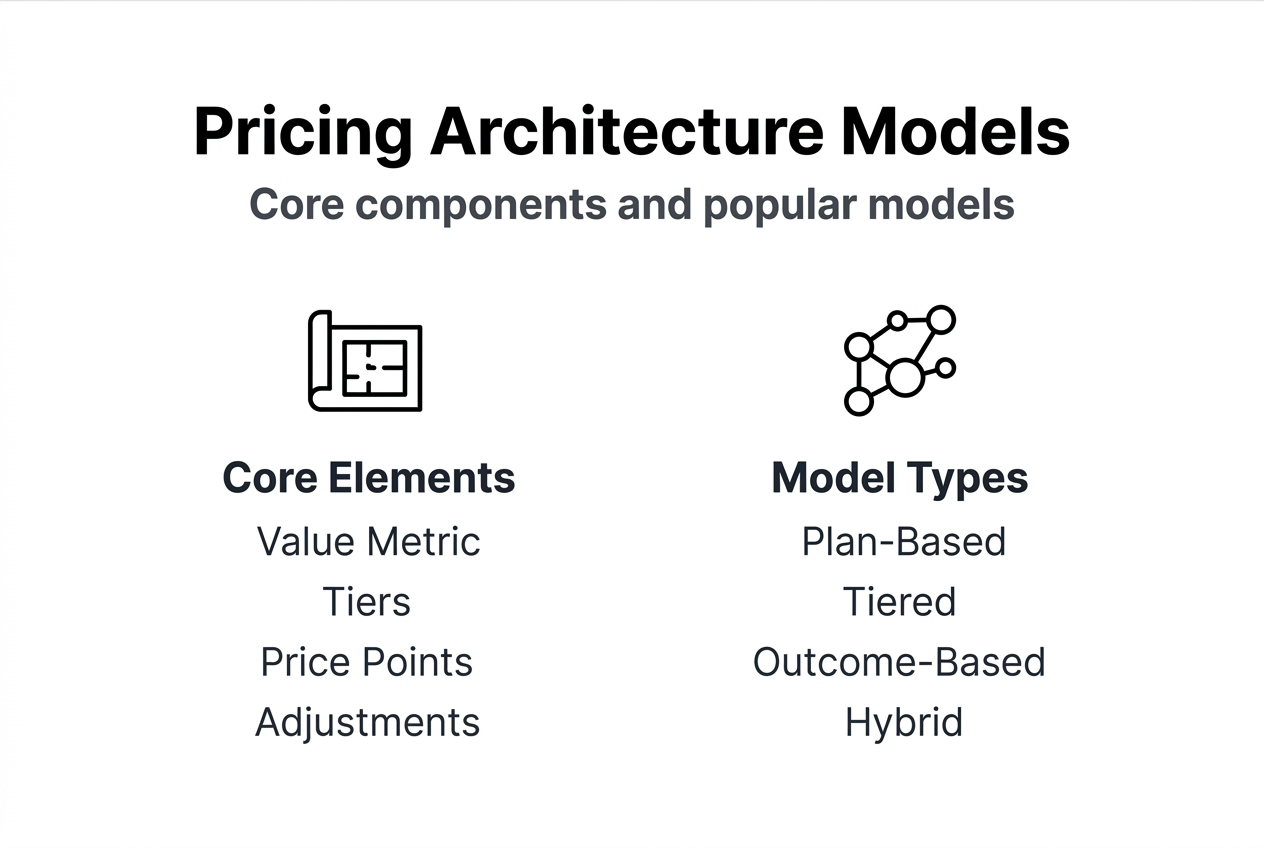
Tiered pricing creates levels based on features, capacity, or support. It enhances clarity, reduces discount pressure, and supports dynamic adjustments as customers grow. However, it requires careful design to prevent tier confusion.
Outcome-based pricing ties fees directly to delivered results. This aligns incentives powerfully but demands robust measurement systems and clear outcome definitions. It works best when results are measurable and attributable.
| Model | Best For | Agility | Operational Complexity |
|---|---|---|---|
| Plan-based | Simple products, stable markets | Low | Low |
| Tiered | Diverse customer segments | High | Medium |
| Outcome-based | Measurable value delivery | High | High |
Most growth-stage companies benefit from tiered or hybrid models. They balance operational feasibility with market responsiveness.
Common misconceptions and pitfalls in pricing strategy
The biggest misconception is treating pricing as a one-time decision rather than an evolving system. Markets shift. Competitors adjust. Customer needs change. Static pricing can’t keep pace.
Many companies cling to plan-based models beyond their useful life. What worked at $500K revenue creates chaos at $5M. The rigidity blocks agility and increases operational errors as complexity grows.
Another pitfall is ignoring cross-functional alignment. When sales, marketing, and finance operate with different pricing assumptions, unauthorized discounts proliferate. Margin leakage follows immediately.
The one-size-fits-all trap is equally dangerous. Believing a single pricing structure serves all customer segments ignores fundamental differences in value perception and willingness to pay. You either leave money on the table with enterprise clients or price out smaller customers.
Finally, companies underestimate governance needs. Without regular reviews and institutionalized pricing processes, even good architectures decay. Teams revert to ad hoc discounting and exception-based pricing.
Pro Tip: Schedule quarterly pricing reviews with cross-functional leadership. Use actual deal data to identify drift from your intended architecture. Course-correct before margin erosion becomes significant.
Frameworks and mental models to build effective pricing architectures
Building robust pricing architecture requires integrating cost floors, competitor benchmarks, and customer value into a unified framework.
Start with cost floors. Every price point must cover variable costs plus contribution to fixed costs. This protects margins and prevents value-destroying deals.
Next, incorporate competitive pricing. You don’t need to match competitors, but you must understand where you sit relative to alternatives. Price significantly above competition only when differentiation is clear and defensible.
Most importantly, anchor to customer-perceived value. What outcomes do customers achieve? What’s their willingness to pay for those results? Value-based pricing captures more margin than cost-plus or competitive approaches.
Dynamic adjustment mechanisms complete the framework. Markets provide continuous feedback through win rates, deal velocity, and customer feedback. Use that data to refine pricing systematically.
Here’s a practical five-step approach:
- Gather comprehensive data on costs, competitor pricing, and customer value metrics across segments
- Define clear customer tiers based on size, needs, and value potential
- Establish price points for each tier with documented floors, targets, and ceilings
- Create adjustment rules for volume, contract length, and strategic accounts
- Implement governance processes for approvals, audits, and regular recalibration
This framework transforms pricing from guesswork into a managed system. It provides structure while maintaining flexibility for market response.
Practical steps to implement and optimize pricing architecture
Implementation starts with documentation. Document all pricing rules, tiers, and logic in a central system accessible to relevant teams. Undocumented pricing exists only in individual heads and dies with turnover.
Define starting, target, and floor prices for every tier. Starting prices anchor negotiations. Target prices represent standard deals. Floor prices protect margins and trigger approval requirements.
Establish governance immediately. Who approves exceptions? How often do you audit actual vs. intended pricing? What triggers architectural reviews? Clear governance prevents drift.
Key implementation practices include:
- Creating pricing playbooks for sales teams with clear tier definitions and qualification criteria
- Building approval workflows for discounts exceeding predefined thresholds
- Tracking pricing metrics like average deal size, discount rates, and margin by tier
- Conducting monthly pricing performance reviews with commercial leadership
- Using CRM data to identify patterns in won, lost, and discounted deals
Cross-functional alignment is non-negotiable. Sales must understand the logic. Marketing must communicate it clearly. Finance must track compliance. Operations must support billing complexity.
Real-world pricing data drives optimization. Track which tiers convert best, where discount pressure concentrates, and which customer segments show pricing sensitivity. Use these insights to refine your architecture quarterly.
For practical examples of pricing implementation, examine how companies structure transparent tier systems that guide customer decisions while protecting margins.
Conclusion: pricing architecture as a strategic revenue foundation
Pricing architecture transforms fragmented, reactive pricing into a controlled, scalable revenue system. It’s not about picking numbers. It’s about building the structural foundation for sustainable growth.
For growth-stage companies, pricing architecture underpins margin protection, forecast accuracy, and competitive positioning. It signals commercial maturity to investors and creates clarity for internal teams.
Structured pricing systems directly impact business outcomes. They increase forecast reliability, reduce operational chaos, and protect profitability as complexity grows.
“The difference between companies that scale profitably and those that grow chaotically often comes down to pricing architecture. One group builds systems. The other reacts to every deal individually. The financial results speak for themselves.”
Prioritizing pricing architecture elevates commercial leadership impact. It shifts focus from firefighting individual deals to designing systems that work at scale. That’s the foundation every growth-stage company needs.
Ready to build your pricing architecture?
If you’re generating revenue but lack pricing clarity, you’re leaving money on the table. Fragmented pricing causes margin leaks, forecast uncertainty, and operational chaos that compounds as you scale.

Brand Mavericks Management specializes in pricing and value architecture for growth-stage companies. We transform reactive pricing into structured revenue systems that protect margins and support predictable growth. Our Revenue Ready engagement designs complete pricing frameworks with documented tiers, guardrails, and governance processes. We build the commercial clarity you need to scale confidently. Whether you need a pricing audit, complete architecture design, or ongoing revenue intelligence, we provide the systems that turn pricing from a pain point into a competitive advantage.
Frequently asked questions
What is the difference between pricing architecture and pricing strategy?
Pricing strategy defines your overall pricing goals and market positioning approach. Pricing architecture is the structured system organizing tiers, prices, and rules that execute that strategy effectively. Strategy sets direction; architecture builds the operational framework delivering results.
How often should a company revisit its pricing architecture?
Review pricing architecture at least quarterly or whenever significant market, product, or competitive changes occur. Regular audits ensure your system stays aligned with market conditions and prevents margin erosion. Annual reviews are too infrequent for dynamic growth-stage markets.
What are the risks of relying solely on plan-based pricing models?
Plan-based pricing is rigid, causing operational bottlenecks and billing errors when adapting to usage-based or hybrid pricing models. It hinders market responsiveness and creates customer confusion in complex scenarios. As your business grows, plan-based models collapse under increased complexity, leading to lost revenue and operational chaos.
How can pricing architecture improve forecast accuracy?
Unified pricing architecture reduces margin variability and eliminates ad hoc discounting, creating consistent pricing signals across deals. This consistency enables more reliable revenue forecasts and better strategic financial planning. When pricing follows documented logic rather than individual negotiations, forecasting becomes data-driven rather than guesswork.
What is a practical first step for a company starting to improve its pricing architecture?
Start by documenting all existing pricing tiers, packages, and price points across customer segments. This baseline audit identifies fragmentation, inconsistencies, and margin variation. Once you see the current state clearly, you can design improved frameworks aligned with customer value and business goals.