
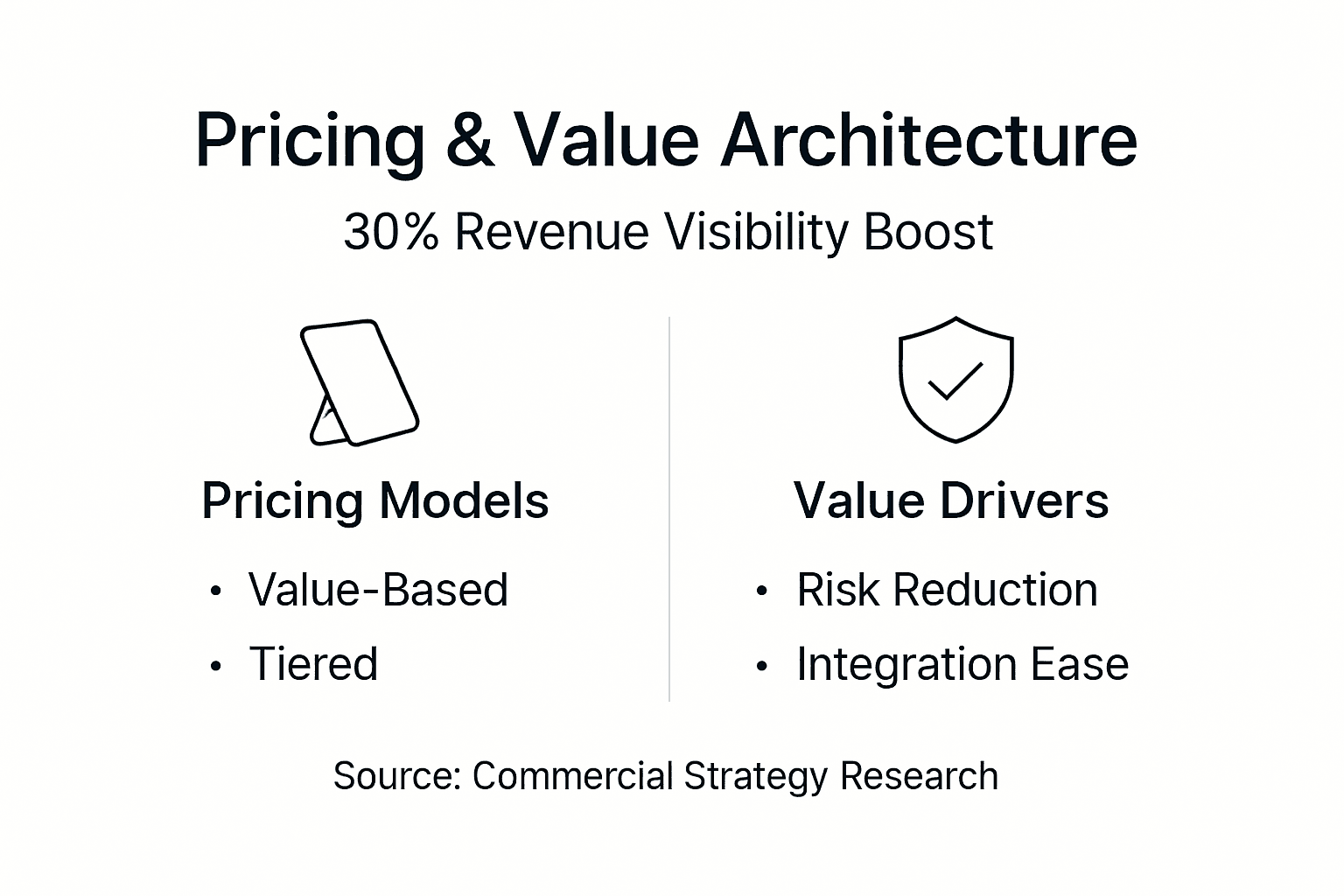
Pricing & Value Architecture: 30% Revenue Visibility Boost
Discover how structured pricing and value architecture delivers 30% better revenue visibility for growth-stage companies. Practical frameworks, metrics, and implementation guidance.

70% of companies report margin leaks due to inconsistent pricing structures, yet most growth-stage businesses continue managing pricing reactively. Revenue unpredictability stems from fragmented pricing and value systems that disconnect customer perception from pricing strategy. This guide explains how structured pricing and value architecture transform revenue visibility, margin control, and growth predictability for founders and commercial leaders.
Table of Contents
- Introduction To Pricing And Value Architecture
- Understanding Value Architecture In Commercial Strategy
- Common Misconceptions And Pitfalls In Pricing Architecture
- Pricing Frameworks And Models For Growth-Stage Companies
- Implementing Structured Pricing And Value Architecture
- Metrics And Kpis To Track Pricing And Value Architecture Effectiveness
- Real-World Case Studies Illustrating Pricing Impact
- Summary And Next Steps For Growth-Stage Companies
- Transform Your Pricing Strategy With Brand Mavericks
- FAQ
Key Takeaways
| Point | Details |
|---|---|
| Structured pricing architecture drives predictable revenue growth | Integrated systems link value perception to pricing, reducing margin leakage by up to 30%. |
| Customer value perception must directly influence pricing | Value-based frameworks outperform cost-plus models in revenue maximization and customer loyalty. |
| Cross-functional governance in pricing boosts revenue and margin | Clear accountability across teams ensures consistent execution and commercial control. |
| Tracking metrics like margin leakage enhances commercial visibility | Board-level dashboards provide actionable insights for continuous pricing optimization. |
Introduction to Pricing and Value Architecture
Pricing and value architecture form interconnected systems that align what customers truly value with your pricing strategy. For growth-stage companies navigating complex commercial ecosystems, this alignment stabilizes revenue streams and protects margins from erosion.
Why does this matter? Without structured pricing, you’re flying blind. Revenue forecasts become guesswork. Margins leak through inconsistent deal structures. Sales teams discount arbitrarily because they lack clear value frameworks.
Companies embedding pricing in integrated revenue management systems show 30% better forecast accuracy. That’s the difference between hoping for growth and engineering it.
Effective pricing and value architecture includes:
- Clear customer segmentation based on value drivers
- Pricing modules mapped to specific value propositions
- Governance frameworks with cross-functional accountability
- Revenue intelligence dashboards tracking margin realization
- Dynamic adjustment mechanisms responding to market feedback
Think of it like building blueprints before constructing a house. You wouldn’t start pouring concrete without architectural plans. Yet many companies price offerings without equivalent rigor or structure.
If you’re looking to understand pricing basics before diving deeper, start there. The foundation matters before adding complexity.
Understanding Value Architecture in Commercial Strategy
Value architecture begins with a fundamental question: what do your customers actually value? Not what you think they should value. What they demonstrate through willingness to pay.
Customer value drivers vary dramatically by segment. Enterprise buyers prioritize risk mitigation and integration ease. Mid-market customers value speed to implementation and support quality. Each segment requires tailored value propositions reflected in pricing.

Consider a SaaS platform offering project management tools. Enterprise clients might pay 5x more than SMBs, not because features differ drastically, but because perceived value differs. Enterprises value compliance certifications, dedicated support, and uptime guarantees. SMBs value quick setup and predictable costs.
Value-based pricing captured this dynamic, resulting in:
- 40% higher average revenue per user (ARPU) versus flat pricing
- 25% improvement in customer retention through better value alignment
- Clearer positioning that attracted higher-value customer segments
Sponsororship businesses face similar dynamics. A title sponsor values brand visibility, hospitality assets, and media reach differently than a supporting partner. Tiered pricing reflecting these value differences maximizes total partnership revenue.
Value architecture isn’t static. Customer priorities shift. Competitors introduce alternatives. Market conditions change. Effective systems include ongoing measurement through surveys, willingness-to-pay studies, and win/loss analysis.
Pro Tip: Map value drivers to specific pricing elements. If enterprise clients value dedicated support, price it explicitly rather than bundling invisibly. Transparency builds trust and justifies premium positioning.
Common Misconceptions and Pitfalls in Pricing Architecture
Most pricing failures stem from treating it as a tactical sales function rather than strategic commercial discipline. Pricing requires input from product, finance, marketing, and customer success. Siloed ownership creates inconsistency and margin erosion.
Common misconceptions include:
-
Benchmarking competitors provides sufficient pricing guidance. Reality: competitor prices reflect their cost structures and value propositions, not yours. Blind benchmarking ignores your unique value.
-
Simple pricing is always better. Reality: simplicity that ignores customer value segmentation leaves money on the table. Strategic complexity aligned to value maximizes revenue.
-
Discounting is necessary to close deals. Reality: excessive discounting signals weak value communication. Structured pricing with clear value justification reduces discount pressure.
-
Pricing can be set once and maintained indefinitely. Reality: dynamic markets require regular pricing review and adjustment based on performance data.
These pitfalls cause margin leakage through:
- Inconsistent discount policies across sales teams
- Misaligned pricing tiers that don’t reflect customer willingness to pay
- Lack of governance allowing ad hoc deal structures
- Missing performance metrics to identify revenue optimization opportunities
Pro Tip: Establish a pricing council with cross-functional representation meeting quarterly. This governance body reviews pricing performance, approves framework changes, and ensures organizational alignment on commercial strategy.
Pricing Frameworks and Models for Growth-Stage Companies
Three primary frameworks dominate commercial pricing strategy, each suited to different business contexts and maturity levels.
Value-based pricing anchors prices to customer perceived value rather than internal costs. This approach maximizes revenue potential by capturing what customers will pay for outcomes. It requires deep customer insight and strong value communication but delivers highest margins when executed well.
Cost-plus pricing adds a margin percentage to production or delivery costs. Simple to implement and ensures cost coverage, but limits upside. Works for commodity products with transparent market pricing but leaves growth-stage companies underpriced relative to value delivered.
Tiered pricing segments offerings by feature sets, usage levels, or service intensity. Common in SaaS and sponsorship businesses, it allows customers to self-select into appropriate value tiers while maximizing revenue across segments.
| Framework | Best For | Advantages | Limitations |
|---|---|---|---|
| Value-based | Differentiated offerings with clear ROI | Maximizes revenue and margins | Requires customer research and strong value messaging |
| Cost-plus | Commodity products or services | Simple, ensures cost recovery | Ignores customer willingness to pay, limits growth |
| Tiered | Diverse customer segments with varying needs | Expands market reach, enables self-service | Complexity in tier design and positioning |
Framework selection depends on your business model and customer complexity. Early-stage ventures often start with simple tiered pricing, evolving to value-based approaches as customer insights deepen.
A sponsorship organization might structure tiers as:
- Title Partner: Maximum visibility, hospitality, and media value
- Premier Partners: Significant brand presence and activation rights
- Supporting Partners: Targeted visibility in specific channels
Each tier reflects different value drivers and willingness to pay, optimizing total sponsorship revenue beyond single flat rate offerings.
Implementing Structured Pricing and Value Architecture
Building effective pricing architecture requires systematic methodology, not guesswork. Start with customer value driver identification through qualitative interviews and quantitative willingness-to-pay studies.
Key implementation steps include:
- Define primary customer segments based on buying behavior and value priorities
- Map value drivers specific to each segment through research and data analysis
- Build pricing modules reflecting value hierarchy rather than arbitrary feature bundling
- Integrate pricing with CRM and revenue intelligence systems for real-time visibility
- Establish governance with clear approval workflows for non-standard deals
- Create dashboard reporting linking pricing decisions to margin and revenue outcomes
Companies embedding pricing in integrated revenue management systems show 30% better forecast accuracy, proving that integration matters as much as strategy.
Common implementation challenges include organizational resistance to pricing discipline and data gaps preventing accurate value quantification. Mitigate resistance through cross-functional workshops demonstrating margin leakage costs. Address data gaps with pilot programs testing pricing hypotheses in controlled customer segments.
Revenue intelligence integration transforms pricing from static to dynamic. Dashboards tracking quote-to-close ratios by price point, discount frequency, and margin realization reveal optimization opportunities invisible in spreadsheets.
If you need to integrate scalable pricing systems with existing technology infrastructure, focus on API connectivity between pricing tools and core revenue systems.
Pro Tip: Build configurability into pricing models from the start. Template-based pricing with defined variables for customization balances consistency with flexibility, enabling sales teams to respond to unique customer needs without destroying margin discipline.
Metrics and KPIs to Track Pricing and Value Architecture Effectiveness
You can’t optimize what you don’t measure. Pricing effectiveness requires specific KPIs providing visibility into revenue realization and margin protection.
Critical metrics include:
- Margin leakage rate: percentage of potential margin lost through discounting and pricing inconsistency
- Pricing realization: actual revenue captured versus list price potential
- Renewal rate by pricing tier: indicator of value alignment and pricing sustainability
- Customer acquisition cost by segment: reveals pricing efficiency across market segments
- Average contract value trends: signals pricing power and value perception shifts
These KPIs surface commercial impact directly. A margin leakage rate exceeding 15% signals governance breakdown or misaligned value communication. Declining renewal rates in specific tiers indicate pricing misalignment with perceived value.
Board-level dashboard reporting transforms these metrics into strategic decision support. Monthly pricing scorecards showing trends, variances from targets, and corrective actions keep commercial leadership aligned.
| Metric | Target | Current | Trend | Action Required |
|---|---|---|---|---|
| Margin Leakage Rate | <10% | 14% | Increasing | Tighten discount approval, reinforce value messaging |
| Pricing Realization | >85% | 79% | Stable | Review competitive positioning, enhance differentiation |
| Renewal Rate (Tier 1) | >90% | 92% | Increasing | Maintain current value delivery |
| Renewal Rate (Tier 2) | >85% | 78% | Decreasing | Investigate value gaps, consider tier restructuring |
Continuous monitoring creates feedback loops enabling rapid pricing optimization. Rather than annual pricing reviews, monthly metric tracking identifies issues early when corrective action has maximum impact.
Real-World Case Studies Illustrating Pricing Impact
Theory matters less than results. Real-world examples demonstrate pricing architecture’s commercial impact across business models.
A B2B SaaS company generating $3M annual recurring revenue faced declining margins despite customer growth. Analysis revealed inconsistent discounting and misaligned pricing tiers. Implementation of value-based pricing with structured governance delivered:
- 35% increase in average contract value through better value segmentation
- Discount frequency reduced from 67% of deals to 31%
- Customer retention improved 22% due to better value-price alignment
- Revenue forecast accuracy increased 28% through integrated pricing intelligence
A sports organization seeking partnership monetization previously offered single sponsorship rate regardless of partner objectives. Tiered architecture reflecting partner value drivers generated:
- Total partnership revenue increased 43% year-over-year
- Partner renewal rate improved from 58% to 81%
- Average partnership value increased 29% through premium tier uptake
- Sales cycle shortened 18% due to clearer value positioning
Both cases illustrate pricing architecture principles in action. Customer value drove tier design. Cross-functional governance ensured consistency. Revenue intelligence revealed optimization opportunities. Results included revenue growth, margin protection, and improved forecast accuracy.
Your business faces similar opportunities. Fragmented pricing systems hide revenue potential. Structured architecture reveals it.
Summary and Next Steps for Growth-Stage Companies
Pricing and value architecture transform revenue from unpredictable to engineered. By aligning what customers value with how you price, you gain commercial control that compounds over time.
Core principles include:
- Customer value perception must drive pricing strategy, not internal costs alone
- Tiered frameworks reflecting value segmentation maximize revenue across customer diversity
- Cross-functional governance ensures consistent execution and protects margins
- Integrated revenue intelligence provides visibility enabling continuous optimization
Practical first steps for implementation:
- Audit current pricing to identify inconsistencies and margin leakage sources
- Conduct customer interviews uncovering true value drivers by segment
- Map existing offerings to value tiers rather than arbitrary feature bundles
- Establish pricing council with representatives from sales, product, finance, and customer success
- Implement dashboard tracking for margin realization, discount frequency, and renewal rates
These actions build foundation for scalable pricing architecture. Start small with pilot segments, validate approaches through data, then expand systematically.
Brand Mavericks specializes in building these commercial systems for growth-stage companies. We turn fragmented pricing into structured revenue engines with measurable performance visibility.
Transform Your Pricing Strategy with Brand Mavericks
If fragmented pricing creates revenue unpredictability in your business, you need structured commercial architecture. Brand Mavericks designs integrated pricing and value systems that give founders and commercial directors the visibility and control growth requires. We build frameworks connecting customer value to pricing strategy, implement governance ensuring consistent execution, and create revenue intelligence dashboards tracking what matters. Ready to transform pricing chaos into predictable growth? Explore how Brand Mavericks pricing services can architect your revenue engine.

FAQ
What is value architecture in pricing?
Value architecture aligns customer perceived value with pricing strategy, structuring offerings by value segments rather than arbitrary features. It enables pricing that reflects what customers truly value, maximizing revenue potential while strengthening value communication.
How can pricing architecture improve revenue visibility?
Integrated pricing tied to value drivers improves forecast accuracy by up to 30% according to research. It reveals margin leakage points through consistent tracking and supports data-driven revenue management with actionable performance metrics.
What are common mistakes to avoid in pricing strategy design?
Treating pricing as purely a sales function limits effectiveness by creating inconsistency. Relying only on competitive benchmarking ignores your unique customer value. Not integrating pricing with commercial systems and governance causes revenue unpredictability and margin erosion.
Which metrics best track pricing effectiveness?
Margin leakage rate, pricing realization, renewal rates by tier, and average contract value trends provide comprehensive pricing performance visibility. Board-level dashboards tracking these KPIs enable continuous optimization and strategic commercial decision-making.