
Step-by-step commercial strategy for growth success
Learn how to build a step-by-step commercial strategy that drives predictable, profitable growth for your business with expert frameworks and actionable systems.

Growth-stage businesses often hit revenue ceilings not because they lack demand, but because they lack a structured commercial strategy. Without clear systems for customer acquisition, pricing, and revenue forecasting, even profitable companies struggle to scale predictably. This guide walks you through a step-by-step commercial strategy framework designed for founders and commercial directors who want to transform fragmented sales efforts into a repeatable revenue engine. You’ll learn how to define your market, execute integrated marketing and sales systems, and monitor the metrics that matter for sustainable, profitable growth.
Table of Contents
- Understanding The Role Of Go-To-Market Strategy In Commercial Success
- Defining Your Target Customer And Crafting A Compelling Value Proposition
- Executing Your Commercial Strategy: Aligning Marketing, Sales, And Revenue Systems
- Monitoring, Verifying, And Optimizing Your Commercial Strategy For Sustained Growth
- Explore Expert Support For Your Commercial Strategy
- Frequently Asked Questions
Key takeaways
| Point | Details |
|---|---|
| GTM strategy integration | Effective go-to-market strategy combines targeting, positioning, sales models, and channels into one cohesive system. |
| Start narrow, then scale | Focus tightly on a specific customer segment and value proposition before expanding to new markets or channels. |
| Revenue systems enable scale | Accurate forecasting and unit economics monitoring are critical to reaching $100M+ revenues without burning resources. |
| Marketing evolves by stage | Marketing strategy must progress through validation, early growth, and scaling stages with distinct goals for each. |
| Monitor contribution margin | Track customer acquisition cost and unit economics alongside top-line revenue to maintain healthy profitability. |
Understanding the role of go-to-market strategy in commercial success
A go-to-market strategy is the comprehensive system that defines how your business acquires customers and generates revenue. It’s not just a marketing plan or sales playbook. GTM strategy determines whether a startup achieves hockey-stick growth or struggles because it integrates every commercial function into a unified approach.
Your GTM strategy includes five core components. First, precise target customer identification based on behavior, budget, and urgency. Second, a differentiated value proposition that clearly communicates why customers should choose you. Third, competitive positioning that establishes your unique market space. Fourth, a sales model that matches your customer’s buying process and your product complexity. Fifth, distribution channels optimized for how your customers prefer to discover and purchase solutions.
Many founders confuse GTM strategy with marketing plans. A marketing plan focuses on channels, campaigns, and messaging tactics. A GTM strategy encompasses the entire revenue engine, including sales process design, pricing architecture, customer success workflows, and revenue forecasting systems. Marketing is one component within the broader GTM framework.
Growth-stage businesses often skip formal GTM planning because they’re already generating revenue. This creates hidden inefficiencies. You might acquire customers through multiple uncoordinated channels, lack clear pricing rationale, or struggle to forecast next quarter’s pipeline. Without a structured GTM approach, you burn resources testing random tactics instead of systematically optimizing proven channels.
The consequence shows up in your unit economics. Customer acquisition costs creep higher while lifetime value stagnates. Sales cycles lengthen because messaging doesn’t align with buyer urgency. Churn increases because customer expectations don’t match product delivery. These symptoms signal the need for GTM clarity.
Pro Tip: Start with one GTM motion before layering others as you scale to maintain focus. Master product-led growth or enterprise sales before attempting both simultaneously, which dilutes execution quality and confuses your market positioning.
Defining your target customer and crafting a compelling value proposition
Precise customer definition separates efficient growth from resource waste. Defining the target customer specifically is essential for effective GTM strategy because it determines every downstream decision from pricing to channel selection. Broad targeting like “small businesses” or “enterprise companies” forces you to build generic solutions that resonate with no one.
Follow this method to profile your ideal customer:
- Identify the specific role or title that experiences the problem you solve most acutely, such as commercial director or revenue operations manager.
- Define the company characteristics where this problem is most urgent, including revenue range, employee count, growth stage, and industry vertical.
- Document the behavioral signals that indicate buying readiness, like recent funding, leadership changes, or regulatory pressures.
- Quantify the budget authority and decision-making process, including who influences, approves, and implements the purchase.
- Validate urgency by understanding the cost of inaction and the timeline pressure driving them to solve now versus later.
Your value proposition must communicate differentiation in 10 seconds or less. Value proposition formula helps differentiate clearly by structuring your message around customer outcomes rather than product features. Use this framework: “We help [specific customer segment] achieve [measurable outcome] by [unique approach] unlike [alternative solutions].”
Test your positioning by asking five people outside your company to repeat back what you do after hearing your pitch once. If they can’t articulate your value clearly, your messaging needs simplification. Clear positioning means a prospect immediately understands whether your solution fits their situation.
Common pitfalls undermine even well-researched customer profiles. Targeting too broadly dilutes your messaging and forces you to compete on price rather than differentiated value. Unclear value propositions that list features instead of outcomes fail to connect with buyer urgency. Copying competitor positioning leaves you undifferentiated in a crowded market.
Pro Tip: Focus your initial customer segment tightly to optimize resource allocation and speed learning. Winning 80% of deals in a narrow niche builds case studies, refines messaging, and creates referral momentum faster than winning 20% across five different segments.
Executing your commercial strategy: aligning marketing, sales, and revenue systems
Execution requires coordinated marketing and sales efforts supported by robust revenue systems. Marketing strategy should evolve through validation, early growth, and scaling stages because the goals and tactics that work at $1M revenue break at $10M revenue. Each stage demands different capabilities.

In the validation stage, your goal is testing whether your value proposition resonates with your target customer. Focus on direct customer conversations, small-scale campaigns, and rapid iteration based on feedback. Measure message clarity and conversion quality, not volume. In early growth, build repeatable channels that consistently deliver qualified leads. Invest in content marketing, search optimization, and referral programs that compound over time. Track cost per acquisition and lead-to-customer conversion rates.
Scaling stage marketing shifts to predictable pipeline generation across multiple channels. Layer paid acquisition, partnerships, and account-based marketing while maintaining efficiency. Your marketing operations must support complex attribution, campaign orchestration, and performance analytics. This is where many companies stumble because they scale tactics without building the underlying systems.
Sales alignment prevents the common trap where marketing generates leads that sales can’t close profitably. Define clear handoff criteria between marketing qualified leads and sales accepted leads. Establish service level agreements for follow-up speed and nurture processes. Align compensation so both teams optimize for customer lifetime value, not just deal closure.
Revenue systems become critical as complexity increases. Companies approaching $50M to $100M see rising CAC and churn impacting growth because manual processes and spreadsheet forecasting break under scale. You need engineered systems for pipeline management, renewal tracking, and revenue recognition.
| Metric | Typical Range | Impact on Profitability | | — | — | | | Customer Acquisition Cost (CAC) | $500 to $50,000+ | High CAC relative to LTV erodes margins and limits growth capital | | Annual Contract Value (ACV) | $5,000 to $100,000+ | Higher ACV supports complex sales but requires longer cycles | | Monthly Churn Rate | 2% to 7% | Each percentage point of churn compounds to massive revenue loss | | CAC Payback Period | 6 to 18 months | Longer payback strains cash flow and slows expansion |
Monitor these critical components regularly:
- Pipeline coverage ratio showing how much qualified pipeline exists relative to quarterly targets
- Win rate by segment, channel, and deal size to identify where execution is strongest
- Sales cycle length trends indicating whether deals are accelerating or stalling
- Revenue forecasting accuracy comparing projected to actual closed revenue
- Contribution margin by customer segment revealing which accounts drive profitability
Monitoring, verifying, and optimizing your commercial strategy for sustained growth
Ongoing verification prevents the slow drift toward inefficiency that kills growth momentum. Inconsistent forecasting and unit economics scrutiny cause failures near $100M revenue because leadership loses visibility into what’s actually driving results versus what they hope is working. Accurate forecasting allocates resources effectively and maintains investor confidence.
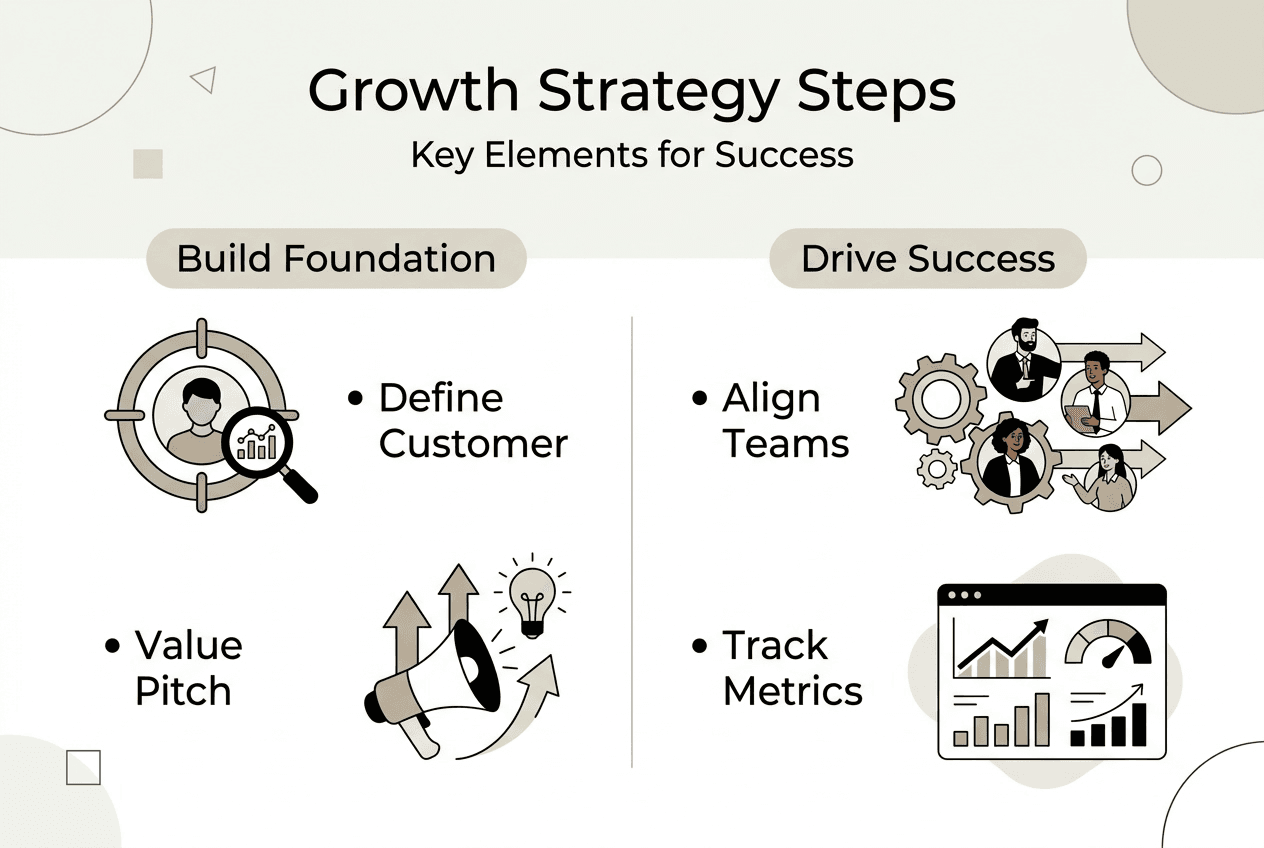
Monitor unit economics as rigorously as top-line revenue. Contribution margin health reveals whether growth is profitable or merely burning capital. Calculate true customer acquisition cost including all marketing spend, sales salaries, tools, and overhead allocated to acquisition. Compare this to lifetime value calculated conservatively with actual retention data, not optimistic projections.
Diagnose common pitfalls systematically:
- Rising CAC signals channel saturation, weakening positioning, or targeting drift; audit your customer profile accuracy and competitive differentiation.
- Increasing churn indicates product-market fit erosion, poor onboarding, or misaligned customer expectations; interview churned customers to identify root causes.
- Lengthening sales cycles suggest unclear value proposition, weak urgency, or misaligned sales process; map actual buyer journey against your assumed process.
- Declining win rates point to competitive pressure, pricing misalignment, or sales execution gaps; analyze lost deals for patterns.
- Forecast inaccuracy reveals poor pipeline hygiene, optimistic stage progression, or inadequate qualification; tighten stage definitions and exit criteria.
| Common Mistake | Best Practice |
|---|---|
| Scaling channels before validating message-market fit | Test positioning with small campaigns before increasing spend |
| Ignoring contribution margin while chasing revenue growth | Monitor unit economics monthly and adjust pricing or targeting |
| Layering new GTM motions before mastering existing ones | Perfect one channel to predictability before adding complexity |
| Forecasting based on hope rather than historical conversion data | Use trailing 90-day conversion rates and stage velocity for projections |
| Treating all customers equally regardless of profitability | Segment by contribution margin and focus resources on best-fit accounts |
Iterative testing and adaptation based on data feedback separates sustainable growth from lucky streaks. Run controlled experiments on messaging, pricing, and channel tactics. Measure results against clear hypotheses. Scale what works and kill what doesn’t, even if you’re personally attached to the idea.
Pro Tip: Establish a regular strategy review cadence with cross-functional teams to catch issues early. Monthly commercial reviews with marketing, sales, finance, and product leaders surface disconnects before they compound into major problems.
Explore expert support for your commercial strategy
Building a structured commercial strategy from scratch takes time many growth-stage businesses don’t have. You’re already running operations, managing teams, and serving customers. Designing revenue systems, forecasting models, and integrated GTM frameworks requires specialized expertise.
Brand Mavericks specializes in commercial strategy and revenue architecture for businesses generating revenue but lacking structured systems. We design complete revenue ecosystems including offerings architecture, pricing models, forecasting frameworks, and performance intelligence. Our commercial strategy consulting services transform fragmented sales efforts into predictable revenue engines with board-level visibility. Whether you need revenue design, financial modeling, or embedded commercial leadership, we provide the clarity and control that replaces guesswork with measurable systems. Contact us to build a commercial strategy tailored to your growth stage and market position.
Frequently asked questions
What is a step-by-step commercial strategy?
A step-by-step commercial strategy is a sequential plan that guides how your business acquires customers, generates revenue, and scales profitably. It starts with precise customer definition and value proposition clarity, then builds integrated marketing and sales systems supported by revenue forecasting and performance monitoring. Unlike ad hoc tactics, a structured commercial strategy connects every revenue activity to measurable outcomes.
How does a commercial strategy differ from a marketing plan?
A marketing plan focuses on channels, campaigns, and messaging tactics to generate awareness and leads. A commercial strategy encompasses the entire revenue engine including sales process design, pricing architecture, customer success workflows, revenue forecasting, and unit economics monitoring. Marketing is one component within the broader commercial strategy framework that integrates all revenue-generating functions.
What metrics should I monitor to ensure my commercial strategy is working?
Monitor customer acquisition cost, lifetime value, contribution margin, pipeline coverage ratio, win rate by segment, sales cycle length, churn rate, and forecasting accuracy. These metrics reveal whether your strategy drives profitable, predictable growth or masks underlying inefficiencies. Track unit economics as rigorously as top-line revenue to ensure growth doesn’t erode profitability.
How do I avoid common pitfalls when scaling my commercial strategy?
Avoid scaling channels before validating message-market fit, ignoring contribution margin while chasing revenue, layering new GTM motions before mastering existing ones, forecasting based on hope rather than data, and treating all customers equally regardless of profitability. Establish regular cross-functional strategy reviews to catch issues early. Test positioning with small campaigns, monitor unit economics monthly, perfect one channel before adding complexity, use historical conversion rates for projections, and segment customers by contribution margin.
When should I seek expert help with my commercial strategy?
Seek expert help when you’re generating revenue but lack structured systems, struggle with forecasting accuracy, see rising customer acquisition costs or churn, need investor-ready financial models, or want board-level commercial visibility without building a full in-house team. Specialized consultants accelerate strategy development and implementation, bringing proven frameworks and avoiding costly trial-and-error learning.