
Achieve Structured Revenue Growth With Clear Commercial Systems
Learn how to drive structured revenue growth by designing, executing, and optimizing a commercial operating system. Follow actionable steps for lasting results.

When you manage a growing sports organization, chaos often shows up as scattered revenue streams and unpredictable results. Many founders and commercial directors realize they lack a clear system for tracking what truly drives profitability. By focusing on a structured commercial operating system and mapping every current revenue channel, you can move from reactive decisions to measurable, repeatable growth. This guide offers practical steps trusted by organizations worldwide to bring calm, clarity, and sustainable profit to your commercial operations.
Table of Contents
- Step 1: Assess Current Revenue Streams and Gaps
- Step 2: Design a Structured Commercial Operating System
- Step 3: Implement Revenue Growth Strategies and Execution Plans
- Step 4: Monitor Performance and Optimize for Profitability
Quick Summary
| Key Insight | Explanation |
|---|---|
| 1. Analyze Revenue Sources | List all current revenue streams and assess their performance over the past year. Uncover gaps for growth opportunities. |
| 2. Build a Commercial Framework | Create a structured operating system to manage revenue processes and ensure consistency in execution. |
| 3. Implement Specific Growth Plans | Define actionable steps for growth initiatives, including target definitions and resource allocation for accountability. |
| 4. Monitor Key Profitability Metrics | Regularly track essential performance metrics to identify profitability and growth areas while making data-driven decisions. |
| 5. Optimize Resources Aggressively | Conduct monthly reviews to adjust budgets and eliminate ineffective initiatives based on performance data. |
Step 1: Assess Current Revenue Streams and Gaps
You’re probably juggling multiple revenue sources right now. Maybe sponsorships, ticket sales, memberships, broadcasting rights, merchandise, or partnerships. But here’s what most sports organization founders miss: they’ve never sat down to see what’s actually working and what’s leaving money on the table.
This step is straightforward. You’ll map every revenue source your organization currently generates, understand how much each contributes, and identify where gaps exist. This clarity becomes your foundation for everything that follows.
Start by listing every single revenue stream your organization has today. Don’t filter or judge yet. Write them down:
- Ticket and attendance revenue
- Sponsorship and partnership agreements
- Broadcast and media rights
- Membership or subscription programs
- Merchandise and retail sales
- Hospitality and VIP experiences
- Licensing and IP monetization
- Grants or government funding
- Donations and community support
Once your list is complete, pull the actual numbers. How much revenue did each stream generate in the last 12 months? What’s the trend? Is sponsorship growing or stagnant? Are memberships expanding or declining?
Assess performance honestly. A revenue stream that feels important might actually be your smallest earner and require the most effort.
Now comes the harder part. Look at institutional revenue diversification frameworks to understand where you might have gaps. Most sports organizations rely too heavily on one or two sources. If 70 percent of your revenue comes from sponsorships, you’re vulnerable. When a sponsor exits or reduces investment, your entire operation shakes.
Identify underperforming areas. What’s the addressable market you’re not touching? Which revenue sources exist in comparable organizations but not yours? These gaps represent your biggest growth opportunities.

Document your findings in a simple table: revenue stream, 2023 actual, 2024 actual, growth rate, and whether it’s stable, declining, or growing. This becomes your reference point.
Here’s a side-by-side comparison of typical sports organization revenue streams and key risk factors affecting their stability:
| Revenue Stream | Risk Factor | Suggested Improvement |
|---|---|---|
| Sponsorships | Loss of key sponsor | Diversify sponsor mix |
| Ticket Sales | Attendance variability | Enhance fan experience |
| Merchandise Sales | Seasonal fluctuations | Expand product range |
| Broadcast Rights | Contract dependencies | Explore new platforms |
| Memberships | Member churn | Target retention efforts |
| Hospitality/VIP | Economic downturns | Offer flexible packages |
| Licensing/IP | Rights enforcement | Invest in brand protection |
| Grants/Funding | Policy changes | Pursue varied grants |
| Donations | Donor fatigue | Launch donor engagement |
Pro tip: Compare your revenue mix against 2-3 similar organizations in your sport. You’ll quickly spot which streams you’re missing and which ones are undermonetized relative to your peers.
Step 2: Design a Structured Commercial Operating System
You’ve mapped your revenue streams and identified the gaps. Now comes the critical part: building the actual system that makes revenue predictable and scalable.
A structured commercial operating system isn’t fancy software or complicated processes. It’s the repeatable framework that controls how deals move from prospect to client, how you track performance, and how you optimize margins. Without it, you’re reacting to problems instead of preventing them.
Start by defining your core commercial processes. These are the backbone:
- Pipeline management: How prospects move from awareness to signed contract
- Deal structuring: What you’re selling, at what price, with what terms
- Client management: How you deliver, renew, and grow accounts
- Performance tracking: How you measure what’s working and what’s not
- Revenue forecasting: How you predict cash and revenue three to twelve months out
Each process needs clear ownership, defined steps, and measurable outputs. When you implement structured operating system design principles, you create repeatability. Your team stops inventing new approaches for every deal and starts executing a proven playbook.
Next, define your commercial roles and responsibilities. Who owns the pipeline? Who approves discounts? Who manages renewals? Ambiguity kills commercial systems. Clarity accelerates them.
Document your sales process in writing. How many stages? What happens at each stage? What’s the criteria for moving a prospect forward? This doesn’t need to be perfect. It needs to exist and be followed.
A documented process beats a perfect process that lives only in someone’s head.
Now build your performance dashboard. What metrics matter most? Revenue by stream. Pipeline health. Average deal size. Win rates. Margin by customer. Pick five to seven metrics that reflect your business reality and track them weekly.
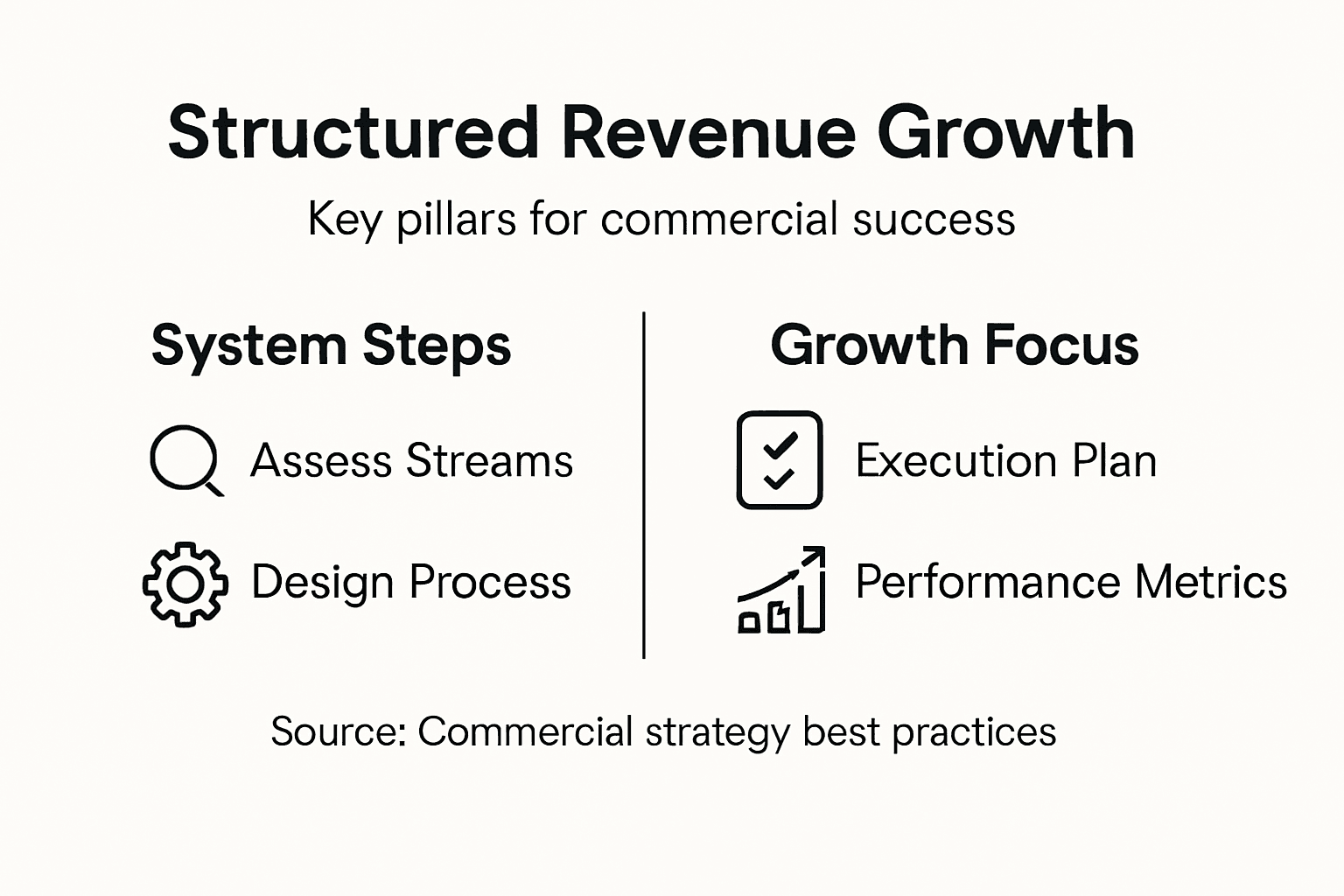
To assist with structured execution, here’s an overview of core commercial processes and their business impact:
| Commercial Process | Description | Business Impact |
|---|---|---|
| Pipeline Management | Moves prospects to signed contracts | Increases deal conversion rate |
| Deal Structuring | Sets pricing and terms for offerings | Maximizes revenue per deal |
| Client Management | Renews and grows existing accounts | Boosts retention and upsells |
| Performance Tracking | Monitors metrics and outcomes | Reveals strengths and gaps |
| Forecasting | Predicts future cash and revenue flow | Improves financial planning |
Finally, establish your rhythm of execution. Weekly pipeline reviews. Monthly performance reviews. Quarterly strategy adjustments. When your team knows the rhythm, commercial discipline becomes automatic.
Pro tip: Start with one core process that’s currently causing the most chaos—usually pipeline management—and systematize it completely before moving to the next one.
Step 3: Implement Revenue Growth Strategies and Execution Plans
You have clarity on your revenue streams and a structured operating system. Now you need to turn strategy into actual results. This is where most organizations stumble. The gap between strategy and execution kills revenue growth.
Start by translating your growth strategy into specific, measurable execution plans. Don’t say “grow sponsorship revenue.” Say “secure three new title sponsors at $250,000 each by Q3” or “increase merchandise per-fan revenue from $8 to $12 by implementing category-specific retail strategy.”
Build your execution plan around these core elements:
- Target definitions: Which customers, markets, or revenue streams are you prioritizing?
- Resource allocation: Who owns each initiative? What budget and timeline?
- Key milestones: What needs to happen in weeks 1-4, 5-8, 9-12?
- Success metrics: How will you know it’s working?
- Risk mitigation: What could go wrong? How do you respond?
Research shows that detailed execution frameworks aligned with organizational activities dramatically increase the odds of successful strategy implementation. Strategy documents sit on shelves. Execution plans drive behavior.
Assign clear ownership for each initiative. Not “the team” or “we.” Name the person responsible. This eliminates confusion and creates accountability. When someone owns it, it gets done.
Create a weekly execution rhythm. Every Monday, your commercial team reviews progress on this week’s milestones. Did we hit our activity targets? What’s blocking momentum? What adjustments do we need? This keeps execution from drifting.
Communicate progress visually. A simple dashboard showing which initiatives are on track, at risk, or off track keeps everyone aligned. When your team sees the same metrics you see, they make better decisions.
Execution plans fail in silence. Visible progress creates accountability and momentum.
Expect to adjust your plan every month. Markets shift. Deals close faster than expected. New competitors emerge. Your execution plan is a living document, not a contract. Adapt quickly, but never abandon your core priorities.
Pro tip: Launch your first growth initiative with just one small team over 90 days before scaling. This teaches you what works before you commit significant resources and builds confidence across the organization.
Step 4: Monitor Performance and Optimize for Profitability
You’ve built your system and launched your growth initiatives. But growth without profitability is just spending money faster. This step is about tracking what matters and making ruthless decisions about where your resources actually belong.
Start by defining your core profitability metrics. These aren’t vanity numbers. They’re the measurements that tell you if your business is actually working. Track these weekly:
- Gross margin by revenue stream
- Customer acquisition cost versus lifetime value
- Renewal rates and churn by segment
- Operating expense as a percentage of revenue
- Profit per customer or per contract
Research on aligning key performance indicators with strategic goals shows that organizations using systematic performance monitoring improve profitability faster than those relying on intuition. The data reveals what’s actually happening versus what you think is happening.
Build a weekly performance dashboard that everyone sees. Revenue this week versus forecast. Margin trends. Which initiatives are hitting their targets? Which are underperforming? Transparency creates accountability.
Now comes the hard part: acting on the data. If sponsorship deals have 15 percent margins but merchandise has 45 percent margins, where should you invest? If a customer segment is perpetually unprofitable, do you improve the offering or exit the segment?
Conduct monthly margin audits. Pull five random contracts from each revenue stream. Calculate the true cost to serve: sales time, delivery resources, support overhead. Many organizations discover they’re losing money on customers they thought were profitable.
What you measure is what you’ll improve. What you ignore will drag you down.
Set up a monthly optimization review. Which initiatives are delivering ROI? Which are consuming resources without return? Reallocate budget aggressively toward what works. Kill what doesn’t. Most organizations are too patient with failing initiatives.
Track leading indicators, not just results. Pipeline velocity matters more than final revenue because it predicts future results. Win rates matter because they signal market fit. Use leading indicators to adjust course before results disappoint.
Pro tip: Create a simple monthly report showing the three biggest margin leaks in your business and assign owner names to fix them by the following month, no excuses.
Build Predictable Revenue Growth with Structured Commercial Systems
If your sports organization or growth-stage business is struggling with fragmented sales efforts and unpredictable revenue streams the solution lies in designing a clear commercial operating system. The article reveals how assessing current revenue, structuring core commercial processes, and executing focused growth plans all play vital roles in transforming chaos into clarity and control. Pain points like overreliance on a few revenue sources, lack of pipeline visibility, and difficulty measuring profitability are holding your growth back.
At Brand Mavericks Management we specialize in helping founders and commercial directors like you turn complexity into confidence. Our Revenue Ready and Growth Engine engagements provide outcome-driven commercial strategy design financial architecture and performance management needed to embed repeatable revenue frameworks. Stop guessing and start controlling your revenue engine today.
Ready to break free from uncertainty and build a reliable revenue ecosystem Visit our services page now to discover how Brand Mavericks Management can help you implement structured commercial systems that generate clear margin visibility scalable growth and lasting commercial discipline. Take the first step toward commercial clarity and business growth today.
Frequently Asked Questions
How do I assess my current revenue streams for structured growth?
Start by listing every revenue source your organization has, including ticket sales, sponsorships, and merchandise. Then, analyze how much each stream has generated in the past 12 months to identify gaps and growth opportunities.
What steps should I take to design an effective commercial operating system?
Define your core commercial processes, such as pipeline management and performance tracking, and establish clear ownership and measurable outputs for each. Document your processes and ensure your team follows them consistently to drive repeatability and efficiency.
How can I create actionable execution plans for revenue growth?
Translate your growth strategies into specific, measurable activities like “secure three new sponsors by Q3.” Allocate resources, set key milestones, and regularly review progress to adapt quickly based on what works.
What metrics should I track to monitor performance and profitability?
Focus on core profitability metrics, including gross margin by revenue stream and customer acquisition cost versus lifetime value. Create a weekly performance dashboard to visualize trends and make informed decisions on resource allocation.
How often should I conduct margin audits to optimize revenue?
Conduct margin audits monthly to identify and address any profitability issues. Pull random contracts from each revenue stream to calculate the true cost to serve and discover hidden margin leaks that need fixing.
What is the best way to ensure my team stays accountable for growth initiatives?
Establish a weekly execution rhythm where your commercial team reviews progress on key initiatives. Use visual dashboards to communicate progress transparently, ensuring everyone is aligned and motivated to meet their goals.