
Types of commercial strategies for growth in 2026
Discover four proven types of commercial strategies with real examples from Coca-Cola, Apple, Tesla, and McDonald's to guide your growth decisions in 2026.

Selecting the right commercial strategy can feel overwhelming when you’re navigating market shifts and competitive pressures. Growth-stage businesses often struggle to identify which approach will deliver predictable revenue without wasting resources on misaligned tactics. This article breaks down four proven types of commercial strategies, complete with real-world examples from Coca-Cola, Apple, Tesla, and McDonald’s, to help you make confident strategic decisions in 2026.
Table of Contents
- Evaluating Criteria For Selecting Commercial Strategies
- Market Penetration: Deepening Presence In Current Markets
- Product Development: Innovating Within Existing Markets
- Market Development: Expanding Into New Markets With Existing Products
- Diversification: Pursuing New Products And Markets For Growth
- Explore Expert Commercial Strategy Guidance
- Types Of Commercial Strategies: Frequently Asked Questions
Key takeaways
| Point | Details |
|---|---|
| Four core commercial strategies | Market penetration, product development, market development, and diversification based on the Ansoff Matrix framework. |
| Market penetration focuses on existing markets | Coca-Cola exemplifies increasing share through targeted campaigns and distribution expansion. |
| Product development expands offerings | Apple drives growth by innovating new devices for their current customer base. |
| Market development enters new territories | Tesla demonstrates expanding into new countries with existing electric vehicle products. |
| Diversification pursues new products and markets | McDonald’s continuously innovates menu items tailored to different regional preferences. |
Evaluating criteria for selecting commercial strategies
Choosing the right commercial strategy requires analyzing multiple factors beyond gut instinct. Market conditions shape which approach will generate sustainable returns. If you’re operating in a saturated market, penetration tactics face steeper resistance than exploring untapped customer segments.
Your company’s resources directly impact strategic feasibility. Product development demands robust R&D capabilities and financial reserves to sustain innovation cycles. Market development requires capital for geographic expansion, local partnerships, and regulatory navigation. Diversification carries the highest resource burden, requiring investment in both new product creation and market entry simultaneously.
Risk tolerance varies dramatically across organizations. Conservative businesses prioritize market penetration strategies that leverage existing assets and customer relationships. Growth-oriented companies accept higher risk by pursuing diversification opportunities that open entirely new revenue streams.
Competitive dynamics influence strategy selection significantly. When competitors dominate your current market, product innovation or geographic expansion often yields better returns than fighting for existing share. Performance management systems provide the margin visibility and pipeline intelligence needed to evaluate which strategy aligns with your profitability goals.
The Ansoff Matrix framework streamlines decision-making by mapping strategies against two variables: market familiarity and product familiarity. This structured approach prevents strategic drift and ensures alignment between growth ambitions and operational capabilities.
Pro Tip: Revisit your strategy selection criteria quarterly as market conditions evolve. What worked in Q1 may require adjustment by Q3 based on competitive moves, customer behavior shifts, or margin performance data.
Key evaluation factors include:
- Current market saturation levels and competitive intensity
- Available financial resources and operational capabilities
- Organizational risk appetite and stakeholder expectations
- Long-term business goals and target market positioning
- Adaptability requirements for anticipated market shifts
Market penetration: deepening presence in current markets
Market penetration grows revenue by increasing market share in existing markets with your current product lineup. You’re targeting customers already buying similar solutions, either from you or competitors. This strategy minimizes risk by operating within familiar territory where you understand customer needs, distribution channels, and competitive dynamics.
Coca-Cola exemplifies effective market penetration through relentless brand-building and distribution optimization. They don’t create radically new beverages for untapped markets. Instead, they execute targeted promotional campaigns, competitive pricing adjustments, and loyalty programs that convert Pepsi drinkers or increase consumption frequency among existing fans.
Tactical approaches for market penetration include:
- Aggressive promotional campaigns and seasonal discounts
- Competitive pricing strategies to undercut rivals
- Brand loyalty programs rewarding repeat purchases
- Intensified advertising across multiple channels
- Distribution expansion to increase product availability
The benefits center on leveraging existing organizational capabilities. Your team already understands the product, the market dynamics, and the customer psychology. You’re not learning new manufacturing processes or navigating unfamiliar regulatory environments. This familiarity accelerates execution and delivers faster short-term revenue gains compared to venturing into unknown territory.
Market penetration offers the lowest risk profile among growth strategies because you’re maximizing returns from proven products in understood markets.
Challenges emerge when markets approach saturation. Every percentage point of additional share requires increasing investment as you compete for the same finite customer pool. Competitors respond aggressively to defend their positions, potentially triggering price wars that erode margins across the industry. Performance metrics become critical to identify when penetration efforts yield diminishing returns, signaling the need to explore alternative growth strategies.
Product development: innovating within existing markets
Product development expands growth by creating new or improved offerings for your current customer base. You’re expanding the existing product line rather than chasing new market segments. This strategy assumes deep customer understanding and the capability to identify unmet needs within your established audience.

Apple demonstrates product development mastery through continuous innovation within their ecosystem. They launched iPhone, then iPad, then Apple Watch, each targeting the same core customer base with complementary devices. They didn’t pivot to enterprise software or financial services initially. They deepened relationships with existing customers by solving additional problems through new hardware and integrated services.
The advantages include meeting evolving customer expectations before competitors can respond. Existing customers already trust your brand, reducing adoption friction for new product launches. You’re reinforcing market position by becoming the comprehensive solution provider rather than a single-product vendor vulnerable to disruption.
Product development requires substantial R&D investment and organizational commitment to innovation culture. Failed product launches waste resources and potentially damage brand reputation if quality doesn’t meet customer expectations. Strong market feedback loops become essential to validate concepts before full-scale development and launch.
Successful execution demands:
- Robust customer feedback mechanisms to identify unmet needs
- R&D capabilities to translate insights into viable products
- Financial reserves to sustain development cycles and market testing
- Organizational agility to iterate based on early adoption data
- Clear brand growth strategy connecting new products to existing market position
Pro Tip: Align product innovation directly with structured customer feedback programs rather than executive assumptions. Regular customer advisory boards and usage analytics reveal genuine needs versus nice-to-have features that won’t drive adoption.
Market development: expanding into new markets with existing products
Market development pursues growth by entering new markets with current products through geographic expansion or targeting different customer segments. You’re leveraging proven offerings while navigating unfamiliar market dynamics, cultural preferences, and competitive landscapes.
Tesla exemplifies market development by systematically entering new countries with their existing electric vehicle lineup. They didn’t redesign the Model 3 fundamentally for each market. Instead, they adapted go-to-market strategies, built charging infrastructure, and navigated local regulations to make their proven products accessible to new customer populations.
The benefits include leveraging product-market fit you’ve already validated. You’re not gambling on unproven offerings. You know the product works, you understand manufacturing and delivery, and you’ve refined the value proposition. The challenge shifts to understanding new customer behaviors, distribution requirements, and competitive positioning in unfamiliar contexts.
Risks center on misreading market dynamics in new territories. Customer preferences vary significantly across geographies and demographic segments. Regulatory requirements can derail launches if not thoroughly researched upfront. Cultural adaptation determines whether your messaging resonates or falls flat with new audiences.
Strategic considerations for market development:
- Geographic expansion into regions with lower competitive intensity
- Demographic targeting of customer segments not currently served
- Channel partnerships with marketing management companies offering local expertise
- Regulatory research and compliance planning before market entry
- Pricing adjustments reflecting local purchasing power and competitive benchmarks
Partnerships accelerate market development by providing local knowledge, established distribution networks, and credibility with new customer bases. Going alone requires building these capabilities from scratch, extending timelines and increasing capital requirements substantially.
Diversification: pursuing new products and markets for growth
Diversification represents the highest-risk growth strategy by simultaneously developing new products for new markets. You’re operating outside your proven capabilities on both dimensions, requiring significant research, investment, and organizational learning. The potential rewards include entirely new revenue streams insulated from your core market’s cyclical pressures.
McDonald’s demonstrates successful diversification through continuous menu innovation tailored to regional tastes. They didn’t just expand existing burger offerings globally. They created entirely new products like the McAloo Tikki for India, addressing vegetarian preferences in a market culturally distant from their American fast-food origins.
The advantages include risk diversification across multiple markets and product categories. Economic downturns or competitive disruptions in one area don’t sink the entire organization. You’re building innovation culture and organizational capabilities that compound over time, making subsequent diversification efforts less risky.
The downsides involve extensive market research requirements, high capital investment, and potential brand dilution if new offerings feel disconnected from core identity. Execution complexity increases exponentially when managing unfamiliar products and markets simultaneously. Performance management becomes critical to identify underperforming initiatives before they consume excessive resources.
Comparing strategy profiles clarifies decision-making:
| Strategy | Risk Level | Investment Required | Speed to Revenue | Market Knowledge Needed |
|---|---|---|---|---|
| Market Penetration | Low | Moderate | Fast | High existing knowledge |
| Product Development | Medium | High | Moderate | High existing knowledge |
| Market Development | Medium | High | Moderate | Low, requires research |
| Diversification | High | Very High | Slow | Low, extensive research |
Key diversification considerations:
- Alignment between new offerings and overall brand architecture
- Organizational capacity to manage multiple simultaneous learning curves
- Financial reserves to sustain extended development and market entry timelines
- Performance tracking systems to evaluate ROI across diverse initiatives
- Exit criteria to cut underperforming diversification bets before they drain resources
Explore expert commercial strategy guidance
Choosing and executing the right commercial strategy requires structured frameworks and ongoing performance intelligence. Brand Mavericks Management specializes in commercial strategy services that help growth-stage businesses design revenue architectures aligned with their market position and capabilities.
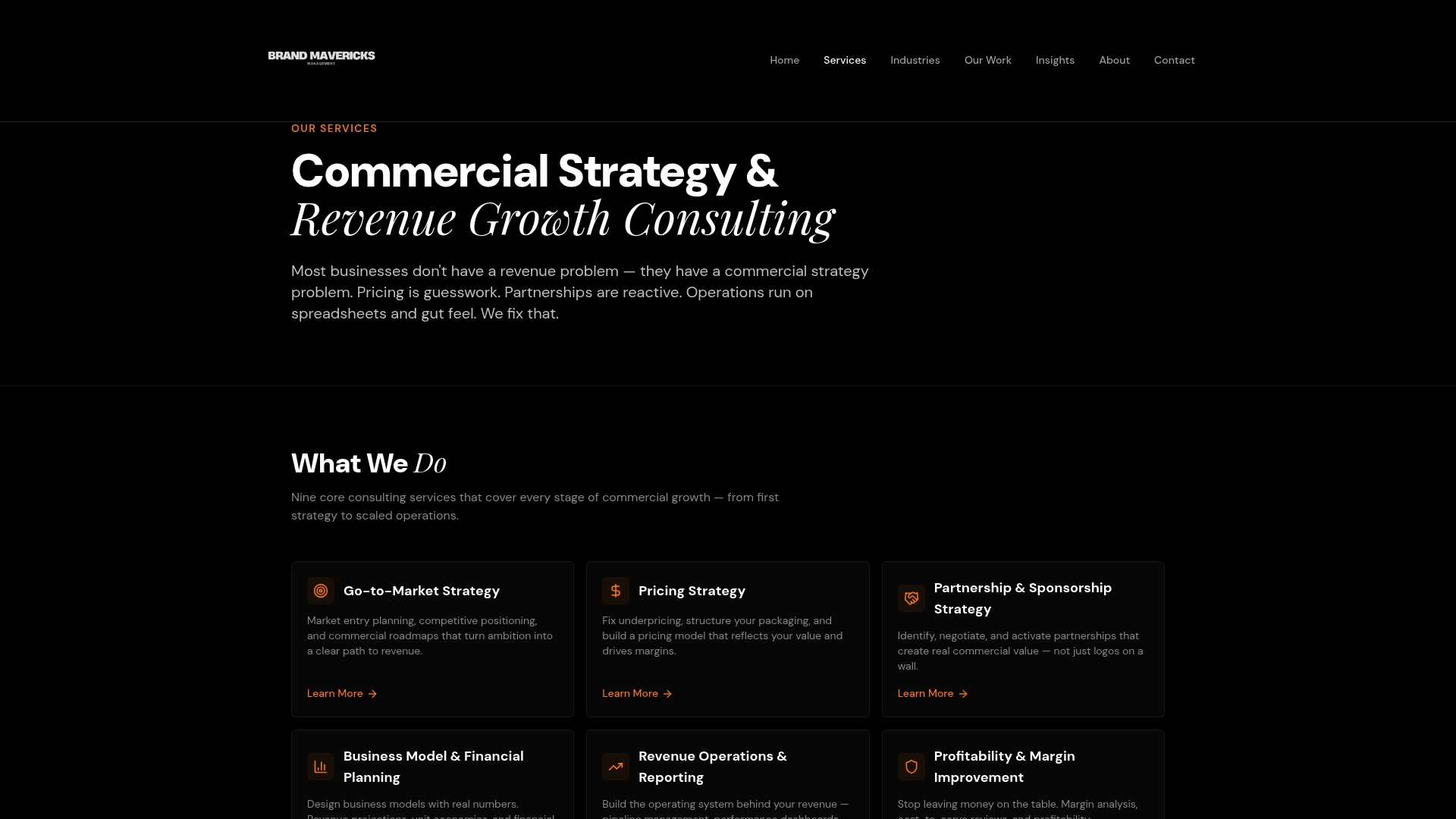
Our Revenue Design and Commercial Strategy engagements build clear commercialization blueprints that connect strategy selection to executable tactics. We provide the performance management systems that track margin health, pipeline quality, and strategic initiative ROI, giving you the visibility to optimize or pivot based on real data rather than assumptions.
Pro Tip: Professional strategy consulting uncovers overlooked growth opportunities by bringing external perspective and structured frameworks to challenge internal assumptions about market potential and competitive positioning.
Types of commercial strategies: frequently asked questions
What is the safest commercial strategy for growth?
Market penetration carries the lowest risk because you’re operating with existing products in familiar markets where you understand customer behavior and competitive dynamics. You’re maximizing returns from proven capabilities rather than venturing into unknown territory.
How often should businesses reassess their commercial strategy?
Reassess quarterly based on performance metrics, competitive moves, and market condition changes. Annual strategy reviews are insufficient in dynamic markets where customer preferences and competitive landscapes shift rapidly. Structured performance management enables data-driven strategy adjustments.
Can a company pursue multiple commercial strategies simultaneously?
Yes, but resource allocation and performance tracking become critical to prevent strategic dilution. Many successful organizations run market penetration in core markets while exploring market development or product innovation in parallel. Clear accountability structures and separate performance metrics for each initiative prevent confusion and ensure proper resource allocation.
What challenges do companies face when diversifying?
Diversification challenges include managing unfamiliar products and markets simultaneously, requiring extensive research and higher capital investment. Brand alignment issues arise when new offerings feel disconnected from core identity. Execution complexity increases dramatically, demanding robust project management and clear exit criteria for underperforming initiatives.
How does performance management aid in commercial strategy success?
Performance management provides the margin visibility, pipeline intelligence, and ROI tracking needed to evaluate strategy effectiveness objectively. It identifies underperforming initiatives early, enabling resource reallocation before losses compound. Structured reporting creates accountability and ensures strategic decisions rest on data rather than assumptions or executive intuition.