
Why Business Models Boost Growth by 35% for Scaleups
Discover how structured business models drive 30-40% better growth for scaleups. Learn frameworks, avoid common mistakes, and integrate models with financial planning for predictable revenue.

Many founders believe a business model is just another word for strategy. That confusion costs real money. When you conflate the two, you fragment your revenue efforts and kill predictability. A business model describes how value is created and captured, distinct from competitive positioning. This guide shows growth-stage companies how structured business models drive revenue clarity and scalable growth.
Table of Contents
- Introduction: What Is A Business Model?
- Why Business Models Matter Specifically For Growth-Stage Companies
- Common Misconceptions About Business Models
- Business Model Frameworks And Their Comparative Value
- How To Integrate Business Model Design With Revenue Intelligence And Financial Architecture
- Conclusion: Achieving Predictable, Scalable Growth Through Business Model Clarity
- Unlock Predictable Growth With Our Business Model Expertise
Key Takeaways
| Point | Details |
|---|---|
| Growth Impact | Companies with structured business models achieve 30-40% higher scaling success and predictable revenue growth. |
| Model vs Strategy | Business models focus on value creation and capture; strategy defines competitive positioning. |
| Innovation Balance | Combining novelty with operational efficiency and partnerships drives superior performance. |
| Financial Integration | Aligning business models with P&L and cashflow forecasting increases investor confidence and funding success. |
| Simplicity Wins | Overly complex models confuse customers and reduce purchase rates; clarity boosts revenue. |
Introduction: What is a Business Model?
A business model is the system your company uses to create, deliver, and capture value. It answers three fundamental questions: What value do you offer? Who pays for it? How do you make money sustainably?
The Business Model Canvas breaks this into nine core components: customer segments, value propositions, channels, customer relationships, revenue streams, key resources, key activities, key partnerships, and cost structure. Each component connects to form a complete commercial architecture.
Here’s where founders trip up. Strategy tells you where to compete and how to win against rivals. Your business model tells you how money flows through your operation. Strategy is about differentiation. Model is about mechanics.
Think of it this way:
- Business Model: How you create and monetize value
- Strategy: How you compete and differentiate
- Execution: How you deliver day to day
When you separate these clearly, decisions become faster. A well-structured business model aligns teams around shared commercial logic. Everyone understands what drives revenue, what costs matter, and where resources go. This clarity eliminates the guesswork that plagues fragmented sales operations.
“The business model is the blueprint of how a company does business. Strategy is the plan to outperform competitors.”
For growth-stage companies generating $500K+ revenue, this distinction matters enormously. You’re past proving the concept. Now you need systems that scale without chaos. Understanding business management importance helps you build those systems correctly from the start.
Why Business Models Matter Specifically for Growth-Stage Companies
Growth-stage companies face a unique challenge. You’ve validated demand, but scaling reveals cracks in your commercial foundation. Revenue becomes unpredictable. Teams misalign. Resources get wasted on activities that don’t drive margin.
Companies with structured business models have 30-40% higher likelihood of scaling sustainably and achieving predictable revenue growth. That’s not a minor edge. That’s the difference between confident board meetings and scrambling to explain variance.
Here’s why model clarity transforms growth-stage operations:
- Revenue Predictability: When you document how each customer segment generates income, you can forecast accurately. No more surprise shortfalls or phantom pipeline.
- Resource Optimization: Clear business models improve resource allocation, directing capital and talent toward high-return activities. You stop funding vanity projects.
- Operational Alignment: Every department understands their role in the value chain. Marketing knows what converts. Sales knows what to prioritize. Finance knows what to track.
- Investor Readiness: Structured models translate directly into credible financial projections. Investors see a business that understands its own economics.
Real Impact: A B2B software company we analyzed grew from $800K to $3.2M annual revenue after clarifying their business model. They discovered they were underpricing enterprise deals by 40% and overservicing small accounts. Model clarity exposed margin leaks invisible in their previous reporting. They restructured pricing, refocused sales efforts, and doubled profitability within 18 months.

For founders and commercial directors, this matters because your next funding round, your board reporting, and your team’s confidence all depend on commercial clarity. Fragmented revenue efforts signal operational immaturity. Structured models signal control.
Common Misconceptions About Business Models
Three myths regularly derail business model design at growth-stage companies. Let’s eliminate them.
1. Business Model and Strategy Are Interchangeable
They’re not. Business model is not the same as strategy; they serve different purposes. Your model explains how you make money. Your strategy explains how you beat competitors. Conflating them creates documents that are too abstract to execute or too tactical to guide positioning.
Fix this by maintaining separate artifacts. Business model canvas for commercial mechanics. Strategy deck for competitive moats and market approach.
2. Complex Models Impress Customers
Wrong direction. Customers don’t buy complexity. They buy clarity. When your offerings, pricing tiers, and value propositions become convoluted, purchase decisions slow down. Prospects get confused. Deal cycles extend.
Simplify ruthlessly. If you can’t explain your model in two minutes, customers can’t decide in two weeks.
3. Novel Models Guarantee Success
Novelty alone does not guarantee success; operational efficiency and partnerships matter just as much. A brilliant revenue idea fails without execution capability. You need systems to deliver, infrastructure to scale, and partners to amplify reach.
Balance innovation with operational reality. Test novel elements in contained pilots before rebuilding your entire commercial engine.
Pro Tip: When designing your business model, start with what’s working now and optimize incrementally. Revolutionary pivots sound exciting but drain resources and confuse teams. Evolutionary improvements compound faster.
Business Model Frameworks and Their Comparative Value
Several frameworks help structure business model thinking. Choosing the right one depends on your growth stage, industry, and strategic priorities.
Business Model Canvas
The Business Model Canvas’s nine blocks provide a practical, comprehensive framework widely adopted for clarity and financial alignment. It maps customer segments, value propositions, channels, relationships, revenue streams, resources, activities, partnerships, and costs on a single page.
Best for: Growth-stage companies needing full commercial visibility and investor-ready documentation.
Lean Startup Model
Focuses on rapid experimentation, validated learning, and iterative product releases. Emphasizes build-measure-learn cycles and pivot decisions based on customer feedback.
Best for: Early-stage ventures still validating product-market fit.
Subscription-Based Models
Centers on recurring revenue, customer lifetime value, churn reduction, and retention optimization. Common in SaaS, media, and membership businesses.
Best for: Companies monetizing through ongoing access rather than one-time transactions.
| Framework | Primary Focus | Revenue Predictability | Scalability Emphasis | Innovation Priority |
|---|---|---|---|---|
| Business Model Canvas | Comprehensive value architecture | High | High | Medium |
| Lean Startup | Product-market fit validation | Low to Medium | Medium | Very High |
| Subscription Model | Recurring revenue optimization | Very High | High | Low to Medium |
For growth-stage companies, the Business Model Canvas typically delivers the most value. It balances strategic thinking with operational detail. It translates cleanly into financial models and performance dashboards.
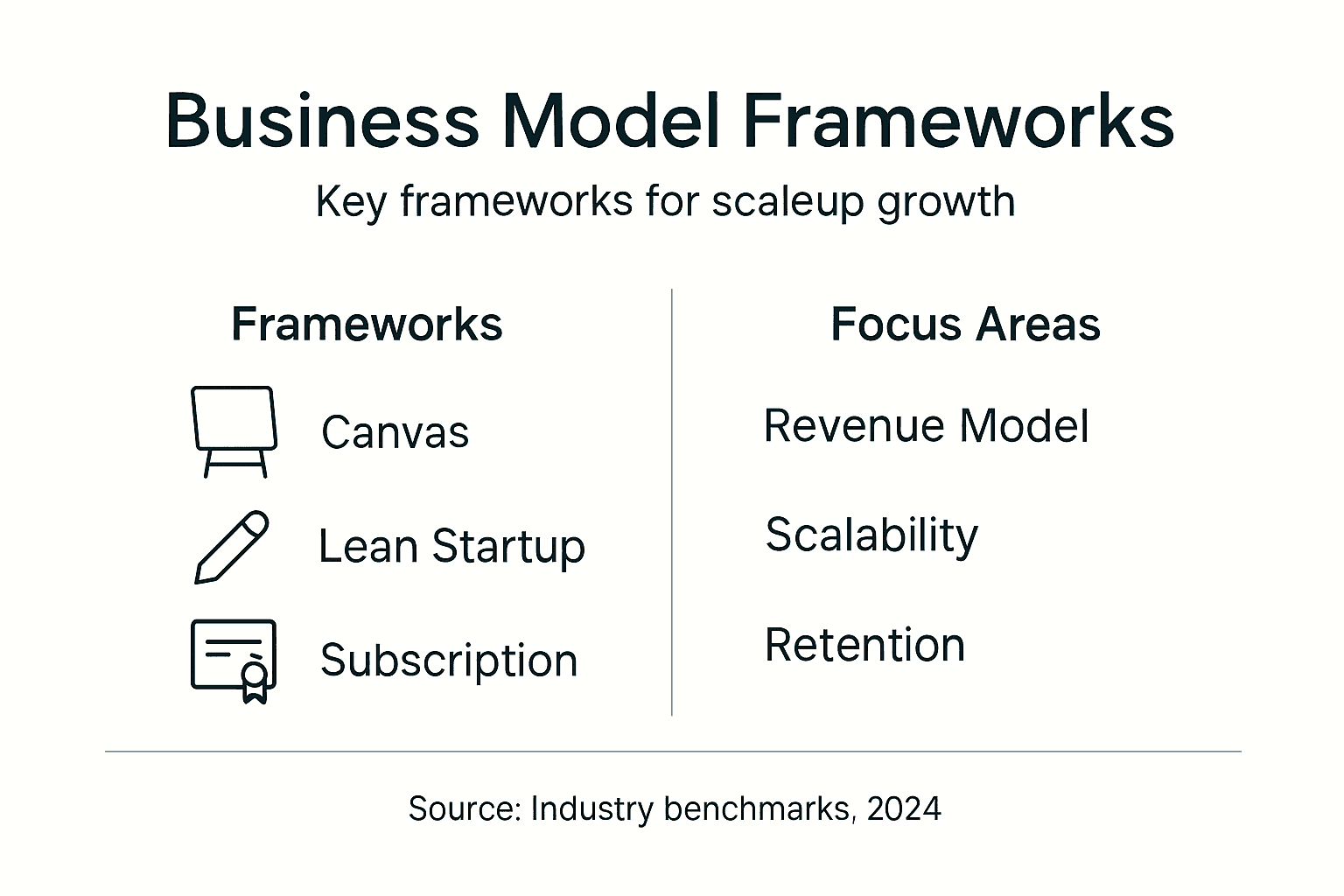
Balancing novelty with efficiency, lock-in, and partnerships drives high performance regardless of framework. Don’t chase innovation for its own sake. Ask whether changes improve customer value, reduce costs, or strengthen competitive position.
Pro Tip: Use multiple frameworks in sequence. Start with Lean principles to validate assumptions. Graduate to Business Model Canvas for scaling. Add subscription thinking if recurring revenue fits your model. Tools complement rather than compete.
Explore business model frameworks comparison for detailed analysis across industries.
How to Integrate Business Model Design with Revenue Intelligence and Financial Architecture
Clarity without execution is just documentation. Here’s how to embed business model thinking into your financial planning, reporting, and operational systems.
Step 1: Map Model Components to Financial Drivers
Translate each Business Model Canvas element into specific financial metrics. Customer segments become revenue by segment. Channels become customer acquisition costs. Key activities become operational expense categories. This mapping creates your P&L structure.
Step 2: Build Integrated Financial Projections
Clear business model alignment with financial plans increases success in funding and scaling operations. Your 5-year projections should flow directly from model assumptions. If your canvas says enterprise customers pay $50K annually with 15% churn, your forecast must reflect that math exactly.
Step 3: Implement Revenue Performance Reporting
Create dashboards tracking the metrics that matter for your specific model. Subscription businesses need MRR, churn, LTV, and CAC. Project-based models need win rates, average deal size, and delivery margin. Generic financial reports hide model-specific insights.
Step 4: Identify and Fix Margin Leaks
Better resource allocation avoids margin leaks and optimizes capital efficiency. Use your model to spot where costs exceed value delivered. Common leaks include overservicing low-value customers, underpricing complex deliverables, and funding channels with negative ROI.
Step 5: Iterate Based on Market Feedback
Your business model is a hypothesis, not scripture. Test assumptions quarterly. When revenue per customer drops, investigate whether your value proposition weakened or customer needs shifted. When acquisition costs spike, examine channel effectiveness or targeting accuracy.
| Integration Area | Key Actions | Expected Outcome |
|---|---|---|
| Financial Planning | Align P&L structure with model components | Accurate forecasting, investor confidence |
| Performance Reporting | Track model-specific metrics | Early warning of margin issues |
| Resource Allocation | Fund high-ROI activities identified in model | Improved capital efficiency |
| Market Validation | Test model assumptions quarterly | Continuous optimization |
Pro Tip: Don’t wait for perfect data to build your model. Start with educated estimates, then refine as real numbers come in. A roughly right model you use beats a perfectly accurate model you don’t.
Conclusion: Achieving Predictable, Scalable Growth Through Business Model Clarity
Structured business models increase chances of sustainable scaling and predictable revenues by 30-40%. That advantage compounds over time. Companies with clear models make faster decisions, allocate resources efficiently, and adapt to market changes without panic.
Here’s what you gain:
- Decision Confidence: When your commercial logic is explicit, strategic choices become obvious rather than debatable.
- Investment Attraction: Investors fund businesses that understand their own economics. Model clarity signals operational maturity.
- Team Alignment: Everyone from marketing to finance operates from the same commercial blueprint.
- Growth Predictability: You can forecast revenue accurately because you understand the mechanics driving it.
For founders and commercial directors at growth-stage companies, adopting formalized business model design isn’t optional anymore. The companies scaling successfully in 2026 all have one thing in common: they treat business model clarity as infrastructure, not documentation. They embed it in planning, reporting, and daily operations.
Your next step is simple. Map your current model using the Business Model Canvas. Identify gaps where assumptions are unclear or metrics are missing. Then integrate those insights into your financial architecture and performance reporting. That’s how you transform fragmented revenue efforts into predictable growth.
Unlock Predictable Growth with Our Business Model Expertise
Growth-stage companies don’t fail from lack of ambition. They stall because fragmented commercial systems kill predictability. We design structured business models that align your revenue engine with clear financial architecture.
Our business model consulting services translate your current operations into investor-ready frameworks with 5-year P&L projections, margin analysis, and performance dashboards. We identify where revenue leaks, where resources misalign, and where growth opportunities hide. You get commercial clarity that replaces guesswork with measurable systems.
FAQ
What is the key difference between a business model and a business strategy?
Your business model defines how you create and capture value through specific revenue streams, cost structures, and customer relationships. Strategy defines how you compete and differentiate against rivals in your market. Model focuses on mechanics; strategy focuses on positioning.
How does a clear business model improve revenue predictability?
Structured models align all commercial activities with financial plans, creating explicit links between customer actions and revenue outcomes. This alignment eliminates surprises in forecasting and supports steady income streams because you understand exactly what drives each dollar.
What common mistakes should growth-stage companies avoid when designing business models?
Three critical errors plague model design: confusing business models with competitive strategy, overcomplicating the model causing customer confusion and slower purchase decisions, and relying solely on novelty without operational efficiency or strategic partnerships. Simplicity and execution capability matter more than clever innovation.
Can business model clarity help in securing investment funding?
Yes, detailed business models aligned with credible financial projections significantly boost investor confidence. They demonstrate you understand your unit economics, revenue drivers, and scaling requirements. Investors fund businesses that prove commercial logic, not just market opportunity.
How often should a company review and update its business model?
Review core model assumptions quarterly and conduct comprehensive model audits annually. Market conditions, customer needs, and competitive dynamics shift constantly. Regular reviews catch margin leaks early and identify optimization opportunities before they become crises.