
Why Commercial Strategy Matters for Growth Companies
Explore why commercial strategy matters, the types and features of structured approaches, margin clarity, reporting systems, and risks for growth-stage firms.

Scaling a tech company beyond half a million in annual revenue brings new pressure—suddenly, guesswork in sales and pricing exposes costly blind spots and wasted effort. Without a comprehensive blueprint that connects goals, resources, and market realities, commercial directors risk chasing growth with scattered strategies and little margin clarity. This guide reveals how structured approaches deliver predictable results and board-ready performance visibility, using frameworks trusted by leading American and European growth-stage companies.
Table of Contents
- Defining Commercial Strategy For Growth
- Key Types Of Commercial Strategy Frameworks
- Structured Approaches And System Features
- Margin Clarity And Performance Visibility
- Common Risks And Mistakes To Avoid
Key Takeaways
| Point | Details |
|---|---|
| Commercial Strategy Definition | A comprehensive plan that aligns all revenue-generating activities toward measurable business outcomes, specifically tailored for growth-stage companies. |
| Importance for Growth Companies | Structured commercial strategy is crucial for scaling predictably, understanding customer segments, and optimizing profitability without losing margins. |
| Three Pillars of Success | Successful commercial strategies hinge on clearly defined offerings, strategic pricing based on value, and aligned go-to-market approaches. |
| Avoiding Common Mistakes | Regularly reviewing your strategy and ensuring it integrates all critical components can prevent costly execution errors and maintain competitive advantage. |
Defining Commercial Strategy for Growth
Commercial strategy isn’t a marketing plan or a sales process. It’s a comprehensive blueprint that aligns every revenue-generating activity in your company toward measurable business outcomes.
For growth-stage companies, this means clarity on what you’re selling, who you’re selling to, how you’re pricing it, and whether each dollar you spend produces predictable returns.
What Commercial Strategy Actually Means
A commercial strategy is a plan that synchronizes your market position, pricing, sales approach, and business model around achieving specific revenue and profitability goals. It’s not generic—it’s built on your strengths, your market, and your constraints.
At its core, it answers five questions:
- What exactly are you selling (products, services, or combinations)?
- Who is your target customer and what problem do you solve for them?
- How do you price your offering relative to value delivered?
- Which go-to-market channels and sales models work best for your business?
- How do revenue streams connect to sustainable profit margins?
Without this clarity, you’re running on assumptions. Sales teams chase the wrong deals. Pricing doesn’t reflect true value. Resources scatter across too many directions.
Clear commercial strategy transforms guesswork into measurable systems. It’s the difference between hoping for growth and architecting it.
Why Growth Companies Need This Now
When you’re generating $500K+ in revenue, you’ve proven product-market fit exists. The challenge shifts: scaling predictably without losing margin or burning cash.
Most growth companies at this stage have:
- A product that works for some customers
- Sales activity that generates revenue but lacks consistency
- Pricing that evolved by accident, not design
- Multiple revenue opportunities that compete for attention
- Limited visibility into what’s actually profitable
Without structured commercial approach, you reinvent your approach every quarter. You chase shiny opportunities. You underprice because you’re uncertain of value. You overinvest in channels that don’t scale.
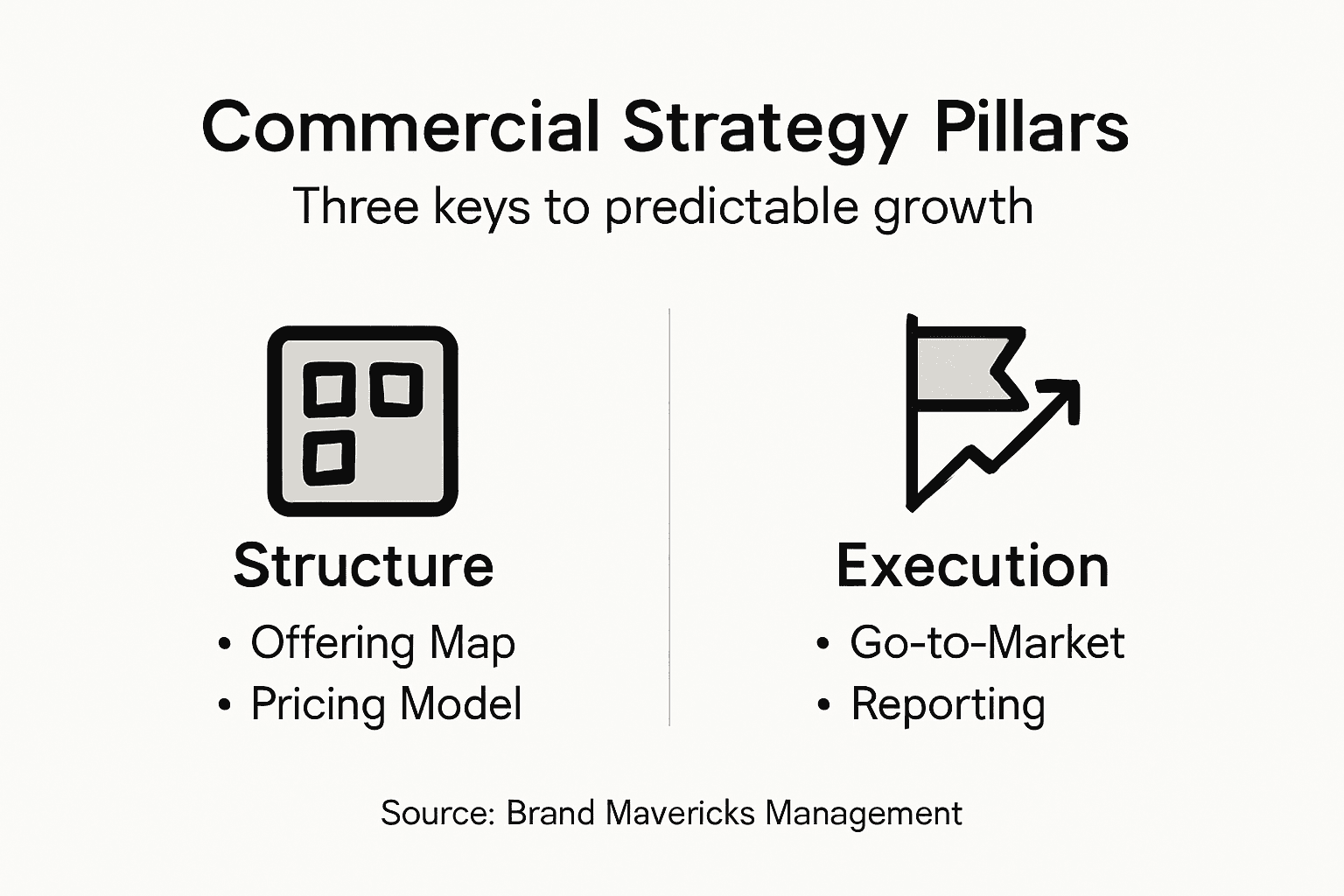
The Three Pillars of Commercial Strategy
A functional commercial strategy rests on three interconnected elements:
1. Offering Architecture Clearly define what you sell, how it’s packaged, and what problems it solves. This isn’t “we do X services.” It’s “we deliver Y outcome through Z delivery model for customers in [specific segment].” Vague offerings create vague sales conversations.
2. Revenue & Pricing Design Price based on value created, not cost-plus guesswork. This includes understanding willingness to pay, competitive positioning, and margin requirements. Strategic pricing directly impacts profitability.
3. Go-to-Market Alignment Your sales channels, sales model, and customer acquisition approach must match how your target customer prefers to buy. A B2B SaaS company needs different channels than a services firm.
How Commercial Strategy Connects to Growth
Clear commercial strategy creates three tangible advantages:
- Predictable revenue: You know which customer segments, channels, and offerings generate revenue—and replicate them.
- Visible margins: You understand unit economics, customer acquisition cost, and profitability by offering type.
- Resource efficiency: You stop spreading effort across low-return activities and concentrate on what works.
Companies with structured commercial strategy aligned to business models report faster scaling and clearer board visibility.

Moving From Theory to Action
Commercial strategy only matters if it drives decisions. The real work begins after you’ve defined it: building reporting systems that track whether execution matches strategy, and adjusting when it doesn’t.
This is where many companies stumble. They create a beautiful strategy document and file it away. Strategy only works when it becomes your operating system—guiding daily sales decisions, pricing conversations, and resource allocation.
Pro tip: Start by documenting one clear revenue stream: your primary customer segment, the specific offering you sell them, your pricing model, and current monthly revenue from that segment. This becomes your baseline for building a full commercial strategy.
Key Types of Commercial Strategy Frameworks
Frameworks aren’t one-size-fits-all templates. They’re structured thinking tools that help you analyze your market, position your offering, and make consistent decisions about growth.
For commercial directors at growth companies, the right framework depends on what question you’re trying to answer: How competitive is our market? What growth opportunities exist? Are we priced correctly? Which customers should we focus on?
The Core Frameworks Every Growth Company Uses
Strategic planning frameworks serve different purposes. Most growth companies rely on a combination rather than a single tool.
SWOT Analysis (Strengths, Weaknesses, Opportunities, Threats)
This is the foundation. You map what you do well, where you’re vulnerable, what the market offers, and what could hurt you. It’s simple but powerful for identifying gaps between your current position and where you need to be.
Ansoff Matrix (Market-Product Growth)
This framework answers: Where should we grow? It maps four directions: selling existing products to existing customers (penetration), new products to existing customers (product development), existing products to new customers (market expansion), or new products to new markets (diversification). For growth-stage companies, this prevents chasing too many directions at once.
Porter’s Five Forces (Competitive Positioning)
Understand the competitive intensity of your market. Analyze supplier power, buyer power, threat of substitutes, threat of new entrants, and competitive rivalry. This reveals whether your market opportunity is defensible.
Balanced Scorecard (Performance Management)
Translates strategy into measurable outcomes across financial, customer, internal process, and learning perspectives. This is critical for growth companies that need board visibility without hiring a full finance team.
Here’s how the core commercial strategy frameworks compare on purpose and outcome:
| Framework | Main Focus | Key Question Answered | Primary Business Value |
|---|---|---|---|
| SWOT Analysis | Internal/external assessment | Where are we strong or vulnerable? | Reveals strengths and threats |
| Ansoff Matrix | Market/product growth | How should we expand? | Prioritizes growth directions |
| Porter’s Five Forces | Competitive dynamics | How tough is competition? | Shows market defensibility |
| Balanced Scorecard | Performance tracking | Are we delivering results? | Drives strategic execution |
Why Multiple Frameworks Matter
No single framework shows you everything. SWOT reveals your position. Ansoff shows growth options. Porter’s Five Forces reveals competitive dynamics. Balanced Scorecard tracks execution.
Together, they create a complete picture:
- Competitive reality (Porter’s Five Forces)
- Internal capabilities (SWOT)
- Growth pathways (Ansoff)
- Measurable outcomes (Balanced Scorecard)
Use frameworks as thinking tools, not scorecards. They guide analysis; they don’t make decisions for you.
How to Choose the Right Framework for Your Situation
Start with your current problem. Are you trying to:
- Understand competitive pressure? Use Porter’s Five Forces to assess market structure.
- Identify growth opportunities? Use Ansoff Matrix to evaluate which directions match your strengths.
- Track whether strategy is working? Use Balanced Scorecard for ongoing performance visibility.
- Diagnose gaps in capability? Use SWOT to map strengths to market opportunities.
Most growth companies start with SWOT (self-assessment), then apply Ansoff (growth options), then track execution with Balanced Scorecard.
Building Your Commercial Framework Stack
Your framework stack should be lean. Pick two to three frameworks that address your biggest questions. Too many creates analysis paralysis.
For a typical growth-stage company:
- Use SWOT quarterly to refresh competitive self-awareness
- Use Ansoff annually to evaluate which growth direction to prioritize
- Use Balanced Scorecard monthly to track revenue, margin, and customer metrics
This combination provides strategic clarity, growth direction, and execution visibility without overwhelming your team.
Pro tip: Start with SWOT analysis against your top three competitors, not your entire market. This forces clarity on what makes you different and reveals specific weaknesses you need to address before scaling.
Structured Approaches and System Features
Strategy without structure is just ideas. Real commercial strategy requires a systematic process that moves from analysis to decision-making to execution tracking.
Growth companies that scale predictably don’t rely on gut instinct. They build repeatable systems that guide how strategy gets made, implemented, and measured.
The Four-Stage Strategic Formulation Process
Structured strategic formulation follows a logical sequence. Each stage builds on the previous one, preventing gaps between what you plan and what you execute.
Stage 1: Environmental Scanning
Analyze your market, competitive landscape, customer needs, and regulatory environment. This isn’t guessing—it’s data-driven understanding of where you operate. Use Porter’s Five Forces, market research, and customer feedback to build this picture.
Stage 2: Vision and Mission Development
Define what you’re building toward (vision) and how you’ll get there (mission). For growth companies, this clarifies whether you’re pursuing market penetration, new markets, or new offerings. Vague missions create scattered efforts.
Stage 3: Clear Objectives
Translate vision into measurable outcomes. Not “grow revenue” but “grow recurring revenue to $2M by Q4 with 65% gross margins.” Specific objectives guide resource allocation and performance measurement.
Stage 4: Strategic Choices
Decide how to achieve objectives. Which customer segments to pursue? Which offerings to prioritize? Which channels to invest in? This is where frameworks like Ansoff Matrix help you evaluate tradeoffs.
System Features That Drive Execution
Structure alone doesn’t guarantee results. Your system needs specific features that support consistent decision-making and performance visibility.
Core features of a functioning commercial strategy system:
- Regular cadence: Weekly sales pipeline reviews, monthly margin analysis, quarterly strategy reviews
- Clear ownership: Commercial director owns strategy. Sales leader owns execution. Finance tracks outcomes
- Decision protocols: How pricing gets approved, how customer tiers get defined, when to pivot
- Performance dashboards: Monthly tracking of revenue by customer segment, margin by offering, pipeline by stage
- Refresh cycles: Quarterly reviews of what’s working, annual strategic reassessment
Structure creates consistency; consistency creates predictability. Without systems, you reinvent strategy every quarter.
Combining Structured and Creative Thinking
Structured approaches aren’t rigid. Strategic approaches that blend analysis and creativity help you stay adaptable while maintaining discipline.
Use structured analysis (SWOT, financial modeling) to understand constraints. Use creative brainstorming to generate growth options. Let structure validate which ideas are realistic.
Example: Structured analysis reveals you’re underpenetrating your existing customer base. Creative brainstorming generates three new package options. Structured analysis validates which one maintains margin.
Building Your Operating Rhythm
Your commercial strategy system lives in your operating rhythm. This is how frequently you review, decide, and adjust.
For growth-stage companies:
- Weekly: Pipeline reviews, sales activity tracking
- Monthly: Margin analysis, customer acquisition cost review, renewal status
- Quarterly: Strategy review, competitive assessment, objective adjustment
- Annual: Full strategic reassessment, market repositioning, long-term planning
This rhythm provides data for decisions without creating analysis paralysis.
Pro tip: Start with a monthly margin audit that breaks revenue by customer segment and offering type. This single report reveals which parts of your strategy are actually profitable and which are burning cash.
Margin Clarity and Performance Visibility
You can’t manage what you can’t see. Most growth-stage companies generate revenue but have zero visibility into which parts are actually profitable.
Without margin clarity, you make decisions based on revenue, not profit. You chase deals that look big but destroy margins. You scale unprofitable business models. You reinvest cash you don’t actually have.
The Problem: Revenue Hides Margin Leaks
A company generating $1.2M revenue might look successful. But if you break it down by customer segment or offering type, the picture changes.
Common margin killers that stay hidden without visibility:
- Low-margin customers that require high support costs
- Offerings priced below true delivery cost
- Hidden service overages that eat into profitability
- Sales channels with high customer acquisition costs
- Customers that churn quickly, making acquisition cost unrecoverable
Without segmented reporting, these problems compound silently. Revenue grows while profit stagnates.
What Margin Clarity Looks Like
Performance visibility frameworks enable transparent understanding of where money actually comes from and where it goes.
Margin clarity means you know:
- Revenue by segment: How much comes from each customer type, product, or channel?
- Gross margin by offering: What percentage of revenue remains after direct delivery costs?
- Customer acquisition cost by channel: How much does it cost to land a customer through each sales or marketing channel?
- Customer lifetime value: How much total profit does the average customer in each segment generate?
- Renewal and churn rates: Which segments stay, which leave, and what does that mean for unit economics?
This isn’t complex. It’s structured reporting on data you already have.
You can’t scale what you haven’t measured. Margin clarity comes before profitable growth.
Building Your Visibility System
Start simple. You need three monthly reports:
Report 1: Revenue Waterfall
Total revenue minus direct costs (delivery, platform fees, subcontractor costs) equals gross profit. Track this by customer segment or offering type. Identify which segments are profitable and which aren’t.
Report 2: Unit Economics
For each major customer segment: average contract value, customer acquisition cost, months to payback, and annual margin per customer. This reveals which segments scale and which drain resources.
Report 3: Pipeline Health
Monthly tracking of sales pipeline by stage, conversion rates, average deal size, and sales cycle length. This shows whether your sales engine is working.
These three reports replace guesswork with data.
Who Owns Visibility?
Clarity requires clear ownership. The commercial director owns strategy and reporting. The finance person ensures accuracy. The sales leader inputs pipeline data.
Without clear ownership, reporting becomes a one-person project that never happens.
From Visibility to Action
Reporting is only valuable if it drives decisions. Use your monthly margin report to:
- Identify underperforming customer segments and decide whether to improve or exit
- Adjust pricing for offerings with lower-than-expected margins
- Reallocate sales effort toward high-margin segments
- Identify which renewal risks threaten profitability
- Calculate how much customer acquisition you can actually afford
Without this discipline, reports sit on shelves.
Pro tip: Create a simple spreadsheet: customer name, monthly revenue, estimated delivery cost, gross margin, and churn risk status. Update it monthly. This single view reveals which customers are profitable and which are strategic liabilities.
Common Risks and Mistakes to Avoid
Most commercial strategy failures aren’t caused by bad frameworks. They’re caused by avoidable mistakes that undermine good strategy before execution even begins.
Understanding these pitfalls helps you build strategy that actually sticks and drives results instead of becoming a document that sits on a shelf.
Mistake 1: Confusing Goals With Strategy
This is the most common error. Companies say “Our strategy is to grow 40% year-over-year” or “We want to increase market share.”
Those are goals, not strategy. Strategy answers how you’ll achieve those goals. Business leaders often confuse objectives with strategic plans, treating revenue targets as if they were comprehensive strategies.
The difference matters:
- Goal: “Grow revenue 40% next year”
- Strategy: “Focus on mid-market segment, launch three new offerings, improve sales cycle from 120 to 90 days”
Without this clarity, teams don’t know what to prioritize or how to make tradeoffs.
Mistake 2: Building Fragmented Strategy
Fragmented strategy focuses on single elements—better pricing, more sales channels, new products—without integrating them into a coherent whole.
Example of fragmentation: You redesign pricing but don’t adjust your sales model. You expand into new markets but don’t change how you message value. You hire a sales team but don’t clarify which customers they should chase.
Pieces don’t connect. Resources scatter. Execution becomes chaotic.
Strategy only works when all components connect. Pricing, positioning, channels, and customer focus must reinforce each other.
Mistake 3: Being Too Vague
Vague strategies create vague execution. “We’ll focus on enterprise customers” doesn’t tell your team anything actionable.
Clear strategy specifies:
- Who: Enterprise companies in [specific industries] with [specific characteristics]
- What: These specific offerings solve their problem
- How: Through these specific channels and sales model
- Why: Because they generate [specific unit economics]
- When: We’ll prioritize this segment in [specific timeframe]
Vagueness feels safe because it’s hard to prove wrong. Specificity is risky—it can fail. But vague strategies guarantee mediocre execution.
Mistake 4: Ignoring Competitive Positioning
You can have a clear strategy that still fails if you haven’t thought about competitive reality. Too many growth companies build strategy based on what they think is best, not on what actually differentiates them.
Your strategy must address: What do we do better or differently than competitors? Why would customers choose us over alternatives? This isn’t marketing messaging—it’s the foundation of everything.
Without competitive clarity, you’re just another vendor competing on price.
Mistake 5: Creating Strategy Without Execution Plans
Strategy without execution is just planning theater. You need to specify not just what you’ll do, but how you’ll do it.
This means:
- Who owns each element of strategy?
- What resources (people, budget, time) does execution require?
- What gets measured and how often?
- What are decision-making protocols?
- When do we review and adjust?
Without these specifics, strategy becomes someone’s side project instead of a working system.
Mistake 6: Not Revisiting Strategy Regularly
Strategy written once and filed away becomes outdated fast. Markets shift. Competitors move. Your business learns new things about what works.
Establish a quarterly review rhythm: Are we still pursuing the right opportunities? Have market conditions changed? Are we executing the strategy we committed to?
Strategy should evolve based on data, not stay frozen.
See which strategy mistakes have the greatest business impact and how to address them:
| Common Mistake | Business Impact | Simple Prevention |
|---|---|---|
| Confusing goals with strategy | Misaligned execution, missed targets | Separate ‘how’ from ‘what’ |
| Fragmented strategy | Wasted resources, inconsistent results | Integrate all strategy elements |
| Being too vague | Teams lack direction | Specify audience and actions |
| Ignoring competition | Race to the bottom on price | Benchmark and differentiate |
| Lack of execution plans | Strategy stalled, no progress | Assign ownership and metrics |
| Not revisiting strategy | Outdated plans, lost relevance | Schedule quarterly reviews |
Pro tip: Before you build new strategy, write down your current commercial approach: what you sell, who you sell to, how you price it, and what channels you use. This baseline shows where you actually operate versus where you think you operate—often revealing gaps that need addressing first.
Unlock Predictable Growth with a Structured Commercial Strategy
If your business is generating revenue but still feels stuck in commercial chaos without clear margin visibility or a predictable growth path you are not alone. The challenges of fragmented sales efforts and unclear pricing strategies highlighted in the article perfectly match the struggles many growth-stage companies face. Brand Mavericks Management specializes in turning those uncertain revenue streams into a well-structured commercial operating system that aligns your offerings pricing and sales channels to scalable and profitable growth.
Our services focus on:
- Designing clear commercial strategies and revenue blueprints tailored to your strengths and market
- Providing revenue intelligence with margin audits and performance reporting to reveal hidden profit opportunities
- Embedding full commercial operating systems that bring execution clarity and ongoing strategy refinement
Take control of your commercial future today. Explore how Brand Mavericks Management can build a structured revenue engine and provide the commercial clarity you need by visiting our services page. Don’t let another quarter pass hoping for growth when you can architect it with confidence. Start your journey toward predictable margin and sustained scalability now. Learn more about how we help companies like yours transition from guesswork to measurable systems at Brand Mavericks Management.
Frequently Asked Questions
What is a commercial strategy?
A commercial strategy is a comprehensive plan that aligns market positioning, pricing, sales approach, and business model to achieve specific revenue and profitability goals, tailored to the company’s strengths and market dynamics.
Why do growth companies need a clear commercial strategy?
Growth companies need a clear commercial strategy to scale predictably, ensure consistent revenue generation, understand profitability, and effectively allocate resources without scattering efforts across unproductive activities.
What are the three main components of a commercial strategy?
The three main components are Offering Architecture, which defines the products and services being offered; Revenue & Pricing Design, which focuses on pricing based on value; and Go-to-Market Alignment, which ensures sales channels match customer buying preferences.
How can a commercial strategy impact a company’s growth?
A well-defined commercial strategy can lead to predictable revenue generation, visible profit margins, and resource efficiency, allowing companies to focus on profitable activities and make informed decisions that drive growth.